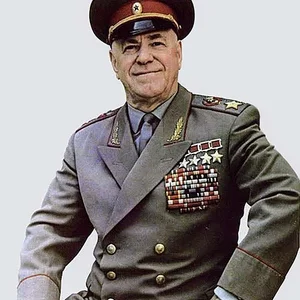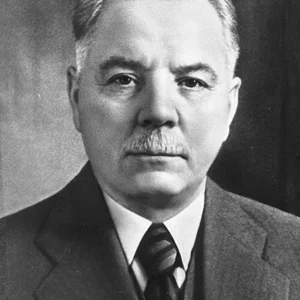

Soviet marshal and statesman, one of the first Marshals of the Soviet Union appointed in 1935. A close associate of Stalin, he served as People's Commissar for Defence and later as the nominal head of the Soviet state from 1953 to 1960.
Voroshilov(1881 — 1969)
Kliment Voroshilov
Union soviétique, Empire russe
5 min read
Frequently asked questions
Key Facts
- Takes part in the Russian Civil War and the defence of Tsaritsyn (1918-1919) alongside Stalin
- Appointed People's Commissar for Defence of the USSR in 1925
- Among the first five Marshals of the Soviet Union created in 1935
- Dismissed from command after the setbacks of the Winter War and the Leningrad front (1940-1941)
- Chairs the Presidium of the Supreme Soviet, nominal head of state of the USSR (1953-1960)
Works & Achievements
As Commissar for Defense, Voroshilov oversaw the professionalization, mechanization, and expansion of the Soviet armed forces.
Participation in the defense of the city during the civil war, a founding episode of his political alliance with Stalin.
Leadership of the city's first defensive operations against the German invasion, before being replaced by Zhukov.
A mass military-preparedness movement bearing his name, which trained millions of young Soviets in marksmanship.
The role of nominal head of the Soviet state, largely ceremonial, held after Stalin's death.
Anecdotes
During the Russian Civil War, Voroshilov commanded the defense of Tsaritsyn alongside Stalin in 1918. This episode sealed their friendship, and the city was later renamed Stalingrad. As for Voroshilov, he gave his name to another city, Voroshilovgrad, in 1935.
Voroshilov remained People's Commissar for Defense for fifteen years, but his military reputation was tarnished by the Winter War against Finland in 1939-1940: the poorly prepared Red Army suffered enormous losses there. Stalin replaced him in this post in 1940.
During the Great Purges of the late 1930s, Voroshilov co-signed condemnation lists sending thousands of Red Army officers before the firing squad, including many of his own fellow marshals such as Tukhachevsky.
A marksmanship medal, the badge of the “Voroshilov Sharpshooter” (Voroshilovsky strelok), was created in his honor in the 1930s. Millions of young Soviets trained in shooting to earn it, as part of mass military preparation.
Voroshilov was one of the few early associates of Stalin to survive the purges and die of old age. After Stalin's death in 1953, he became nominal head of state (Chairman of the Presidium of the Supreme Soviet) until 1960.
Primary Sources
Comrades Voroshilov, Tukhachevsky, Budyonny, Blyukher and Yegorov are raised to the rank of Marshal of the Soviet Union.
The Workers' and Peasants' Red Army has become a powerful armed force, ready to defend the achievements of socialism against any aggressor.
Voroshilov, among the signatories, affixed his signature approving the execution of lists of the accused submitted by the NKVD during the Great Terror.
Key Places
Mining region of the Donbass where Voroshilov was born in 1881, into a modest working-class family.
City on the Volga whose defense Voroshilov helped organize alongside Stalin in 1918, during the civil war.
Seat of Soviet power where Voroshilov carried out his duties as Commissar for Defense and later as head of state.
City whose defense Voroshilov commanded against the German advance in 1941, at the start of the long siege.
Official burial place of Soviet dignitaries where Voroshilov was interred after his death in 1969.
Liens externes & ressources
Références
Œuvres
Réorganisation et modernisation de l'Armée rouge
1925-1940
Défense de Tsaritsyne
1918
Programme du « Tireur vorochilovien »
années 1930
Présidence du Praesidium du Soviet suprême
1953-1960