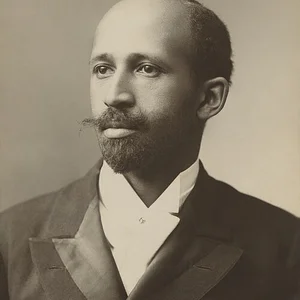

William Edward Burghardt Du Bois (1868-1963) was an African American sociologist, historian, and civil rights activist. The first African American to earn a doctorate from Harvard, he was a leading theorist in the fight against racial segregation and a co-founder of the NAACP in 1909.
W.E.B. Du Bois(1868 — 1963)
W. E. B. Du Bois
États-Unis, Ghana
6 min read
Frequently asked questions
Famous Quotes
« The problem of the twentieth century is the problem of the color line.»
Key Facts
- Born in 1868 in Massachusetts, he became in 1895 the first African American to earn a doctorate from Harvard.
- Published The Souls of Black Folk in 1903, a foundational work on the African American condition.
- Co-founded the NAACP (National Association for the Advancement of Colored People) in 1909.
- Organized several Pan-African Congresses starting in 1919.
- Went into exile in Ghana, where he died in 1963, the day before the March on Washington.
Works & Achievements
His doctoral dissertation, the first major historical study of the slave trade in the United States, published in the Harvard Historical Studies.
The first field-based sociological study of an African American community, a founding work of urban sociology.
A landmark collection of essays introducing the concepts of “double consciousness” and the “veil,” a cornerstone of African American thought.
An activist movement demanding immediate equal rights, the direct forerunner of the NAACP.
The leading civil rights organization for Black Americans, still active today.
An influential activist magazine he edited for nearly 25 years, a platform for African American culture and struggles.
A groundbreaking work of history that rehabilitated the active role of Black people during the Reconstruction of the South.
An international gathering held in Paris connecting the struggles of Black peoples around the world.
Anecdotes
In 1895, W. E. B. Du Bois became the very first African American to earn a doctorate (Ph.D.) from Harvard University. His dissertation focused on the suppression of the slave trade in the United States and remains a landmark work of historical scholarship.
Du Bois coined the famous concept of “double consciousness”: in his view, African Americans always see themselves through the contemptuous eyes of others, torn between their Black identity and their American identity. This analysis, published in 1903, left a lasting mark on thinking about race.
He publicly opposed Booker T. Washington, another major Black leader. Washington advocated patience and vocational training, while Du Bois demanded immediate equal rights and the cultivation of an educated elite, the “Talented Tenth.”
Deeply disillusioned by persistent racism in the United States, Du Bois left his country in 1961 to settle in Ghana, at the invitation of President Kwame Nkrumah. He died there in 1963, having become a Ghanaian citizen, on the eve of Martin Luther King's great March on Washington.
In 1900, Du Bois presented dozens of photographs and colorful charts about the lives of African Americans in Georgia at the Paris World's Fair. These strikingly modern infographics aimed to prove to the world the progress and dignity of the Black community.
Primary Sources
The problem of the twentieth century is the problem of the color-line.
It is a peculiar sensation, this double-consciousness, this sense of always looking at one's self through the eyes of others.
We claim for ourselves every single right that belongs to a freeborn American, political, civil, and social; and until we get these rights we will never cease to protest and assail the ears of America.
The object of this publication is to set forth those facts and arguments which show the danger of race prejudice, particularly as it is today manifested toward colored people.
Key Places
Small New England town where Du Bois was born and raised in 1868, in a small but relatively integrated Black community.
Where Du Bois earned his doctorate in 1895, the first African American to receive the degree from the prestigious institution.
Where Du Bois taught sociology and conducted his major studies on the condition of African Americans in the South.
City where Du Bois edited the journal The Crisis and led the NAACP for decades.
Where Du Bois studied economics and sociology from 1892 to 1894, an experience that broadened his view of the world.
Capital where Du Bois settled in 1961 at the invitation of Kwame Nkrumah, became a Ghanaian citizen, and died in 1963.
Typical Objects

Magazine founded and edited by Du Bois in 1910, the press organ of the NAACP. In it, he denounced racism and celebrated African American culture and achievements.

The Ph.D. earned in 1895, the first awarded by Harvard to an African American. A symbol of Black access to the highest levels of education.

Colorful, handmade statistical charts depicting the lives of African Americans in Georgia. A pioneering visual demonstration of sociology.

The writing instruments of a prolific intellectual, author of thousands of pages of essays, articles, and works of history and sociology.

The neat attire — stiff collar, waistcoat, and hat — that Du Bois wore with care. His elegant appearance asserted dignity and self-respect in the face of racist contempt.

Symbol of the Pan-African movement that Du Bois helped organize from 1919 onward, connecting the struggles of Black people in Africa, the Americas, and the Caribbean.
School Curriculum
Vocabulary & Tags
Key Vocabulary
Tags
Daily Life
Morning
A rigorous academic, Du Bois rose early and devoted his mornings to reading and writing, in the quiet of his study. He prized discipline and a meticulously organized schedule.
Afternoon
Afternoons were often given over to teaching, fieldwork, or writing articles for *The Crisis*. He met with colleagues, activists, and correspondents from around the world.
Evening
In the evening, Du Bois continued his reading, his abundant correspondence, or the preparation of lectures. A cultured music lover, he enjoyed music and intellectual discussions.
Food
A member of the educated middle class, he had an ordinary urban diet of the era, blended with New England habits. Temperate and methodical, he placed little importance on indulgence at the table.
Clothing
Du Bois was renowned for his polished elegance: a three-piece suit, detachable collar, necktie, hat, and sometimes a cane and gloves. This impeccable attire asserted his dignity in the face of the surrounding racism.
Housing
He lived in comfortable urban intellectual's lodgings, in **Atlanta** and then **New York**, surrounded by books and papers. His final home was a house in **Accra**, **Ghana**, where he passed away.
Historical Timeline
Period Vocabulary
Liens externes & ressources
Références
Œuvres
The Suppression of the African Slave-Trade
1896
The Philadelphia Negro
1899
The Souls of Black Folk (Les Âmes du peuple noir)
1903
Cofondation du Niagara Movement
1905
Cofondation de la NAACP
1909
Fondation et direction de The Crisis
1910
Black Reconstruction in America
1935