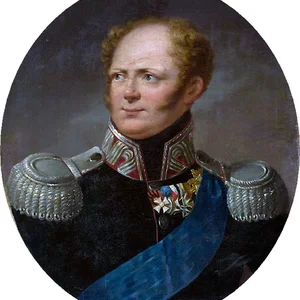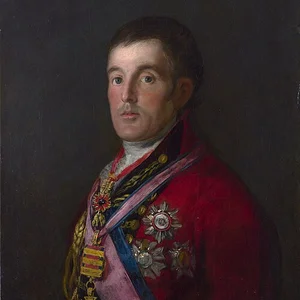

Arthur Wellesley, Duke of Wellington, was a British general and statesman. The victor over Napoleon at the Battle of Waterloo in 1815, he also served as Prime Minister of the United Kingdom from 1828 to 1830.
Wellington(1769 — 1852)
Wellington Katzor de Oliveira
Brésil
6 min read
Frequently asked questions
Famous Quotes
« It was the nearest run thing you ever saw in your life.»
Key Facts
- Born in 1769 in Dublin, the same year as Napoleon Bonaparte
- Commanded the allied forces during the Peninsular War (1808-1814)
- Definitively defeated Napoleon at the Battle of Waterloo on 18 June 1815
- Became Prime Minister of the United Kingdom from 1828 to 1830
- Died in 1852, with a state funeral in London
Works & Achievements
A triumph in India that reveals the strategic talents of the young Wellesley against a far more numerous army.
A series of campaigns in Portugal and Spain that wear down the Napoleonic armies and build his European reputation.
A lightning manoeuvre that destroys a French army in a matter of hours and opens the road to Madrid.
A victory that drives the French troops out of Spain for good.
A decisive clash that ends the Napoleonic Empire and makes Wellington a European hero.
An emancipation law for British Catholics, passed under his government despite strong resistance.
A vast collection of his military correspondence, a major source for the history of the Napoleonic Wars.
Anecdotes
The rubber boots known today as "wellingtons" take their name from the duke. He asked his bootmaker to modify the Hessian boot to make it more comfortable on horseback and under the uniform: the fashion immediately spread among British officers.
After the Battle of Waterloo, Wellington confided to his friend Thomas Creevey that the victory had been "the nearest run thing you ever saw in your life." The general himself acknowledged that the outcome had hung by a thread.
His nickname the "Iron Duke" does not come solely from his resolve on the battlefield. In 1832, to protect his London residence, Apsley House, from rioters who supported electoral reform, he had iron shutters fitted to the windows: the moniker stuck.
During the war in Spain (the Peninsular War), Wellington earned his reputation as a cautious strategist. He said of his own soldiers, recruited from among the poorest: "I don't know what effect they will have on the enemy, but, by God, they terrify me."
Although they were the two greatest adversaries of their age, Wellington and Napoleon never met in person. After Waterloo, Wellington even bought back several possessions that had belonged to the emperor, including a statue of Napoleon as Mars the Peacemaker that still stands in Apsley House.
Primary Sources
Such a desperate action could not be fought, and such advantages could not be gained, without great loss; and I am sorry to add that ours has been immense.
It has been a damned nice thing — the nearest run thing you ever saw in your life.
I never saw the British infantry behave so well... The whole field, from right to left, was a mass of dead bodies.
I am one of those who have probably passed a longer period of my life engaged in war than most men, and principally in civil war; and I must say this, that if I could avoid, by any sacrifice whatever, even one month of civil war, I would sacrifice my life in order to do it.
Key Places
Birthplace of Arthur Wellesley, then the capital of Ireland within the British kingdom.
Site of the decisive victory of 18 June 1815 against Napoleon, south of Brussels.
Scene of the great victory of 1812 during the Peninsular War.
The duke's London residence, nicknamed “Number One, London,” today the Wellington Museum.
The duke's home in his role as Lord Warden of the Cinque Ports; he died there in 1852.
Site of his state funeral and his tomb, alongside Admiral Nelson.
Typical Objects

A calf-high leather boot, adapted by the Duke for riding and marching, which became a classic of men's fashion in the 19th century.

A two-pointed hat worn by British generals, recognizable by its cockade. Wellington often wore it sideways, across the width.

An instrument essential to the commander for observing enemy movements. At Waterloo, Wellington ceaselessly scanned the horizon while waiting for the Prussians.

The officers' bladed weapon, a symbol of command as much as a tool of combat in the Napoleonic charges.

A detailed plan of the terrain used to plan marches and positions. Wellington was renowned for his meticulous knowledge of the battlefields.

The insignia of the highest military rank, presented to Wellington by several grateful European sovereigns after the fall of Napoleon.
School Curriculum
Vocabulary & Tags
Key Vocabulary
Tags
Daily Life
Morning
On campaign, Wellington rose before dawn, renowned for sleeping little. He spent his first hours studying maps, reading his scouts' reports, and dictating orders to his aides-de-camp.
Afternoon
The afternoon was devoted to inspecting the troops, reconnoitring the terrain on horseback, and coordinating with his allies. In times of peace and politics, he sat in Parliament or received visitors at Apsley House.
Evening
In the evening, the Duke enjoyed dinners where he proved temperate but conversational. He composed an abundant correspondence before going to bed early, keeping his famous discipline even in wartime.
Food
Wellington was known for his frugality: he ate simply and drank in moderation, preferring efficiency to extravagance. On campaign, he often shared the ordinary soldier's fare rather than surrounding himself with luxury.
Clothing
Off the battlefield, he wore plain, well-kept civilian clothes; on the field, the uniform of a general officer, the bicorne hat, and his famous cloak. His understated elegance contrasted with the flashiness of certain marshals.
Housing
He lived between his London residence at Apsley House, his estate of Stratfield Saye in Hampshire, and Walmer Castle in Kent. On campaign, he lodged in a tent or in makeshift quarters, as close as possible to his men.
Historical Timeline
Period Vocabulary
Liens externes & ressources
Références
Œuvres
Victoire d'Assaye
1803
Campagne de la Peninsule
1808-1814
Bataille de Salamanque
1812
Bataille de Vitoria
1813
Bataille de Waterloo
1815
Catholic Relief Act
1829
The Dispatches of the Duke of Wellington
1834-1838