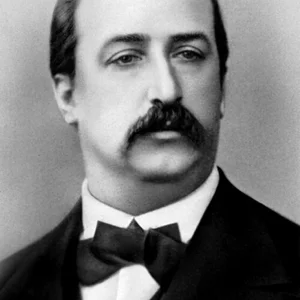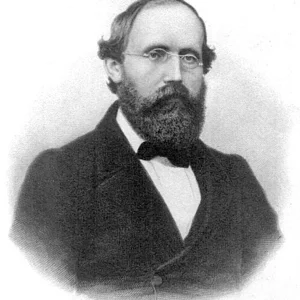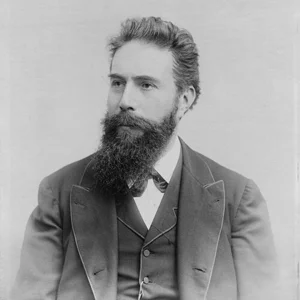

A German physicist, in 1895 he discovered an unknown radiation that he named “X-rays.” This discovery revolutionized medicine and physics. He received the very first Nobel Prize in Physics in 1901.
Wilhelm Röntgen(1845 — 1923)
Wilhelm Röntgen
royaume de Prusse, république de Weimar, Empire allemand
5 min read
Frequently asked questions
Key Facts
- Born in 1845 in Lennep (Rhenish Prussia), Germany
- Discovered X-rays on 8 November 1895 in his laboratory in Würzburg
- Produced the first radiograph, that of the hand of his wife Anna Bertha
- Received the first Nobel Prize in Physics in 1901
- Died in 1923 in Munich
Works & Achievements
Demonstration of an unknown electromagnetic radiation able to pass through matter, revolutionizing physics and medicine.
Three founding papers describing the properties of X-rays, circulated around the world within a few weeks.
An image of Anna Bertha Röntgen's hand, the birth certificate of modern medical imaging.
Demonstration of the “Röntgen current,” proving that a dielectric moving through an electric field produces a magnetic effect.
Rigorous experimental physics studies that established his reputation as a measurer of great precision before his major discovery.
The inaugural award honoring the extraordinary services rendered by the discovery of the rays that bear his name.
Anecdotes
On 8 November 1895, while working alone in his laboratory in Würzburg with a Crookes tube wrapped in black cardboard, Röntgen noticed that a screen coated with barium platinocyanide began to glow at a distance. Intrigued by this invisible and unknown radiation, he decided to call it “X,” the letter used in mathematics to represent an unknown quantity.
To study his discovery, Röntgen shut himself away in his laboratory for several weeks, sometimes eating and sleeping there. He was so obsessed with these rays that he feared he had fallen victim to an illusion and refused to speak of them until he was absolutely certain of his observations.
The very first medical radiograph was of the hand of his wife Anna Bertha, taken on 22 December 1895. On seeing her bones and her wedding ring appear on the plate, she is said to have exclaimed, “I have seen my death!”, overwhelmed at the sight of her own skeleton while still alive.
When he received the very first Nobel Prize in Physics in 1901, Röntgen refused to file a patent on his discovery, believing that X-rays should belong to all of humanity. He even donated the Nobel Prize money to his university.
Röntgen was a man of great modesty and hated having his name associated with his discovery: in several Germanic countries, people still speak today of “Röntgenstrahlen” (Röntgen rays) despite his wishes.
Primary Sources
If the discharge of a large induction coil is passed through a sufficiently evacuated Hittorf or Crookes tube, one observes nearby a screen coated with barium platinocyanide that lights up brightly with each discharge.
For the sake of brevity, I should like to use the term “rays” and, to distinguish them from others, I shall designate them by the letter X.
The discovery of X-rays opened an entirely new field of research, whose applications to medicine have proved to be of considerable significance.
Key Places
Town in the Rhineland where Wilhelm Röntgen was born in 1845. Today it is home to a museum dedicated to X-rays.
Swiss institution where Röntgen trained as a mechanical engineer and earned his doctorate in 1869.
It was in his physics laboratory in Würzburg that Röntgen discovered X-rays in November 1895.
Röntgen headed the physics institute here from 1900 and ended his career here.
Bavarian city where Wilhelm Röntgen died in 1923 and was buried.
Swedish capital where Röntgen received the very first Nobel Prize in Physics in 1901.
Typical Objects

A partially evacuated glass tube through which an electric discharge passes, producing cathode rays. It was with such a tube that Röntgen discovered X-rays.

A small screen coated with a salt that glows when exposed to X-rays. Its unexpected glow put Röntgen on the trail of his discovery.

An induction coil producing high voltage, used to power discharge tubes. It supplied the energy needed to produce the rays.

A medium sensitive to light and X-rays, allowing the first radiographic images to be captured. Anna Bertha's hand was immortalized on one in 1895.

An image of Anna Bertha Röntgen's left hand showing the bones and her wedding ring, regarded as the first medical radiograph in history.

An instrument measuring electric charges, common in the physics laboratories of the time. Röntgen used it in his research on electricity.
School Curriculum
Vocabulary & Tags
Key Vocabulary
Daily Life
Morning
Röntgen, a rigorous and methodical man, would reach his physics institute early. The morning was devoted to the lectures given to students and to the careful preparation of his experimental setups.
Afternoon
The afternoon was spent in the laboratory, where he meticulously adjusted his discharge tubes, his coils, and his measuring instruments. A perfectionist, he checked each result several times before believing it.
Evening
In the evening, Röntgen would return home to his wife Anna Bertha, but during his research on X-rays he sometimes remained shut away in his laboratory for weeks, taking his meals and sleeping there.
Food
A well-off member of the bourgeoisie in Wilhelmine Germany, he ate simple, hearty food: rye bread, meats, potatoes, cabbage, and Bavarian beer. A lover of the outdoors, he enjoyed meals taken in the mountains.
Clothing
As a respectable professor of the late 19th century, he wore a dark three-piece suit, a stiff collar, a tie or bow tie, and sported a long, full beard in keeping with the fashion of the day.
Housing
He lived in the official residences and bourgeois houses attached to the universities where he taught. Passionate about nature, he owned a chalet in Weilheim, Bavaria, for his hunting and hiking stays.
Historical Timeline
Period Vocabulary
Liens externes & ressources
Références
Œuvres
Découverte des rayons X
8 novembre 1895
Über eine neue Art von Strahlen (Sur une nouvelle sorte de rayons)
1895-1896
Première radiographie médicale
22 décembre 1895
Travaux sur l'effet magnéto-électrique des diélectriques
1888
Recherches sur la compressibilité des liquides et la capillarité
années 1870-1880
Premier prix Nobel de physique
1901