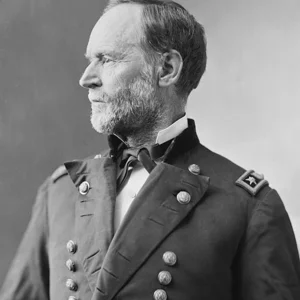

American general in the Union Army during the Civil War. He is famous for his “march to the sea” across Georgia in 1864, an early application of the concept of total war.
William Sherman(1820 — 1891)
William Sherman
États-Unis
6 min read
Frequently asked questions
Famous Quotes
« War is hell.»
Key Facts
- Born in 1820 in Ohio, died in 1891 in New York
- Capture and burning of Atlanta in September 1864
- Led the “march to the sea” from Atlanta to Savannah (November-December 1864)
- Practice of “total war” targeting the economic resources of the Confederate South
- Commanding General of the United States Army from 1869 to 1883
Works & Achievements
Decisive role in the siege that gave the Union full control of the Mississippi, splitting the Confederacy in two.
Major strategic victory that demoralized the South and helped secure Lincoln's reelection.
Campaign from Atlanta to Savannah applying “total war”: destroying the South's economic resources to hasten its surrender.
Northward advance through the two Carolinas, culminating in the surrender of Joseph Johnston's army.
Directives organizing how the army would forage off the land during the march through Georgia.
Autobiographical account of his military career, a major and controversial source on the Civil War.
As commanding general, he modernized the army and founded the command school at Fort Leavenworth.
Anecdotes
Sherman's middle name, “Tecumseh,” was given to him by his father in tribute to the famous Shawnee Native American chief. Orphaned of his father at age nine, he was raised by an influential neighbor, Thomas Ewing, whose daughter Ellen he later married.
At the start of the war, Sherman was for a time removed from command: the press branded him “insane” because he believed it would take hundreds of thousands of men to defeat the South. The future proved him right, and he returned to favor after the Battle of Shiloh in 1862.
During his “March to the Sea” in 1864, Sherman ordered his 60,000 soldiers to live off the land: they destroyed railroads, crops, and warehouses across a strip of territory about a hundred kilometers wide, in order to break the South's ability to keep fighting the war.
He is credited with the famous phrase “War is hell,” which sums up his conviction that war had to be waged harshly in order to be shorter. He also firmly refused any candidacy for the presidency in 1884.
Sherman and General Ulysses S. Grant formed a deep and lasting friendship. Sherman said of their bond: “He stood by me when I was crazy, and I stood by him when he was drunk.”
Primary Sources
I am tired and sick of war. Its glory is all moonshine. It is only those who have never fired a shot, nor heard the shrieks and groans of the wounded, who cry aloud for blood, for vengeance, for desolation.
War is cruelty, and you cannot refine it; and those who brought war into our country deserve all the curses a people can pour out.
The army will forage liberally on the country during the march. To this end, each brigade commander will organize a good and sufficient foraging party.
There is many a boy here today who looks on war as all glory, but, boys, it is all hell.
Key Places
Sherman's hometown, where he was born in 1820. He was taken in by the Ewing family after his father's death.
Sherman received his officer's training here and graduated in 1840. He rubbed shoulders with future generals from both sides.
A railroad and industrial hub of the South, captured by Sherman on September 2, 1864. The city was largely burned before the army's departure.
The Atlantic port that marked the end of the “March to the Sea,” captured on December 21, 1864. Sherman symbolically offered it to Lincoln as a Christmas gift.
Site of the bloody battle of April 1862 where Sherman, though wounded, distinguished himself through his composure. This battle revived his career.
The city where Sherman spent his final years and died in 1891. His funeral brought together former adversaries, a sign of national reconciliation.
Typical Objects

A dark blue tunic adorned with stars indicating the rank of general. Blue was the distinctive color of the Northern armies during the Civil War.

A bladed weapon and badge of command carried by senior officers. More symbolic than useful in combat by this era, it marked authority.

A device transmitting messages in Morse code along electrical lines. Sherman used it intensively to coordinate his armies across vast distances.

The railroad ensured the resupply of Union armies; destroying enemy tracks was a strategic objective. Rails twisted in the fire were nicknamed “Sherman's neckties.”

Artillery mounted on a wheeled carriage, firing shells with greater range and accuracy than smoothbore guns. A centerpiece of the bombardment of besieged cities like Atlanta.

A muzzle-loading rifled musket, the standard weapon of the Union infantry. Its increased range made frontal charges far more deadly.
School Curriculum
Vocabulary & Tags
Key Vocabulary
Tags
Daily Life
Morning
On campaign, Sherman rose before dawn, often after a short night, and walked through the camp to check on the condition of his troops. He devoted the morning to reading telegraphic dispatches and dictating his orders.
Afternoon
The afternoon was taken up with inspections, the study of maps, and planning the movements of his columns. Tireless, Sherman often rode out on horseback to scout the terrain in person.
Evening
In the evening, inside his tent, he wrote his abundant correspondence and talked with his officers by the fire. Nervous and unable to sleep, he slept little and smoked many cigars.
Food
On campaign, the everyday fare was frugal: soldier's biscuit (hardtack), coffee, salt pork, and whatever the foragers gathered from the farms they passed through. Sherman often shared the rough diet of his men.
Clothing
He wore the blue uniform of the Union, but with a careless elegance: his coat often unbuttoned and his felt hat battered. This simplicity stood in contrast to the pomp of some other generals.
Housing
On campaign, he lodged under a plain canvas tent or in houses requisitioned along the road. In peacetime, he lived in Washington, Saint Louis, and later New York.
Historical Timeline
Period Vocabulary
Liens externes & ressources
Références
Œuvres
Campagne de Vicksburg
1863
Prise d'Atlanta
1864
Marche vers la mer
1864
Campagne des Carolines
1865
Special Field Orders No. 120
1864
Mémoires du général W. T. Sherman
1875
Réorganisation de l'armée de l'Ouest
1869-1883