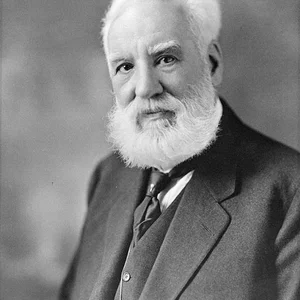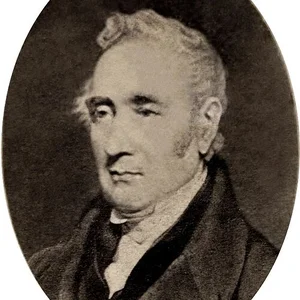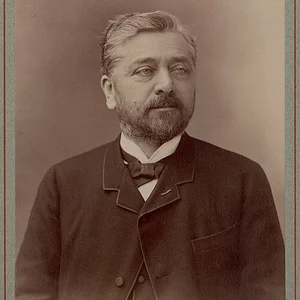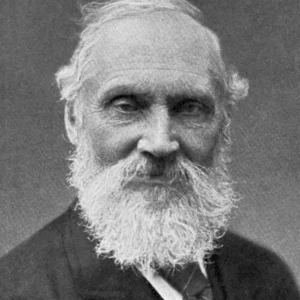

British physicist and mathematician of the 19th century, he made fundamental contributions to thermodynamics and electromagnetism. He is the originator of the absolute temperature scale that bears his name. He also oversaw the laying of the first transatlantic telegraph cable.
William Thomson (Lord Kelvin)
William Thomson, 1st Baron Kelvin
Royaume-Uni de Grande-Bretagne et d'Irlande
9 min read
Frequently asked questions
Famous Quotes
« If you can't measure it, you can't improve it.»
« Science is the measurement of truth.»
Key Facts
- Born in 1824 in Belfast, died in 1907 in Largs (Scotland)
- Proposed in 1848 the absolute temperature scale (kelvin, SI unit)
- Stated the second law of thermodynamics alongside Clausius in the 1850s
- Oversaw the laying of the first successful transatlantic telegraph cable in 1866
- Ennobled in 1892 with the title of Lord Kelvin, the first scientist to enter the House of Lords
Works & Achievements
Thomson defined a temperature scale based on pure thermodynamics, independent of any material substance. Absolute zero (0 K = −273.15 °C) corresponds to the complete absence of thermal motion; this scale is today the SI unit of temperature.
Thomson stated that heat cannot spontaneously flow from a cold body to a hot one — a fundamental principle that explains the irreversibility of natural phenomena and the concept of ever-increasing entropy in the universe.
Following the failed attempt of 1858, Thomson oversaw the successful laying of the first permanent cable linking Ireland to Newfoundland. His inventions — the mirror galvanometer and reception system — were decisive in ensuring reliable transmission.
A treatise on mechanics and mathematical physics that unified Newtonian dynamics with the new concepts of energy. It became the standard reference for an entire generation of British physicists.
An analogue machine that automatically computed tides by harmonic decomposition of lunar and solar forces. Used by the hydrographic services of several countries, it foreshadowed the analogue computers of the twentieth century.
A series of twenty lectures delivered in Baltimore synthesising classical physics — mechanics, heat, electricity, and light. Published in 1904, they capture Thomson at the very limits of classical physics, sensing the revolutions that were to come.
Anecdotes
William Thomson entered the University of Glasgow at just 10 years old, accompanying his father who taught mathematics there. At 15, he won the prize for excellence in astronomy. This exceptional precocity would lead him to become a full professor at the same university at age 22, a post he held for 53 consecutive years.
During the laying of the first transatlantic telegraph cable in 1858, Thomson was on board the ship. The cable worked for a few weeks before failing. During the second attempt in 1866, it was his invention — the mirror galvanometer, capable of detecting minute electrical signals — that finally made a stable link between Europe and America possible. Queen Victoria knighted him in recognition.
In 1848, Thomson proposed a temperature scale based not on the properties of a particular liquid, but on the universal laws of thermodynamics. He defined absolute zero (−273.15 °C) as the theoretical temperature at which all thermal motion ceases. This scale, named 'kelvin' after his death, is today the international unit of temperature in science.
Thomson spent years calculating the age of the Earth from our planet's rate of cooling, concluding it was approximately 20 to 100 million years old. This estimate, well-argued for its time, proved to be radically underestimated: radioactivity, discovered shortly before his death, heats Earth's interior and was unknown to him. This error illustrates how rigorous science can be overturned by an unexpected discovery.
Lord Kelvin was passionate about sailing and owned his own yacht, the Lalla Rookh, aboard which he conducted numerous experiments. He invented an improved maritime compass and an automatic depth sounder — instruments that saved many lives at sea. He readily filed patents and thus became one of the wealthiest scientists of his era.
Primary Sources
The determination of temperature has long been recognized as a problem of the greatest importance in physical science. [...] The numerical value of an absolute temperature does not depend on the physical properties of a specific substance.
When equal quantities of mechanical effect are produced by any means whatever from purely thermal sources, equal quantities of heat are put out of existence; or, heat and mechanical effect are mutually convertible.
The mirror galvanometer is the only instrument sensitive enough to detect the feeble electrical impulses which can be transmitted through 2000 miles of submarine cable.
The more I study the science of physics, the more I am struck by two great difficulties, two great clouds that hang over our understanding of the universe.
The foundations of dynamics may be said to consist in the following propositions: a material point is a portion of matter so small that, for the purposes of the investigation, it may be treated as a mathematical point.
Key Places
Birthplace of William Thomson on 26 June 1824. His family later moved to Glasgow when his father obtained a university chair there.
Thomson studied here from age 10, then served as professor for 53 years (1846–1899). His physics laboratory was among the first of its kind in the United Kingdom. The River Kelvin, which flows alongside the campus, gave him his baronial title and lent its name to the unit of temperature.
Thomson studied mathematics here from 1841 to 1845, finishing second in the prestigious Mathematical Tripos. It was here that he discovered the formal analogies between electrostatics and the theory of heat.
The coastal town where Thomson owned his main residence, Netherhall, and moored his yacht. He died there on 17 December 1907 at the age of 83.
The burial place of Lord Kelvin, interred in January 1908 near the tomb of Isaac Newton — a testament to the exceptional status accorded to his scientific contributions.
The European starting point of the transatlantic telegraph cable. It was from this Irish shore that the first messages were sent to Newfoundland in 1858 and again in 1866, under Thomson's technical supervision.
Typical Objects

Instrument invented by Thomson to detect extremely weak electric currents. It was thanks to this device that the signals transmitted by the transatlantic cable could be read reliably, making intercontinental communication possible.

A precision apparatus designed by Thomson to measure the intensity of an electric current using mechanical forces, without any external calibration. It served as an international reference for electrical measurements in the late nineteenth century.

Thomson completely redesigned the marine compass to make it less sensitive to the vibrations of steam-powered ships and to the magnetic disturbances caused by iron hulls. His compass was adopted by the Royal Navy and sold worldwide.

An analogue mechanical machine built to Thomson's designs in 1872 to automatically calculate the times and heights of tides over several years. It stands as a remarkable feat of engineering from the era before computers.

Thomson used precision gas thermometers in his research to calibrate his absolute temperature measurements. These instruments, though cumbersome, were the only ones capable of providing the rigour needed to define absolute zero.

Several thousand kilometres of insulated copper cable, coiled in the hold of the ship Great Eastern. Thomson supervised its laying between Ireland and Newfoundland in 1866, establishing the first permanent link between Europe and America.
School Curriculum
Vocabulary & Tags
Key Vocabulary
Tags
Daily Life
Morning
Thomson rose early and devoted his mornings to theoretical research in his office at the University of Glasgow. He would write up calculations and scientific correspondence with colleagues such as Joule, Faraday, and Helmholtz, often before his first lectures of the day. He was known for scribbling equations on whatever surface was at hand, including the breakfast tablecloth.
Afternoon
Afternoons were divided between teaching — he delivered lectures on “natural philosophy” to several hundred students — and his experimental physics laboratory, one of the first of its kind in Britain. He personally supervised the experiments and encouraged his students to build their own measuring instruments.
Evening
In the evenings Thomson was a willing host to colleagues and visiting scholars at his residence; dinners were the occasion for lively scientific debate. During the summer months he would leave Glasgow for Largs, where he would sail the Irish Sea aboard his yacht the *Lalla Rookh* while continuing his experiments on ocean currents and terrestrial magnetism.
Food
Like most of the prosperous Victorian middle class, Thomson ate heartily: oat porridge in the morning, roasted meats, fish, boiled vegetables, and sweet puddings. He had a taste for Scottish whisky and port, the customary drinks in the university clubs of Glasgow and Edinburgh.
Clothing
Thomson dressed in the typical Victorian gentleman's fashion: a dark wool suit, waistcoat, top hat, and gloves for formal occasions. In the laboratory he wore a coat or work jacket to protect his clothes during electrical and chemical experiments. After his ennoblement in 1892, he occasionally wore the insignia of his honours at academic ceremonies.
Housing
Thomson first lived in university accommodation close to the Glasgow campus. Following his success with the transatlantic cable, he had Netherhall built, a large house in Largs on the Ayrshire coast, with a view over the Firth of Clyde. There he installed a private laboratory and a jetty for his yacht — fitting symbols of Victorian scientific and commercial achievement.
Historical Timeline
Period Vocabulary
Liens externes & ressources
Références
Œuvres
Échelle de température absolue (kelvin)
1848
Formulation de la deuxième loi de la thermodynamique
1851
Pose du câble télégraphique transatlantique
1866
Treatise on Natural Philosophy (avec P.G. Tait)
1867
Prédicteur de marées
1872
Baltimore Lectures
1884