 flip
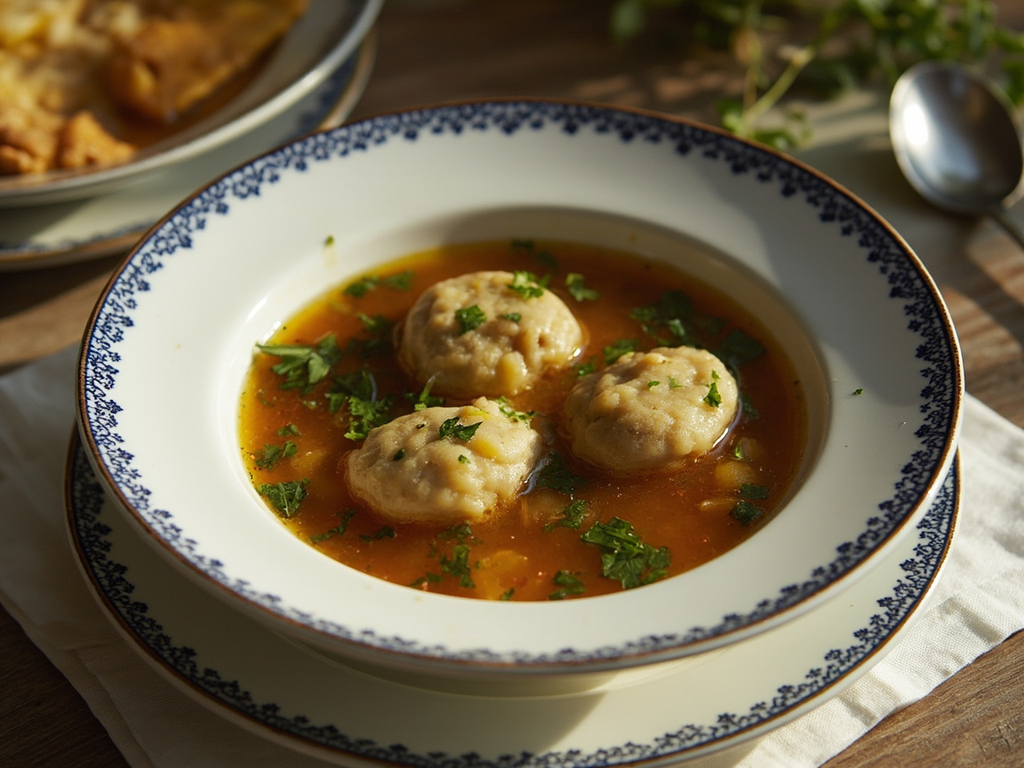
flipLeberknödelsuppe — Liver Dumpling Soup
Leberknödelsuppe — Liver Dumpling Soup
Why this dish? Mozart, a gourmand and bon vivant, mentioned in his letters his taste for liver dumplings and sauerkraut, hearty everyday Viennese dishes that comforted him between concerts.
A clear, fragrant beef broth in which tender liver dumplings bound with stale bread and seasoned with marjoram float. The ordinary daily soup, simple, nourishing, and warm, as it was served in Viennese homes.
Come, sit down without ceremony! When I came home chilled from a rehearsal at the theater, nothing revived me like a good broth with my dear liver dumplings swimming in it — with a heap of sauerkraut on the side, I assure you happiness was complete. The secret, you see, lies in the well-soaked stale bread and a pinch of marjoram, otherwise the dumpling weighs like a wrong note. My dear Constance would make fun of me, but I devoured it with the appetite of a regimental drummer!
- •Calf's liver — a fine piece (heart of the dumpling)
- •Stale rolls (Semmeln) — a few (binder)
- •Eggs — a few (binder)
- •Onion, parsley, marjoram — to taste (aromatics)
- •Lard — a knob (fat)
- •Beef broth — as needed (soup base)
Leberknödelsuppe — Liver Dumpling Soup
A clear, fragrant beef broth in which tender liver dumplings bound with stale bread and seasoned with marjoram float. The ordinary daily soup, simple, nourishing, and warm, as it was served in Viennese homes.
Why this dish? Mozart, a gourmand and bon vivant, mentioned in his letters his taste for liver dumplings and sauerkraut, hearty everyday Viennese dishes that comforted him between concerts.
Come, sit down without ceremony! When I came home chilled from a rehearsal at the theater, nothing revived me like a good broth with my dear liver dumplings swimming in it — with a heap of sauerkraut on the side, I assure you happiness was complete. The secret, you see, lies in the well-soaked stale bread and a pinch of marjoram, otherwise the dumpling weighs like a wrong note. My dear Constance would make fun of me, but I devoured it with the appetite of a regimental drummer!
Ingredients (period version)
- Calf's liver — a fine piece (heart of the dumpling)
- Stale rolls (Semmeln) — a few (binder)
- Eggs — a few (binder)
- Onion, parsley, marjoram — to taste (aromatics)
- Lard — a knob (fat)
- Beef broth — as needed (soup base)
Ingredients
- Calf's liver — 250 g (heart of the dumpling)
- Stale bread — 200 g (binder)
- Milk — 150 ml (to soften the bread)
- Eggs — 2 (binder)
- Onion — 1 small (aromatic)
- Parsley and marjoram — 1 tbsp (aromatics)
- Butter — 20 g (to sweat the onion)
- Beef broth — 1.5 L (soup base)
- Salt, pepper, nutmeg — to taste (seasoning)
Method
- Cut the bread into cubes and soak in warm milk.
- Finely chop the calf's liver (or briefly blend).
- Sweat the chopped onion in butter, let cool.
- Mix squeezed bread, liver, eggs, onion, herbs, salt, pepper, and nutmeg until a homogeneous mass forms; let rest 20 min.
- Shape dumplings the size of a small ball, wet hands with cold water so they don't stick.
- Poach dumplings 12–15 min in simmering broth (not boiling hard) until they rise to the surface.
- Serve in very hot broth, sprinkled with parsley.
How it was made : Using every part of the animal was a necessity: offal like liver, mixed with stale bread from the day before, made a complete and economical soup. The dumplings were poached directly in the large broth pot simmering on the hearth.
The contemporary twist : A few croutons browned in brown butter and a grating of lemon zest on top to brighten the broth.
Sources : Wolfgang Amadeus Mozart, family correspondence (letters)
Wolfgang Amadeus Mozart · Charactorium