
The wyvern is a legendary creature of medieval European heraldry and folklore, depicted as a winged, two-legged dragon with a venomous, barb-tipped tail. Distinct from the classic four-legged dragon, it frequently appears on coats of arms and heraldic emblems.
Wyvern
Wyvern
6 min read
Frequently asked questions
Key Facts
- A creature from medieval European folklore and heraldry (12th-15th centuries)
- A two-legged dragon: two legs and two wings, unlike the four-legged heraldic dragon
- A tail ending in a venomous barb, the creature's distinctive feature
- A recurring figure on coats of arms, notably in English heraldry (the “wyvern” of Wessex)
- A symbol of strength, war, and protection in the heraldic tradition
Works & Achievements
Monumental embroidery showing a dragon-shaped standard beside King Harold, one of the earliest records of the creature's heraldic use.
A foundational tale of a woman with a serpent's tail, sometimes winged, which fed the European imagination of dragon-ladies akin to the wyvern.
A reference treatise that classifies and describes heraldic beasts, including dragons and winged serpents.
A work that explicitly defines the wyvern by its two legs and barbed tail, establishing the distinction from the dragon.
A novel that reimagines the creature of Franche-Comté folklore as a young woman surrounded by snakes, adapted into a film in 1989.
Heraldic emblems where the golden or red wyvern serves as an enduring territorial symbol, still visible today.
Anecdotes
The word “wyvern” comes from the Latin vipera (viper), which passed into Old French as “wivre” or “guivre.” In heraldry, heralds distinguish it from the dragon by one precise detail: the wyvern has only two legs, whereas the classic dragon has four.
The golden wyvern is associated with the ancient Anglo-Saxon kingdom of Wessex. On the Bayeux Tapestry, embroidered around 1077, you can spot a dragon-shaped standard falling near King Harold at the Battle of Hastings — proof that this winged monster already served as a battle emblem.
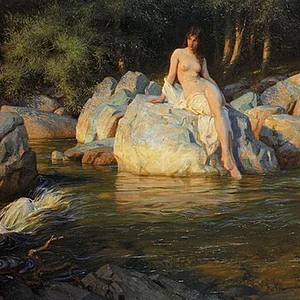
In the folklore of Franche-Comté and the Jura, the “vouivre” is a winged serpent that wears a carbuncle — a blazing gemstone — as its single eye. Legend tells that it sets this jewel down at the water's edge to bathe, and that bold souls would try to snatch it during that brief moment of vulnerability.
Medieval heralds loaded the wyvern with powerful meaning: depending on the region, it could stand for war, plague, or envy, but also for the strength and watchfulness of a guardian. It still appears today on the coats of arms of cities such as Leicester, in England.
The French writer Marcel Aymé breathed new life into the creature in his novel La Vouivre (1943), in which a mysterious young woman roams the countryside accompanied by serpents and a coveted ruby. The book was adapted for the screen in 1989.
Primary Sources
The wyvern is a kind of winged serpent that has only two legs; its tail ends in a knotted, barbed point, which sets it apart from the dragon, which has four legs.
The dragon and its two-legged cousin rank among the most dreaded beasts one may bear in a coat of arms, a sign of valor and of the fierce defense of whatever is entrusted to them.
And Melusine was, from the navel downward, in the shape of a serpent's tail, as thick as a barrel in which herring is packed, and exceedingly long.
The Vouivre often passed through the countryside, clad in a silk gown, wearing on her brow a great ruby worth more than all the lands of the region.
Key Places
An ancient Anglo-Saxon kingdom whose emblem was a golden dragon, the symbolic ancestor of the English heraldic wyvern. Winchester was its capital.
A region where, in folklore, the vouivre dwells — a winged serpent that carries a glowing carbuncle. Many villages of Franche-Comté still preserve legends of its flights over the rivers.
A city whose coat of arms bears a wyvern, inherited from the medieval Earls of Leicester. The creature remains a symbol of local identity there.
A castle linked to the legend of Melusine, a woman with a serpent's tail often given wings, close to the imagery of the wyvern. The site nourishes the folklore of serpent-ladies.
A town that preserves the famous Tapestry, which depicts a dragon-shaped standard fallen at the Battle of Hastings. A testimony to the warlike use of the winged monster.
Liens externes & ressources
Références
Œuvres
Tapisserie de Bayeux
vers 1077
Le Roman de Mélusine (Jean d'Arras)
1393
A Display of Heraldry (John Guillim)
1610
The Academy of Armory (Randle Holme)
1688
Armoiries de Wessex et de Leicester
Moyen Âge à aujourd'hui