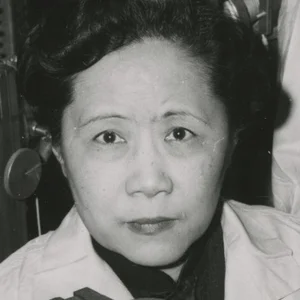
Xie Xide (1921-2000) was a Chinese physicist, a pioneer of solid-state physics and semiconductors in China. The first woman to serve as president of Fudan University in Shanghai, she played a major role in the development of modern Chinese physics.
Xie Xide(1921 — 2000)
Xie Xide
République populaire de Chine
5 min read
Frequently asked questions
Key Facts
- Born in 1921 in Quanzhou, China
- Earned a doctorate in physics from MIT (Massachusetts Institute of Technology) in 1951
- Returned to China in 1952 to develop physics teaching and research
- Became the first woman president of Fudan University in Shanghai in 1983
- Died in 2000 in Shanghai, recognized as a pioneer of semiconductor physics in China
Works & Achievements
A foundational textbook for teaching semiconductor physics in China, training generations of researchers and engineers.
The establishment, at Fudan, of teaching and research in a field then essential to the country's technological development.
Educational works that shaped the teaching of solid-state physics in Chinese universities.
A work bringing modern mathematical tools to Chinese physicists.
The first woman to lead Fudan; there she fostered international openness and scientific exchange.
Recognition of her role as a pioneer of modern Chinese physics.
A contribution to the development of Chinese research in surfaces and microelectronics.
Anecdotes
As a teenager, Xie Xide contracted skeletal tuberculosis of the hip that kept her bedridden for nearly four years. Rather than giving up her studies, she taught herself English, mathematics, and physics from her bedroom. She would walk with difficulty for the rest of her life, but this ordeal forged her iron determination.
In 1951, she earned her doctorate in physics at the prestigious MIT, in the United States. The following year, determined to serve the young People's Republic of China, she returned home with her husband by a roundabout route through England, because the American authorities were trying to hold on to the scientists they had trained.
In 1958, together with the physicist Huang Kun, she wrote “Semiconductor Physics,” a foundational textbook that would train generations of Chinese engineers and researchers at a time when these technologies were still in their infancy in the country.
During the Cultural Revolution (1966-1976), she was, like many intellectuals, persecuted, removed from her research, and forced into menial tasks. She picked up the thread of her work again as soon as that period ended, without any outward bitterness.
In 1983, she became the first woman to head Fudan University in Shanghai, one of the largest in China. During her tenure, she opened the university widely to international exchanges and helped reconnect Chinese science with the rest of the world.
Primary Sources
A foundational university textbook devoted to the electronic properties of semiconductors, long a reference work for Chinese higher education in solid-state physics.
A body of lectures and educational texts through which Xie Xide introduced and structured the teaching of solid-state physics at Fudan University.
A work presenting the mathematical tools of group theory applied to physics, reflecting her commitment to passing on the modern theoretical foundations.
Public addresses in which she championed international openness, scientific rigor, and the place of women in research.
Key Places
Port city in southeastern China where Xie Xide was born in 1921.
University in Fujian where she earned her physics degree in 1946, after her years of illness.
American institute where she earned her doctorate in physics in 1951.
Major Chinese university where she taught, led semiconductor research, and became president in 1983.
Chinese metropolis where she spent most of her career and where she died in 2000.
Liens externes & ressources
Références
Œuvres
Physique des semi-conducteurs (avec Huang Kun)
1958
Création du programme de physique des semi-conducteurs
années 1950
Physique du solide (cours et ouvrages)
années 1950-1980
La théorie des groupes et ses applications en physique
1986
Présidence de l'université Fudan
1983-1988
Élection à l'Académie des sciences de Chine
1980
Fondation du Centre de recherche sur la microélectronique de Shanghai
années 1980