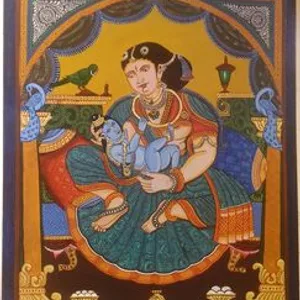

Yashoda is a central figure in Hindu mythology, the foster mother of the god Krishna. Wife of Nanda, chief of the cowherds of Vrindavan, she raises Krishna with unconditional maternal love, a symbol of devotion (bhakti) in Hinduism.
Yashoda
Yashoda
8 min read
Frequently asked questions
Key Facts
- Foster mother of Krishna according to the Puranas, notably the Bhagavata Purana (composed around the 6th–9th century)
- She raises Krishna in Vrindavan after Vasudeva entrusts him to Nanda to protect him from King Kamsa
- Iconic scene: Yashoda sees the entire universe in the mouth of the infant Krishna
- She embodies vatsalya (maternal love), one of the nine forms of bhakti in the Vaishnavite tradition
- A recurring figure in medieval Indian devotional poetry (Mirabai, Surdas, 15th–16th centuries)
Works & Achievements
The scene in which Yashoda tries to bind Krishna with a rope that is always two fingers too short is one of the most celebrated stories in Krishnaism, illustrating divine omnipotence freely submitting itself to a mother's love.
When Yashoda asks Krishna to open his mouth, she glimpses the entire universe within. This episode is a foundational moment of theological revelation, comparable to the vision granted to Arjuna in the Bhagavad Gita.
A collection of devotional poems by the blind poet-saint Surdas, entirely devoted to the leelas of the child Krishna. Yashoda is portrayed with extraordinary tenderness throughout; these poems shaped popular Hindu devotion for centuries.
The image of Yashoda holding or nursing the infant Krishna is a major iconographic subject in Indian art, from the Mathura sculptures of the 7th century to the Rajput miniatures of the 18th century.
Lullabies sung by Yashoda at Krishna's cradle have been passed down for centuries across India and are still performed during Janmashtami; they constitute a devotional musical genre in their own right.
Anecdotes
One day, gopika women came to complain to Yashoda that Krishna was stealing butter from their homes and giving it to the monkeys. Yashoda, both amused and embarrassed, caught her son to scold him. Krishna looked at her with his big innocent eyes and denied everything with such candor that his mother could not help but laugh, unable to punish him. This episode, famous under the name of 'Makhan Chor', is one of the most beloved leelas of Krishnaite mythology.
One day, playmates told Yashoda that Krishna had eaten dirt. Worried, she ordered him to open his mouth so she could check. Looking inside, Yashoda saw not dirt, but the entire universe: the stars, the oceans, the mountains, and all living beings. Overwhelmed by this cosmic vision, she immediately forgot everything she had just seen, for Krishna erased her memory through his maya — thus protecting her from the truth of his divine nature.
Irritated by Krishna's mischief, Yashoda decided to tie him to a mortar with a rope to keep him from causing trouble. But every time she lengthened the rope, it was always two fingers too short to go around him. She looked for other ropes and knotted them together, but the same thing kept happening. Finally, Krishna, moved by his mother's effort and pure love, allowed himself to be tied — this episode earns him the name Damodara, 'he whose belly is bound'.
Although Yashoda is Krishna's foster mother, the Puranic tradition specifies that she never discovered her son's true divine identity during her lifetime. It is precisely this blissful ignorance that allowed their relationship to be of absolute purity. Hindu theology sees in Yashoda's love the perfect model of maternal devotion (vatsalya bhakti): an unconditional love founded not on knowledge of divine greatness, but simply on the heart's attachment.
Primary Sources
Yashoda, beholding the entire universe within the open mouth of the child, was seized by an overwhelming cosmic vision. Then, by Krishna's grace, her memory was veiled and she saw nothing but her beloved little boy.
Nanda and Yashoda raised the child Krishna at Gokula with boundless love. Yashoda, unaware that he was the Supreme Lord, cherished him as any mother cherishes her son.
Vasudeva carried the infant Krishna across the flooded Yamuna and exchanged him for the newborn daughter of Yashoda and Nanda at Gokula. Yashoda awoke the following morning with no memory of giving birth, and found a son at her side.
Krishna spoke to his mother Yashoda and revealed his divine nature to her, but through his *maya* he immediately erased that memory from her mind so that their maternal bond would remain pure and untainted by reverential awe.
Key Places
Village of cowherds where Yashoda and her husband Nanda raised the child Krishna. It is the setting for most of Krishna's childhood leelas and the everyday home of Yashoda.
Sacred forest and village where Krishna spent his youth among the gopas and gopis. Vrindavan is the spiritual heart of Krishnaism and the foremost pilgrimage site for Krishna devotees around the world.
City neighboring Gokula, and the kingdom of the tyrant Kamsa, Krishna's uncle. It was to escape Kamsa that Vasudeva entrusted the infant Krishna to Yashoda — this danger is why Yashoda became his foster mother.
Sacred river flowing alongside Mathura and Vrindavan. It was by crossing the flooded Yamuna that Vasudeva carried the infant Krishna to be entrusted to Yashoda; the river is revered as sacred throughout the Krishnaite tradition.
Typical Objects

The rope with which Yashoda tried to tie Krishna to the mortar is the most symbolic object in her story. It represents both the binding nature of maternal love and the divine's willing submission to human devotion.

A large traditional mortar used for grinding grain, to which Yashoda finally managed to tie Krishna. It has become a symbol of the simple life of the cowherds of Gokula and appears in many depictions of the Damodar episode.

Yashoda churned milk every morning to make fresh butter (*makhan*), a daily task for gopa women. This was the very butter that young Krishna would steal, much to the despair of his mother and their neighbors.

The cradle in which Yashoda rocked the infant Krishna symbolizes the pure tenderness of their bond. It continues to inspire the lullabies (*lori*) sung during Janmashtami celebrations across India.

Each evening, Yashoda performed the *arati* (lamp ceremony) with an oil lamp to protect Krishna from evil spirits and express her devotion to him. The lamp is the central instrument of Hindu domestic piety.

An earthenware pot in which Yashoda kept fresh butter. Krishna would regularly smash it open to share its contents with the monkeys, earning Yashoda complaints from neighbors throughout Gokula.
School Curriculum
Vocabulary & Tags
Key Vocabulary
Daily Life
Morning
Yashoda rose before dawn to perform her ritual ablutions, then prayed before the family altar while reciting Vedic hymns. She would then begin churning the night's milk to make fresh butter (*makhan*), the main task of the gopa women, singing devotional hymns as she worked. She would then bathe little Krishna, dress him in his ornaments, and feed him before the day's activities began.
Afternoon
Afternoons were devoted to caring for the home and keeping an eye on Krishna at play — responding to the *gopika* neighbors who complained about his mischief, and managing the cows and milk. Yashoda also took part in the communal activities of the village of Gokula, a pastoral community organized around the tending of sacred cattle herds.
Evening
At sunset, Yashoda performed the *arati* (oil lamp ritual) to protect Krishna from evil spirits. She prepared his meal, told him stories, and rocked him in his *palana* while singing *lori* (lullabies). The evening ended with communal prayers shared with the other women of the village.
Food
The diet of Yashoda and the gopa of Gokula was entirely vegetarian and dairy-based: curdled milk (*dahi*), fresh butter (*makhan*), and ghee, along with grains (millet, barley), vegetables, fruits, and honey. The butter churned each morning was both the staple food and the main product of their pastoral economy.
Clothing
Yashoda wore the traditional draped sari in cotton or light silk, often yellow or red (auspicious colors), with gold jewelry — bracelets, earrings, a necklace, and a vermilion *bindi* on her forehead. Her hair was braided and adorned with fresh flowers, in keeping with the traditions of married women of respectable gopa families.
Housing
Yashoda's family lived in a large mud-and-timber house, typical of the pastoral villages on the Ganges plain. The home included a cowshed (*goshala*), an inner courtyard, a kitchen, and a prayer space. Nanda, chief of the herdsmen, had a more spacious dwelling than the other villagers, reflecting his status as *mukhiya* (community leader).
Historical Timeline
Period Vocabulary
Liens externes & ressources
Références
Œuvres
Épisode de Damodar (Damodar Leela)
Attesté dans le Bhagavata Purana, IXe-Xe s.
Vision cosmique dans la bouche de Krishna (Vishvarupa Darshana)
Attesté dans le Bhagavata Purana, IXe-Xe s.
Sursagar de Surdas
XVe-XVIe siècle
Iconographie 'Yashoda Krishna' (peinture et sculpture)
VIIe siècle à nos jours
Berceuses (Lori) pour Krishna
Tradition orale, IXe siècle à nos jours