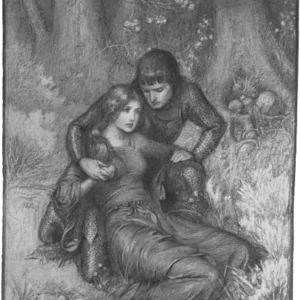

Igraine is a character from Arthurian legend, wife of Gorlois, Duke of Cornwall, and later of King Uther Pendragon. Seduced by Uther through a spell cast by Merlin that gives him the appearance of Gorlois, she becomes the mother of King Arthur.
Igraine
Igraine
6 min read
Frequently asked questions
Key Facts
- Appears in Geoffrey of Monmouth's Historia regum Britanniae (around 1138) as the wife of Gorlois, Duke of Cornwall
- Uther Pendragon, smitten with her, persuades Merlin to transform his appearance into that of Gorlois so he can join her at Tintagel Castle
- From this union is born King Arthur, the central figure of the legend
- Taken up and developed in the 13th-century Arthurian prose romances (the Lancelot-Grail cycle)
- Often portrayed as the mother of Arthur's half-sisters, including Morgan le Fay
Works & Achievements
Igraine gives birth to Arthur, the future king of Britain; her role as a mother makes her a founding figure of the Arthurian cycle.
After the death of Gorlois, Igraine marries Uther and becomes queen, sealing the union that legitimizes Arthur's lineage.
Mother of several daughters including Morgan le Fay, Igraine is at the root of the legend's rich female genealogy.
Geoffrey of Monmouth set down her story in writing, the starting point for its spread across Europe.
Taken up in the Vulgate Cycle and by Robert de Boron, where her role as a victim of the enchantment is developed.
Her transmission by Malory ensured her literary survival down to the modern retellings of the legend.
Anecdotes
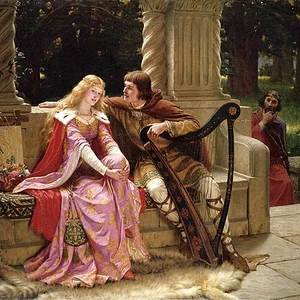
Ygerne is the wife of Duke Gorlois of Cornwall when King Uther Pendragon falls hopelessly in love with her at a banquet. To win her over, Uther turns to the wizard Merlin, who magically gives him the appearance of Gorlois. That very night, the real Gorlois dies in battle: Ygerne therefore does not know who is sharing her bed.
From this deceitful night the future King Arthur is born. According to Geoffrey of Monmouth, Merlin demands the child as his payment: Arthur is at once secretly handed over and raised far from the court, which explains why no one will know of his royal lineage until the episode of the sword Excalibur.
Ygerne is often portrayed as the mother of several daughters, among them Morgan (Morgan le Fay) and Anne (or Elaine). Arthur thus has half-sisters born of her first husband Gorlois, weaving the family ties behind many of the dramas of the Arthurian legend.
The character's name changes from one author and language to another: Igerna or Igerne in Geoffrey of Monmouth (in Latin), Ygerne or Ygraine in the French and English romances. This variation is typical of the “Matter of Britain”, passed down orally and then fixed in writing by authors from different countries.
In certain later versions, such as those compiled by Thomas Malory in the 15th century, Ygerne lives on for a long time and eventually is reunited with her son Arthur, who was unaware of her existence. The scene of their reunion brings to light the secret of his birth, until then hidden by Merlin.
Primary Sources
Uther, inflamed with love for Igerna, took on the appearance of Gorlois through Merlin's arts and was received into the castle of Tintagel as if he were her lawful husband.
Uther loved Igerna, the wife of the Duke of Cornwall, and through Merlin's art he took on the likeness of her lord to come to her.
Merlin transformed the king into the likeness of the duke, so that Igerna believed him to be her husband and welcomed him without suspicion; that night Arthur was begotten.
Thus Igerna was deceived by the enchantment, and Arthur was conceived; and Merlin secured the promise that the child would be delivered to him to be raised in secret.
Key Places
Iconic site where legend places Arthur's conception, when Uther joins Igraine disguised as Gorlois. A real site of an early medieval Brittonic princely settlement.
Region in the southwest of Great Britain, the domain of Duke Gorlois and the main setting of Igraine's story in the Matter of Britain.
A Cornish fortress where, according to Geoffrey of Monmouth, Duke Gorlois takes refuge and meets his death while Igraine is kept safe at Tintagel.
Legendary kingdom of Britain of which Igraine becomes queen after her marriage to Uther. The center of the nascent Arthurian power.
Typical Objects

A long laced and belted tunic (bliaut) such as a duchess like Igraine would wear in the imagination of the Arthurian romances. It signals her rank and beauty, the very things that stir **Uther**'s desire.

The enchantment by which **Merlin** gives **Uther** the appearance of **Gorlois**. This charm is the central magical device behind the conception of **Arthur** and the deception of **Igraine**.

A ring symbolizing **Igraine**'s marriage, first to **Gorlois** and then to **Uther**. It embodies the successive marital bonds at the heart of her story.

A crown worn by **Igraine** as the wife of King **Uther Pendragon**. It underscores her shift from the rank of duchess to that of queen.

A coastal castle in **Cornwall** where **Igraine** is kept safe by **Gorlois** and where **Uther** reaches her through trickery. Reputed to be impregnable, it symbolizes protection foiled by magic.

The weapon of **Igraine**'s first husband, a warrior lord killed in battle on the very night of **Uther**'s ruse. It evokes the martial rivalry that frames **Igraine**'s fate.
School Curriculum
Vocabulary & Tags
Key Vocabulary
Tags
Daily Life
Morning
As one imagines her as a duchess of the early Breton Middle Ages, Ygerne begins the day with prayer and her toilette, assisted by her attendants. She dons her bliaut and organizes the castle household.
Afternoon
The afternoon is divided between supervising the servants, weaving and embroidery with her ladies, and welcoming her husband's guests. As the wife of a great lord, she ensures the good order of the household.
Evening
In the evening, the court gathers for the meal in the great hall, enlivened by tales, songs, and harp music. It is at such a banquet that legend places Uther's love at first sight for Ygerne.
Food
A great lady was nourished on bread, game meats and poultry, fish on lean days, cheeses, and fruit. Wine and mead accompanied the meals of the Breton nobility.
Clothing
Ygerne would wear the long laced tunic (bliaut) of noblewomen, belted and covering a linen chemise, with a veil or wimple over her hair. Fine fabrics and jewels signaled her high rank.
Housing
She resides in fortified castles such as Tintagel, perched and protected, combining a common hall, lordly chambers, and a chapel. These coastal fortresses offered both security and prestige.
Historical Timeline
Period Vocabulary
Liens externes & ressources
Références
Œuvres
Conception du roi Arthur
récit légendaire
Mariage avec Uther Pendragon
récit légendaire
Maternité de Morgane et des demi-sœurs d'Arthur
récit légendaire
Personnage de l'Historia regum Britanniae
vers 1136
Figure des romans arthuriens en prose
XIIIe siècle
Présence dans Le Morte d'Arthur de Malory
1485