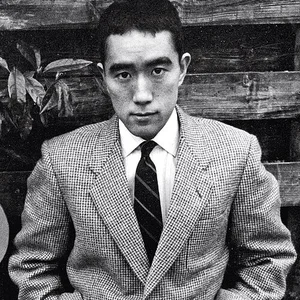

Japanese writer, playwright, and essayist, a major figure in 20th-century literature. A prolific author blending classical aesthetics with modern obsessions, he remains famous for his ritual suicide by seppuku following an attempted coup d'état.
Yukio Mishima(1925 — 1970)
Yukio Mishima
Japon
6 min read
Frequently asked questions
Key Facts
- Born in Tokyo in 1925 under the name Kimitake Hiraoka
- Publishes his autobiographical novel Confessions of a Mask in 1949, which brings him fame
- Releases The Temple of the Golden Pavilion in 1956, inspired by the real-life burning of a Kyoto temple
- Completes his tetralogy The Sea of Fertility in 1970
- Takes his own life by seppuku on November 25, 1970, after an attempted uprising in Tokyo
Works & Achievements
A largely autobiographical novel that brought Mishima to public attention and explores the gap between social appearances and inner life.
A luminous love story between two young fishers on an island, inspired by his trip to Greece. One of his greatest popular successes.
A novel inspired by a real event: a young monk sets fire to a famous temple in Kyoto. A powerful meditation on beauty and destruction.
Contemporary reworkings of classical Noh theatre plays, which showcase his genius as a playwright.
A novel inspired by a real political affair, which earned Mishima a sensational lawsuit for invasion of privacy.
An autobiographical essay in which he explains his obsession with the body, bodybuilding and the union between mind and action.
A vast novel cycle in four volumes (Spring Snow, Runaway Horses, The Temple of Dawn, The Decay of the Angel), his testament work completed on the day of his death.
Anecdotes
At birth, Mishima was named Kimitake Hiraoka. His paternal grandmother, Natsuko, took him away from his parents a few weeks after he was born and raised him shut up in her sickroom until he was twelve, forbidding him sunlight and the rough games of boys. This stifling confinement deeply shaped the writer's morbid and refined imagination.
As a teenager, he chose the pen name “Yukio Mishima” partly to hide his writing from his father, a senior civil servant who despised literature and sometimes tore up his manuscripts. “Yuki” evokes the snow of the mountains near Mount Fuji: a borrowed name to become someone else.
A frail and sickly child, Mishima threw himself around the age of thirty into intensive weight training, kendo and boxing. He completely transformed his body, obsessed with the Japanese ideal of *bunbu-ryōdō*, the union of the brush and the sword, that is, of letters and arms.
Considered three times for the Nobel Prize in Literature during the 1960s, Mishima saw his mentor and friend Yasunari Kawabata become, in 1968, the first Japanese writer to receive it. He is said to have warmly congratulated the elder whose work he admired.
On the morning of November 25, 1970, Mishima delivered the final volume of his great tetralogy to his publisher. A few hours later, with four members of his militia, he took a general hostage in a Tokyo barracks, harangued the soldiers from a balcony to demand the return of the emperor, then took his own life by seppuku.
Primary Sources
For a long time, I claimed I could remember scenes I had witnessed at the moment of my own birth.
I gradually came to feel that it was my body, and not words, that provided the proof of my existence.
We watched postwar Japan grow drunk on material prosperity and forget the spiritual foundation of the nation.
The lieutenant and his young wife choose to die together, faithful to the very end to their ideal of loyalty.
Key Places
Capital of Japan where Mishima was born in 1925 and spent most of his life. There he witnessed the defeat, the occupation, and then the rapid modernization of the postwar period.
Mishima studied law here after the war, following the path laid out by his father. He briefly entered the senior civil service before devoting himself entirely to writing.
During his trip around the world in 1952, Mishima discovered ancient Greece and its cult of bodily beauty. This journey inspired his novel *The Sound of Waves*.
Headquarters of the Japan Self-Defense Forces where Mishima attempted his uprising on November 25, 1970. It was there that he delivered his final speech and then took his own life.
Vast cemetery in the suburbs of Tokyo where the Hiraoka family grave is located. Mishima is buried there under his real name.
Typical Objects
Traditional sword with a curved blade, both a weapon and a symbol of the warrior's soul. It was with a katana that Mishima's seppuku ritual took place in 1970.
📷 Wikimedia · Wikimedia Commons ↗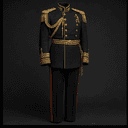
Military uniform designed by Mishima himself for his private militia, inspired by European officers' attire. It served to display the group's discipline and identity.
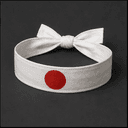
White cloth band tied around the forehead, often adorned with the rising sun and a slogan. Mishima and his men wore them during their final action in 1970.
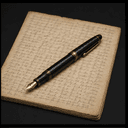
Mishima wrote by hand, most often at night, with clockwork discipline. In this way he completed dozens of novels, plays, and essays.
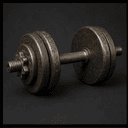
Weights and bars he lifted almost every day in a Tokyo gym. Bodybuilding allowed him to transform his once-frail body.
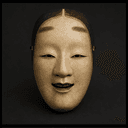
Carved mask used in Noh theater, a highly codified classical Japanese art. Mishima was passionate about it and wrote modern Noh plays.
School Curriculum
Vocabulary & Tags
Key Vocabulary
Daily Life
Morning
Mishima wrote at night, often until dawn, then slept through much of the morning. His late rising contrasted with the military discipline he otherwise championed.
Afternoon
The afternoon was devoted to the body: weight-training sessions at a Tokyo gym, kendo and boxing practice. He also handled his interviews, his plays, and the affairs of his private militia.
Evening
In the evening, Mishima frequented dinners, theaters, and literary circles, cultivating his image as a man of the world. Once night fell, he settled at his desk to write in deadly earnest.
Food
He ate both Japanese and Western food, enjoying European cuisine and Tokyo's elegant restaurants. Mindful of his physique, he watched his diet to maintain his chiseled musculature.
Clothing
In everyday life, Mishima loved well-cut Western suits and took great care with his elegance. For his commitments he wore the uniform of the Tatenokai, and for his artistic photographs sometimes the kimono or only a loincloth.
Housing
He lived in Tokyo in a Western-style house that he had decorated in a baroque and theatrical taste, with European-style columns and statues. This eccentric interior reflected his fascination with the West as much as with traditional Japan.
Historical Timeline
Period Vocabulary
Liens externes & ressources
Références
Œuvres
Confessions d'un masque (Kamen no kokuhaku)
1949
Le Tumulte des flots / Le Bruit des vagues (Shiosai)
1954
Le Pavillon d'or (Kinkaku-ji)
1956
Cinq nô modernes (Kindai nôgakushû)
1956
Après le banquet (Utage no ato)
1960
Le Soleil et l'Acier (Taiyô to tetsu)
1968
La Mer de la fertilité (Hôjô no umi), tétralogie
1965-1970