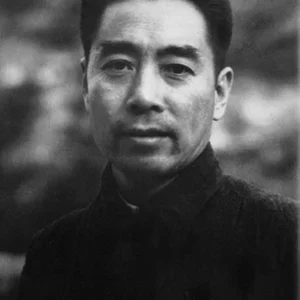

Zhou Enlai was the first Premier of the People's Republic of China, from its founding in 1949 until his death in 1976. A skilled diplomat and loyal companion of Mao Zedong, he played a central role in Chinese foreign policy and tempered some of the excesses of the Cultural Revolution.
Zhou Enlai(1898 — 1976)
Zhou Enlai
République populaire de Chine, dynastie Qing, république de Chine
6 min read
Frequently asked questions
Key Facts
- Takes part in the Long March (1934-1935) alongside Mao Zedong
- Becomes Premier of the People's Republic of China at its founding in 1949
- Also serves as Minister of Foreign Affairs from 1949 to 1958
- Attends the Bandung Conference in 1955, promoting Afro-Asian solidarity
- Architect of the Sino-American rapprochement, with Nixon's visit to China in 1972
Works & Achievements
A diplomatic framework based on mutual respect for sovereignty and non-interference, co-formulated with India. It became a cornerstone of Chinese foreign policy.
Zhou contributed to the agreements that ended the First Indochina War. There he asserted the international weight of the new China.
An address that rallied many newly decolonized countries to China. It established Zhou as a bridging figure among the Afro-Asian nations.
Secret negotiations with Henry Kissinger, followed by the welcoming of Nixon to Beijing. A major turning point in the Cold War that culminated in the Shanghai Communiqué.
A plan to modernize agriculture, industry, defense, and science. It inspired the later reforms of Deng Xiaoping.
Anecdotes
In April 1955, at the Asian-African Conference in Bandung, Indonesia, Zhou Enlai won over the delegates with his moderation and eloquence, presenting China as a friend to the decolonized nations. There he championed the “Five Principles of Peaceful Coexistence,” which became a cornerstone of Chinese diplomacy.
In February 1972, Zhou Enlai welcomed American President Richard Nixon to Beijing on a historic visit that ended more than twenty years of hostility between the two countries. The famous handshake at the foot of the aircraft steps became a symbol: a few years earlier, in Geneva in 1954, U.S. Secretary of State Foster Dulles had refused to shake Zhou's hand.
Zhou Enlai was nicknamed “the survivor” because he managed to hold on to his post as Premier for 27 years, weathering purges and political campaigns that eliminated nearly all of his rivals. During the Cultural Revolution, he worked behind the scenes to protect senior officials, intellectuals, and treasures of the national heritage threatened by the Red Guards.
Stricken with cancer, Zhou Enlai kept working from his hospital bed until his final days. When he died in January 1976, hundreds of thousands of Chinese defied the official ban to pay tribute to him in Tiananmen Square, in what became known as the “Tiananmen Incident” of April 1976.
As a young man, Zhou Enlai studied in Japan and then left for France in the early 1920s as part of a “work-study” program. It was in Europe, in Paris and in Germany's Ruhr region, that he embraced communism and helped found the European branch of the Chinese Communist Party.
Primary Sources
The Chinese people came here to seek unity and not to quarrel. We, the peoples of Asia and Africa, must seek common ground while reserving our differences.
The two sides reviewed the long-standing serious disputes between them in international relations; they agreed that countries, regardless of their social systems, should conduct their relations on the principles of respect for sovereignty and territorial integrity.
To accomplish the comprehensive modernization of agriculture, industry, national defense, and science and technology, so as to bring our national economy into the front ranks of the world.
Key Places
Zhou Enlai's birthplace, in eastern China. His childhood home is today a memorial.
Zhou stayed here in the early 1920s as part of the “work-study” program and became committed to communism there.
City of the 1955 Afro-Asian Conference, where Zhou Enlai established himself as a leading diplomatic voice of the Third World.
Government complex in the heart of Beijing where China's leaders were based and where Zhou Enlai carried out his duties as Premier.
Capital of the People's Republic of China, where Zhou worked and died in 1976. Tiananmen Square hosted the popular tributes after his death.
Typical Objects
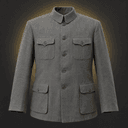
Straight-collared jacket with buttons and four pockets, worn by Zhou Enlai as by other Chinese leaders. It symbolized egalitarianism and a break with traditional dress.
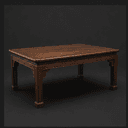
The favored workplace of Zhou, a shrewd negotiator, during the great international conferences. Around it played out Geneva, Bandung and the opening to America.
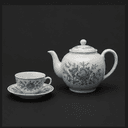
Tea accompanied Zhou Enlai's long meetings and diplomatic talks. Sharing tea was a ritual of hospitality at the heart of Chinese culture.
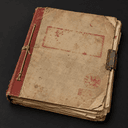
Zhou managed the administration of the People's Republic through countless files and reports. Known as a tireless worker, he often annotated them late into the night.
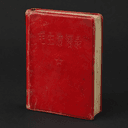
A collection of quotations from Mao Zedong, omnipresent during the Cultural Revolution. Brandished by the Red Guards, it embodied the cult of personality that Zhou had to navigate.
School Curriculum
Vocabulary & Tags
Key Vocabulary
Daily Life
Morning
Known for his stamina, Zhou Enlai often began his days early after short nights. He moved seamlessly from reading reports to government meetings and preparing diplomatic files.
Afternoon
The afternoon was devoted to audiences, meetings with foreign delegations, and coordinating the ministries. A meticulous premier, he personally followed up on numerous matters.
Evening
In the evening, Zhou frequently received official guests at state banquets in the Great Hall of the People. He would then carry on working late into the night, annotating administrative documents.
Food
His diet followed Chinese cuisine, based on rice, vegetables, slow-cooked dishes, and tea. At diplomatic banquets, he saw to the refinement of the dishes to honor his guests.
Clothing
Zhou wore the straight-collared Mao suit (zhongshan), plain and buttoned up, which had become the uniform of Chinese leaders. His impeccable attire contrasted with his image of revolutionary austerity.
Housing
He lived and worked at Zhongnanhai, the government compound adjoining the Forbidden City in Beijing. His way of life was reputed to be modest for a leader of his rank.
Historical Timeline
Period Vocabulary
Liens externes & ressources
Références
Œuvres
Les cinq principes de la coexistence pacifique
1954
Rôle diplomatique à la conférence de Genève
1954
Discours de Bandung
1955
Ouverture diplomatique vers les États-Unis
1971-1972
Programme des « Quatre Modernisations »
1975