Kids interview Ada Lovelace
by Charactorium · Ada Lovelace (1815 — 1852) · Sciences · 5 min read
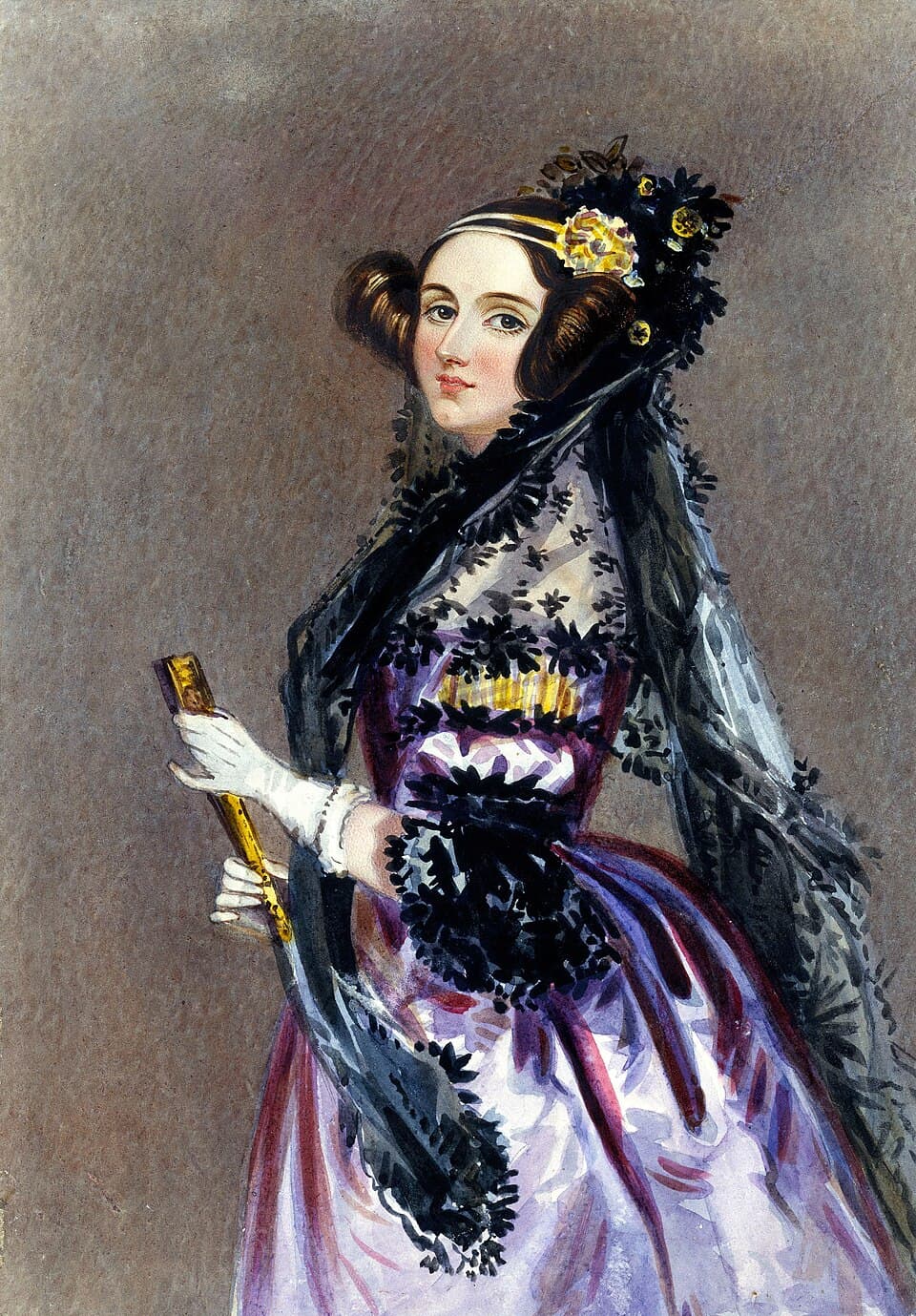
That morning, two twelve-year-old visitors pushed open the door of a London home, their class on a discovery outing. A lady in Victorian dress awaited them, pen resting beside a large notebook. Her name was Ada Lovelace, and she had agreed to answer all their questions.
—Is it true you were born on Christmas Day? And who was your father?
Yes, my child, I was born on Christmas Day 1815, in London. Quite a gift, they say! My father was a very famous poet, Lord Byron. But here's the thing: I never knew him. My parents separated when I was just a tiny baby. Imagine growing up with a name everyone admired, and a face you never saw. It was strange. My mother, Annabella, made a decision: her daughter would not be a poet like that absent father. So she turned me toward numbers, shapes, calculation. And you know what? I loved it.
I carried a name everyone admired, and a face I never saw.
—Why was your mother afraid you would write poetry like your father?
Ah, that's a good question! My mother was afraid of passions, you see. My father lived in emotions, travels, scandals. She thought mathematics would keep my feet on the ground, nice and steady. So from my earliest age, I had tutors, books, lessons rare for a girl of my time. But I'll let you in on a secret: I never really left poetry. I hid it in numbers! I called it my scientific poetry. To me, a beautiful equation is like a melody. Imagine music played with numbers instead of notes.
I hid poetry in numbers: I called it my scientific poetry.
—What was a typical day like at your home? What did you eat for breakfast?
In the morning, I woke around seven or eight, and maids helped me dress. For breakfast: tea, toast, a bit of jam. Nothing too heavy. Then the most important part began — my correspondence. I wrote letters to my learned friends, especially Mr. Babbage. In my day, you see, there was no machine to carry your voice afar. A letter took days to arrive. So we thought long before writing each sentence. In the afternoon, I immersed myself in my calculations, surrounded by papers. In the evening, sometimes salons, concerts. But my heart was in the numbers.
—Was it hard to be a woman doing science in your time?
Yes, my child, more than you can imagine. In my day, a lady was expected to host a salon, to be charming, and that's it. A learned lady was almost a mocking term. Universities like Cambridge did not admit girls. I had to study by letters, almost in secret, with a great mathematician named De Morgan. And I was often ill, on top of that. But I never gave up. I corresponded with the greatest scholars of my time. Imagine having to prove every day that you have the right to think. It's tiring. But work never lies about what you're worth.
Work never lies about what you're worth.
—How old were you when you met Mr. Babbage?
I was seventeen, it was 1833, at a party in London. Picture a large room full of people in fancy clothes, chatting about this and that. And there, in a corner, Charles Babbage was showing off a strange machine full of brass gears. Everyone looked politely, then moved on. I stood there, fascinated. I wanted to understand how it worked! Babbage immediately saw I was not like the other guests. We became friends for life. That meeting, you see, changed everything for me. A machine of metal, and a seventeen-year-old girl: a fine beginning, don't you think?
—Did you ever argue with him? Was he nice?
Oh, we loved each other dearly, but we bickered too! One day, in 1843, Babbage had altered one of my Notes without asking. I was furious! I wrote to him that I was perfectly willing to correct my own texts, but I could not stand another person meddling with my sentences. You see, I cared about my work as you care about a drawing you made yourself. You don't scribble on it without permission! Babbage was a genius, brilliant, but stubborn as a mule. And I, too, I must admit. Two stubborn people who admire each other — it sparks, but it also achieves great things.
I cared about my sentences as you care about a drawing you made yourself.
—What's the connection between a calculating machine and a loom?
Ah, that's my favorite idea! In my time, there was a loom invented by a man named Jacquard. To make complex patterns in fabric — flowers, leaves — you slipped into the machine cards punched with small holes. The holes told the loom which threads to lift. I understood something wonderful: Babbage's Analytical Engine could do the same! Instead of weaving flowers, it could weave numbers and operations. Imagine a weaving, but with numbers instead of silk thread. That, my child, is the great idea: you can give instructions to a machine, like a score to a musician.
Instead of weaving flowers, this machine could weave numbers.
—Is it true you wrote the world's very first program?
So they say, and it touches me deeply. In 1843, I was translating a text about Babbage's machine. But I became so passionate that my Notes ended up three times longer than the original! In them, I wrote a sequence of instructions, step by step, to calculate a family of complex numbers, the Bernoulli numbers. An ordered sequence of instructions like that, you see, is called an algorithm. And mine was meant for a machine. No one had done that before. The machine didn't even exist yet for real! I was writing a recipe for a cook who wasn't even born. Strange adventure, isn't it?
I was writing a recipe for a cook who wasn't even born.
—Did you think your machine could become intelligent, like a brain?
Now that's a question I pondered a lot! And my answer was clear: no. I had written that this machine has no pretensions whatever to originate anything on its own. It follows what it's told, that's all. It doesn't guess anything, it doesn't create anything by itself. Imagine an excellent student who perfectly follows the teacher's instructions, but never has an idea of their own. The machine is like that. It is fast, faithful, tireless — but imagination, the spark, you have to give it. Many thought I was dreaming too much. On the contrary: I saw very clearly where the machine stopped.
The machine perfectly follows instructions, but it will never have an idea of its own.
—And you, did you imagine that one day these machines would do many things?
Oh yes, my child! That's where my dreamer's heart spoke. I wrote that one day a new, vast, and powerful language would be born, at the service of humanity. You see, I felt these machines would not only be used to count money or harvests. I thought they could manipulate all kinds of symbols — perhaps even compose music, who knows! In my day, 1843, saying such a thing was almost madness. I died young, at 36, without seeing any of it. But I knew. A planted seed grows even when the gardener is no longer there to watch it grow.
A planted seed grows even when the gardener is no longer there to watch it grow.
This imaginary interview was generated by artificial intelligence from sources documented in Ada Lovelace's profile. It dramatises what the figure might have said based on what we know about them, but does not constitute attested historical testimony. For primary sources and factual documentation, refer to the full profile.