Imaginary interview with Ada Lovelace
by Charactorium · Ada Lovelace (1815 — 1852) · Sciences · 5 min read
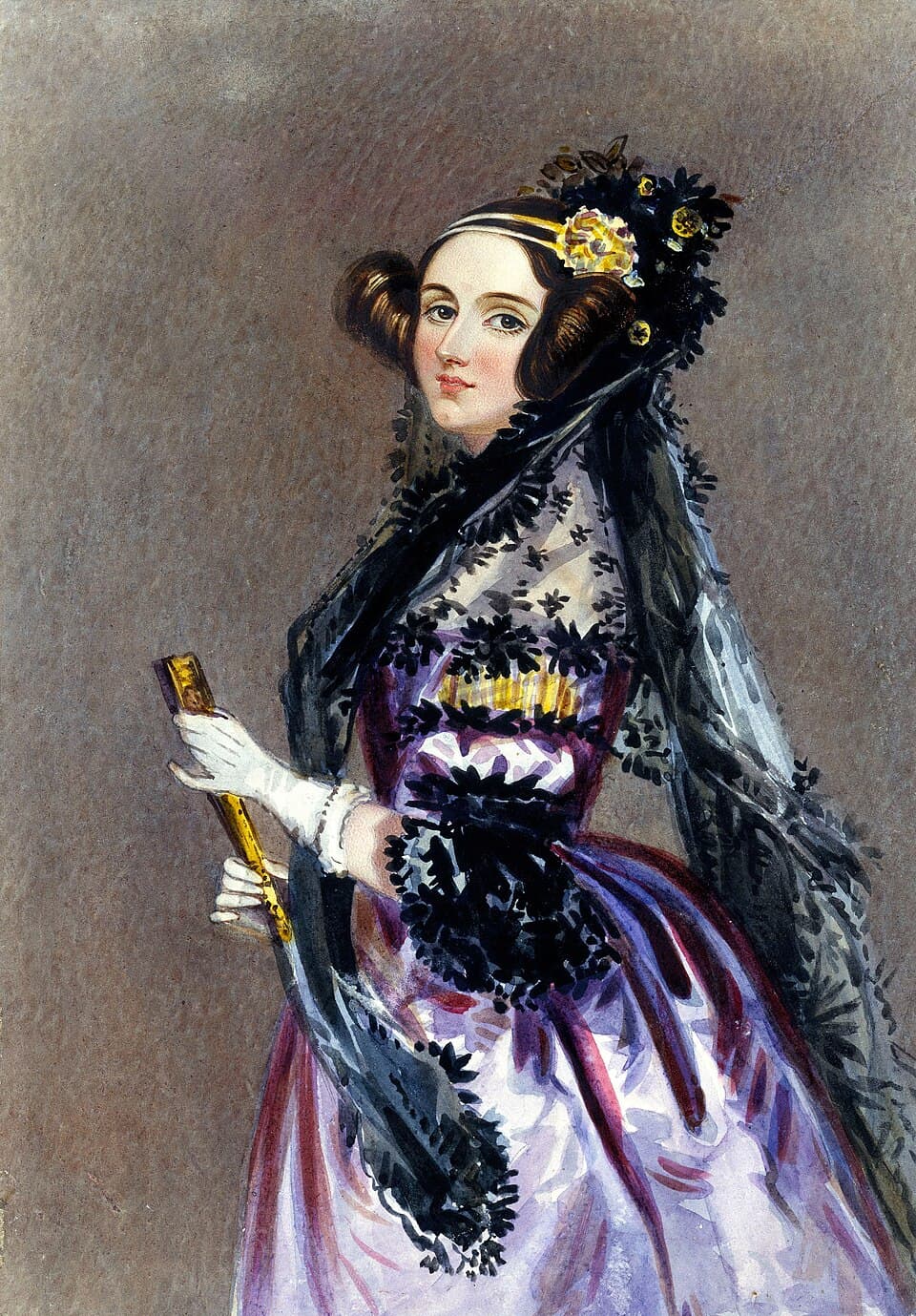
London, a winter afternoon in 1843. In her Mayfair study, cluttered with sheets covered in symbolic notation, the Countess of Lovelace has just completed her famous Notes. The pen still wet, she agrees to speak of this machine that, she says, weaves numbers as a loom weaves flowers.
—You were born on Christmas Day, daughter of Lord Byron. How does one go from a poet's blood to pure mathematics?
I came into the world on Christmas Day 1815, and my father, the poet, had already packed his bags. I never knew him. My mother, Annabella Milbanke, feared above all that I might inherit that fever of imagination which had, she believed, ruined him. So they gave me geometry as a lullaby, demonstrations instead of verses. I will say plainly that I have my own way of learning: I need a rigid exactness in the statement of a principle, but once the difficulty is clearly posed, I grasp it with a quickness that surprises even myself. They wanted to tear me away from poetry; they only taught me to seek it elsewhere.
They wanted to tear me away from poetry; they only taught me to seek it elsewhere.
—What remains of the poet in you, in this so austere discipline?
Everything, I believe. I call it my scientific poetry: imagination and rigor are not enemies, they marry each other. When I study a theorem, I almost hear a music — a sequence of relations, a harmony of symbols that follow one another. My mother had delivered me to pure mathematics as one locks up a bird; I found a sky there. My mentor by correspondence, Augustus De Morgan, wrote to me that my aptitude surpassed the ordinary for a student. You see, my father sought the infinite in a rhyme; I pursue it in an equation. The material differs, the vertigo is the same.
—You were seventeen when you met Charles Babbage. What happened that evening?
It was in 1833, in one of those London salons where they display the curiosities of the day as one shows a wild beast. Babbage had brought a fragment of his machine, and while the other ladies marveled as if at a conjuring trick, I saw something else: gears that thought in numbers. Few people in that room understood what they were looking at. I understood that this mechanism was not a perfected clock, but a beginning. Our correspondence never ceased until my end; nearly twenty years of exchanges on the principles of this Analytical Engine that so few dared to take seriously.
The others saw a perfected clock; I saw a beginning.
—You are sometimes presented as Babbage's docile assistant. Does that annoy you?
Deeply. I owe him much, but I am nobody's secretary. When he took it upon himself to alter one of my Notes without warning me, I wrote to him bluntly: I am always ready to correct myself what needs correcting, but I cannot endure another person to meddle with my sentences. My words are mine, as my reasoning is mine. Babbage conceived the Analytical Engine, granted; but it was I who saw what it could become, and it is in my annotations — three times longer than the memoir I was translating — that this vision is recorded.
I cannot endure another person to meddle with my sentences.
—Your Notes of 1843 contain what is considered the first algorithm in history. How would you describe it?
I wanted to prove, not promise. Many claimed the Analytical Engine could calculate; I preferred to show how. So I set down, step by step, the complete procedure for producing the Bernoulli numbers — an ordered sequence of operations that the machine would execute without a human hand intervening between two results. I arranged it in a table, a diagram where each operation calls the next, like the punched cards of the Jacquard loom command the passage of threads. The Analytical Engine weaves algebraic patterns just as the Jacquard loom weaves flowers and leaves. It is, I believe, the first time a score has been written for an instrument that does not yet exist.
The first score written for an instrument that does not yet exist.
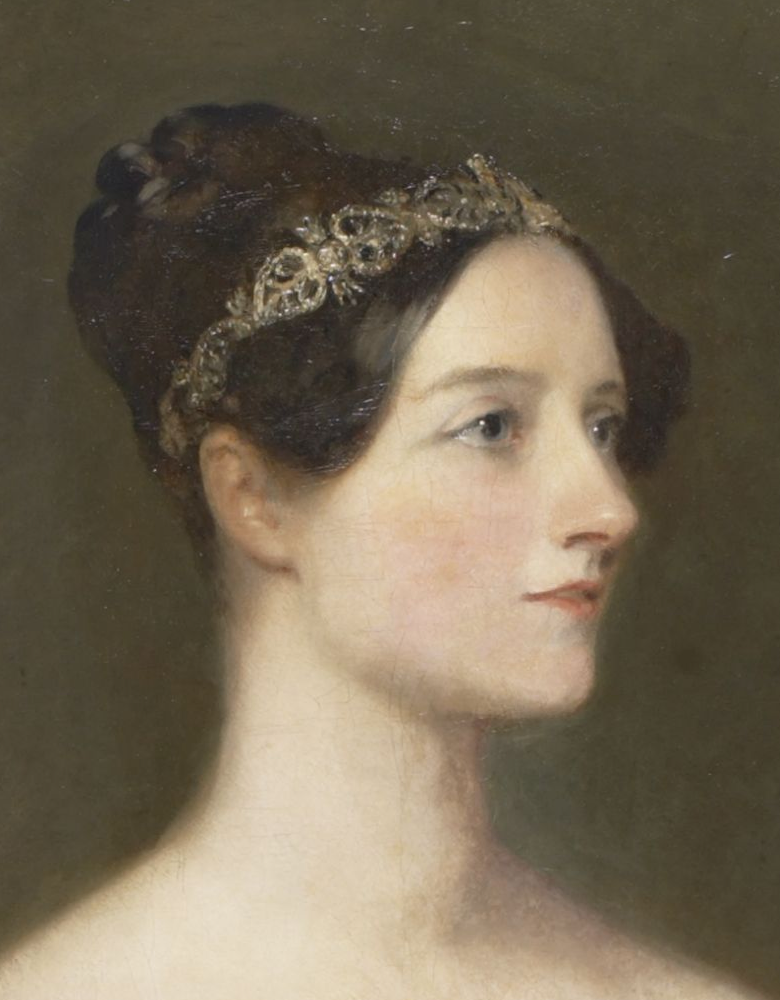
—This comparison with the loom, where did it come from?
From the Jacquard loom itself, which all industrial England knows. Think of those punched cards that dictate to the mechanical weaver where to place each silk thread: they encode a design without touching the threads. The Analytical Engine proceeds in the same way, except it does not embroider foliage; it chains arithmetic operations. It is this filiation, from shuttle to calculation, that made me glimpse the essential: a machine that manipulates symbols according to rules is no longer limited to numbers. I dare write that a new language, vast and powerful, will be born from all this for the uses of men. Silk today, algebra tomorrow, and after?
Silk today, algebra tomorrow, and after?
—Many imagine that your machine could one day think. What do you say to that?
I insist on dispelling this illusion, and I wrote it in black and white in my Notes. The Analytical Engine has no pretensions whatever to originate anything. It can follow an analysis, execute what we order it to execute; but it has no power of anticipating any truth or relation that we have not first conceived. It does not create: it unfolds. Therein, paradoxically, lies its greatness — not to ape the human mind, but to extend its reach. To confuse the tool with intelligence would be to believe that the pen writes the poem. The machine calculates; it is still we who think.
The machine calculates; it is still we who think.
—If the machine creates nothing, what fascinates you so much about manipulating these symbols?
Precisely that it frees the symbol from number. As long as one spoke of calculation, one imagined additions, columns of digits. But symbolic notation knows no such limit: if one could represent by signs the relations between sounds, I tell you, the machine would compose music of unsuspected complexity and breadth. It is a notation that intoxicates me, not a cash register. That is why I speak of scientific poetry: behind the gearwork, there is a universal grammar of operations, and whoever masters it holds an instrument whose uses we have not yet fully guessed.
It is a notation that intoxicates me, not a cash register.
—A learned woman in Victorian London, a countess received in salons: how do you reconcile these two worlds?
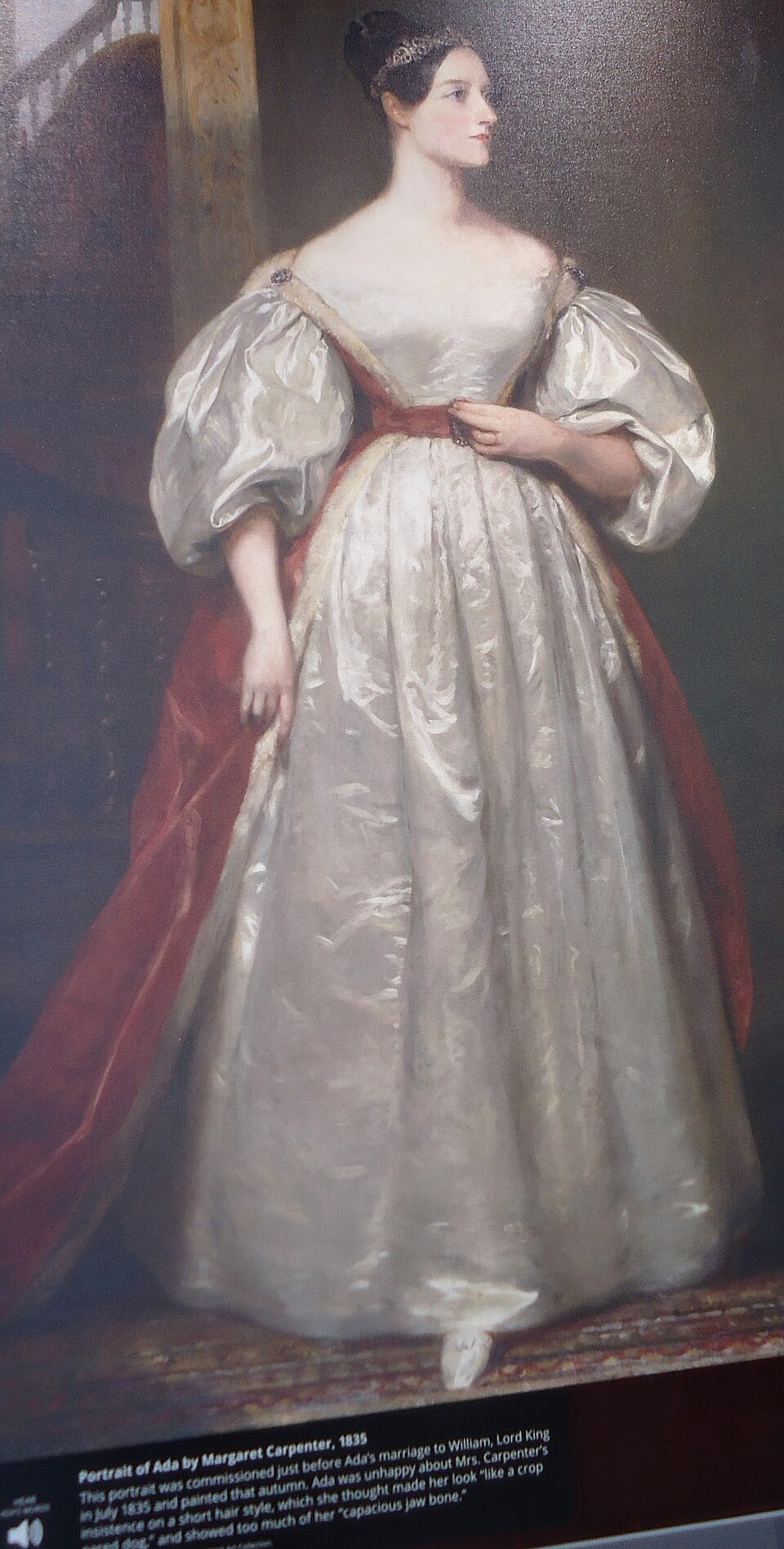
With a weariness that few imagine. In the evening, they want me as Countess of Lovelace in the salons of Mayfair, in a long dress and corset, chatting about everything except mathematics — for a lady who calculates is considered an eccentric. By day, I shut myself away with my manuscripts and my pen, correcting notations until my eyes ache. They willingly grant a woman of my rank the Royal Society as they grant her a concert: as a visitor, never as a scholar. I had to conquer every inch of intellectual ground against the very idea that a woman could occupy it. My health, already, paid the price.
A lady who calculates is considered an eccentric.
—You are often ill, yet tireless in your work. Where do you draw this obstinacy?
From the conviction of having seen something that my century was not ready to look at. My body betrays me — ailments follow one another and I know my constitution is fragile — but the mind, it, does not suffer any slackening. I correspond with the best geometers of my time, I rework my demonstrations at night when the house sleeps. If I exhaust myself over these Notes, it is because a work demands that one burn for it. I sometimes have the feeling of writing for readers who are not yet born; let them read me in a century, and only then will they know what this machine could carry.
I sometimes write for readers who are not yet born.
This imaginary interview was generated by artificial intelligence from sources documented in Ada Lovelace's profile. It dramatises what the figure might have said based on what we know about them, but does not constitute attested historical testimony. For primary sources and factual documentation, refer to the full profile.