Imaginary interview with Alan Turing
by Charactorium · Alan Turing (1912 — 1954) · Sciences · 6 min read
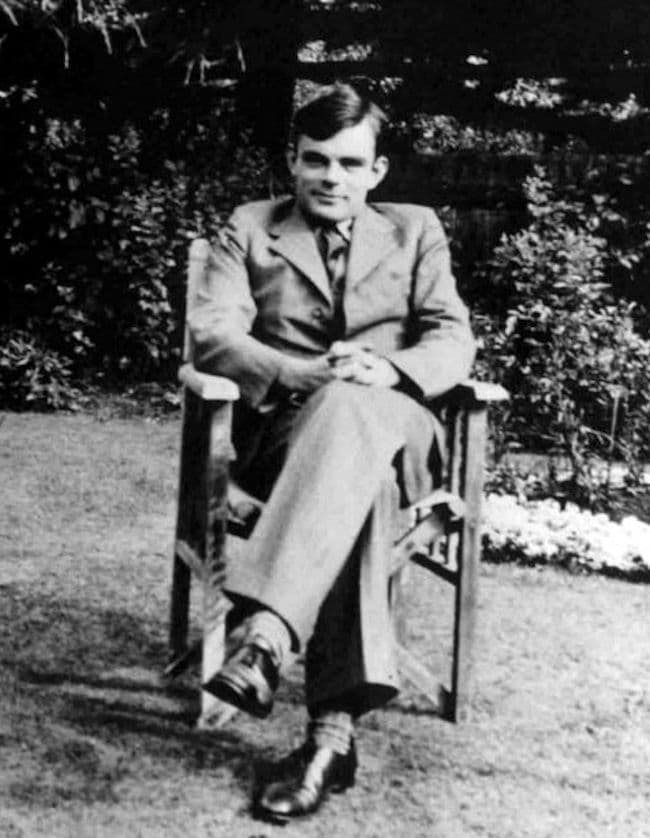
Manchester, winter 1953. In an office cluttered with papers covered in equations and circuit diagrams, a man in a crumpled tweed jacket receives us, still out of breath from a morning run. Alan Turing speaks quickly, in bursts, as if chasing several thoughts at once.
—How did you come up with the idea for that theoretical machine your colleagues now call the 'Turing machine'?
It all started with an annoying question posed by logicians: is there a mechanical procedure to decide the truth of a mathematical statement? In 1936, at Cambridge, I stopped imagining abstract symbols and imagined a man. A man sitting in front of a paper tape divided into squares, writing and erasing signs according to strict rules, without ever needing to understand what he is doing. That is what computing is: not a flash of genius, but a sequence of operations so simple that a limited machine could execute them. On Computable Numbers was born from that very concrete image. I then understood that a single machine, well designed, could imitate all others — a universal machine. Computability was no longer a metaphysical mystery: it was a matter of tape, squares, and patience.
Computing is not a flash of genius, but a sequence of operations so simple that a limited machine could execute them.
—Why did you choose the humble image of a paper tape rather than a purely mathematical formalism?
Because I distrust formalisms that float above reality. The logicians of my time piled up symbols without ever asking: what would someone actually do to solve this? Yet a human computer — in the sense that 'computer' was then used for a person who computes — works with a sheet of paper, a pencil, limited attention. He sees only one square at a time. So I replaced the sheet with an infinite tape divided into squares, and attention with a finite number of internal states. This bareness is a strength: if I can describe computation with so little, then I have captured its essence. The most rudimentary machine becomes the most faithful mirror of logical thought.
—Do you remember your arrival at Bletchley Park in 1939?
We were sent to a Victorian mansion in Buckinghamshire, surrounded by wooden huts where we shivered in winter. The Government Code and Cypher School gathered there mathematicians, chess players, linguists — a cabinet of human curiosities in the service of secrecy. Facing us, the German Enigma machine: a keyboard, rotors, and such a dizzying number of settings that attacking message by message was madness. But there was a flaw: no letter could ever be enciphered as itself. It was on this tiny detail, and on the lazy repetitions of enemy operators, that we built our method. I slept little, I ran between the huts, and I felt that every lost hour was paid in lives, out there, on the Atlantic convoys.
I felt that every lost hour was paid in lives, out there, on the Atlantic convoys.
—How did that electromechanical 'Bombe' you designed work?
The Bombe was not a brain; it was a methodical beast. Imagine a humming cabinet of rotating drums that imitated several Enigma machines working in concert. Rather than searching for the right key, I programmed it to eliminate the wrong ones: we fed it a crib, a fragment of guessed plaintext — often a weather report repeated every morning — and the machine ran through combinations until a logical contradiction collapsed on its own. When the drums stopped, we had a possible setting. This logic of reasoning by contradiction, mechanized and accelerated, accomplished in hours what a man would not have finished in a thousand years. It has been said that this shortened the war by two years. I dare not count, but I know the weight of a day gained.
The Bombe was not a brain; it was a methodical beast.
—In 1950, you asked a scandalous question: can a machine think?
Yes, and I maintain that the question, posed that way, hardly makes sense. 'Can machines think?' — we would first have to agree on machine and think, and we would get bogged down in definitions. So I proposed, in Computing Machinery and Intelligence, to replace this question with a game. An interrogator converses in writing with two hidden interlocutors, one human, one machine, and tries to guess which is which. If the machine deceives him as often as a human would, by what right do we deny it the word 'think'? What will later be called the Turing Test shifts the debate from the mystery of consciousness to something observable: conversation. I do not claim that the machine feels; I only say that at a certain point, our obstinacy in believing it stupid becomes a superstition.
At a certain point, our obstinacy in believing the machine stupid becomes a superstition.
—Many object that a machine will never do anything other than what it has been ordered to do. What do you answer them?
That is my favorite objection, because it backfires. They tell me: a machine can do nothing new, it follows its program. But what is a child, if not a mechanism that we instruct? I rather imagine a machine that we would not finish in advance: we would give it rudiments, then educate it, by rewards and punishments, like a clumsy tutor with a student. It would accept information from outside and act on the world in return. Its very mistakes would be fruitful — a machine that never errs cannot be intelligent, because it learns nothing. Artificial intelligence, if we want that name, will not be a perfect clock but a stubborn schoolboy. That is why I find this objection so reassuring: it describes exactly the limit I intend to cross.
A machine that never errs cannot be intelligent, because it learns nothing.
—You are also discovered bent over leopard spots and flower spirals. What attracts you to the living world?
The wonder of a child, no doubt, mixed with the stubbornness of a mathematician. How does a ball of identical, perfectly symmetrical cells suddenly decide to have a head and a tail, stripes, fingers? Last year, in The Chemical Basis of Morphogenesis, I put forward the idea that chemical substances — I call them morphogens — reacting with each other and diffusing through a tissue suffice to explain these forms. An instability, a tiny imbalance between two substances that feed and inhibit each other, and lo and behold, concentration waves set in: bands, spots, spirals. Order does not descend from heaven or from a hidden plan; it emerges from chemical disorder, through the sole laws of reaction and diffusion. It is the same obsession that has gripped me all along: showing that the complex arises from the simple.
Order does not descend from heaven; it emerges from chemical disorder.
—Is it not strange to move from breaking secret codes to the formation of an animal's spots?
Not at all — it is always the same hunt. At Bletchley Park, I sought the hidden pattern beneath the apparent chaos of Enigma messages; confronted with a flower, I seek the hidden rule beneath the apparent chaos of its growth. In both cases, we suspect that a blind, local mechanism — an operator repeating its formula, a molecule diffusing step by step — generates a global order that no one designed. My machines at Manchester, the Mark 1 and those that will follow, serve me precisely for this: I have them simulate those diffusion equations, calculate step by step how two morphogens would end up drawing their stripes. The computer becomes my theoretical microscope. I do not change profession when I leave codes for corollas; I hunt the same thing, the pattern beneath the randomness.
I always hunt the same thing: the hidden pattern beneath the apparent chaos.
—Your colleagues say you run long distances, sometimes to work. Where does this passion come from?
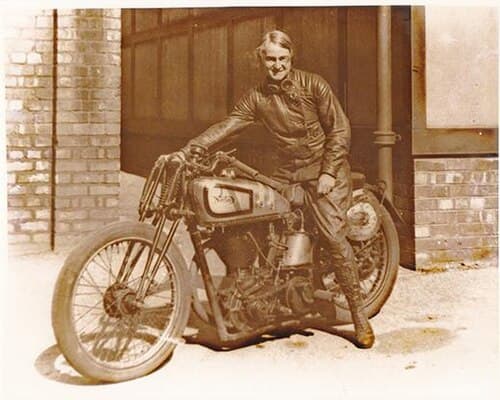
From the need to clear my head, I think, and from a certain impatience of the body. I am often described as scruffy — disheveled hair, wrinkled jacket, little regard for a tie — and that is true: appearance matters less to me than running. I run marathon distances, on the road, in all weathers, and I sometimes reach a meeting on foot faster than a colleague by bus. It is said, and I do not deny it, that I have thought of the Games. But it is not the medal that attracts me. When I run, the equations stop harassing me; they arrange themselves on their own, like the drums of the Bombe that finally stop on the right setting. Physical fatigue is the only silence I know.
When I run, the equations stop harassing me; they arrange themselves on their own.
—This indifference to conventions is found throughout your way of life. Is it a deliberate choice?
Deliberate, no; accepted, yes. I live simply, in modest lodgings cluttered with books and papers, I eat what rationing allows — bread, eggs, tea — without making a fuss. Socializing bores me; dinners where one talks for the sake of talking seem a waste of time I would rather give to a problem. I know this disconcerts, that my frankness passes for rudeness. But I have never been able to feign interest I do not feel, nor hide the interest that consumes me. A good part of my life was spent in the secrecy imposed by the war; perhaps I acquired the habit of wearing, in the rest of it, no useless mask. The truth of a problem, like that of a man, benefits from being laid bare.
The truth of a problem, like that of a man, benefits from being laid bare.

This imaginary interview was generated by artificial intelligence from sources documented in Alan Turing's profile. It dramatises what the figure might have said based on what we know about them, but does not constitute attested historical testimony. For primary sources and factual documentation, refer to the full profile.