Kids interview Alexandra David-Néel
by Charactorium · Alexandra David-Néel (1868 — 1969) · Exploration · 4 min read
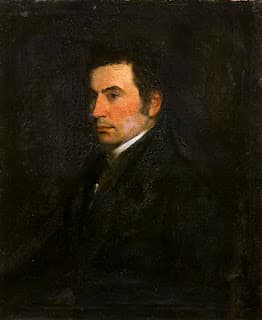
Two sixth-graders visit the house-museum in Digne-les-Bains during their school field trip. A tiny old lady, bundled up, waits for them in her study full of books. She crossed Tibet on foot—and she is happy to tell all.
—Is it true that before being an explorer, you sang at the opera?
Yes, my child! Imagine a young woman on stage, in costume, singing in front of a full house. That was me. But when evening came, I returned to a proper married life, and I was bored to death. Do you know what was expected of a lady in my time? Keep house, entertain, keep quiet. In 1911, I packed my bags and left for Asia. They called it women's emancipation—the right for a woman to decide her own life. Many thought I was crazy. I, for once, felt like I could breathe.
A woman too has the right to decide her own life.
—How old were you when you left? Were you afraid?
I was forty-two, already a grown lady, not a kid! And yes, I was afraid, of course. Imagine: you leave alone for countries whose roads, winters, and dangers you don't know. But fear, you see, is no reason to stay. It's just a traveling companion. My immersion in Asia lasted fourteen years, from 1911 to 1925: India, Japan, China, Tibet. Fourteen years away from home. When you truly want something, you learn to walk alongside your fear.
Fear is no reason to stay. It's a traveling companion.
—They say you spoke thirteen languages? How do you do that?
Thirteen, yes! But not all at once, don't worry. You learn one, then another, like climbing a mountain step by step. Tibetan, Sanskrit, Chinese... Why so much work? Because the monks kept sacred texts that no one else could read. Imagine a library whose key you don't have: language is the key. In Sikkim, in the Himalayas, I studied for hours. And one day, I could speak directly with the lamas—the Tibetan monks—without anyone translating between us. What joy that was!
A language is the key to a library you couldn't open.
—What was the point of talking with Tibetan monks?
To understand, my child! When you speak someone's language, they open their door and their heart. I even exchanged letters with a very great sage, the Panchen Lama, one of Tibet's spiritual leaders. Other Western travelers stayed outside: they watched without understanding, like in front of a closed window. I got to enter. It was from these exchanges that my book Mystics and Magicians of Tibet was born, in 1929. You see, I didn't just want to see Tibet from afar. I wanted to listen to it from within.
I didn't want to see Tibet from afar. I wanted to listen to it from within.
—Is it true you disguised yourself as a beggar to go to Lhasa?
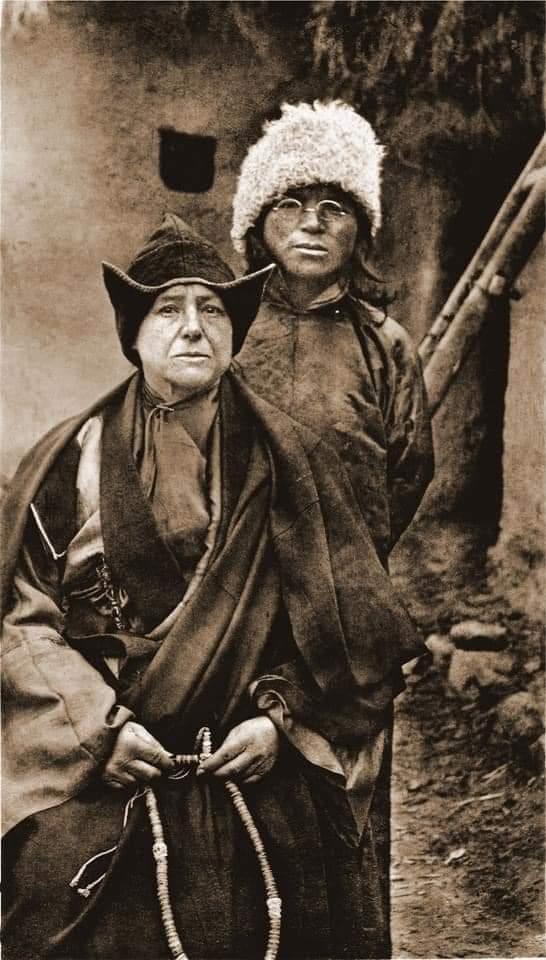
Absolutely! Lhasa is Tibet's sacred city, its capital. At the time, it was forbidden to foreigners—you just couldn't enter. So, what to do? I blackened my face, put on old Tibetan clothes, and became a poor beggar among others. With my adopted son Yongden, we walked over two thousand kilometers, on foot, across frozen mountains. Imagine the cold biting your fingers, day after day. In 1924, I entered Lhasa. The first Western woman to set foot there.
To enter the forbidden city, I made myself a beggar.

—Weren't you cold and hungry all the time while walking?
Oh yes! The cold especially. Imagine passes so high that the air is thin, and snow everywhere. To avoid starving, we ate like the locals: tsampa, a roasted barley flour mixed with butter tea. It sounds strange, but it warms you and sticks to your ribs. At night, we slept wherever we could. And no one could guess who I was: a beggar speaking too good Tibetan would stand out! I told the whole story in A Parisian's Journey to Lhasa, published in 1927.
Butter tea and barley flour: that's what kept me going.
—In the morning, during your travels, what did you do first?
I got up before dawn, when everything is still silent. And I meditated. Do you know what meditation is? It's sitting quietly, closing your eyes, calming your mind like calming troubled water. I often held my mala between my fingers—a rosary of one hundred and eight beads, which Buddhists slide one by one. Many explorers looked at Buddhism from afar, like a spectacle. I practiced it for real. It's very different, you see: you only truly understand something when you agree to live it yourself.
You only truly understand something when you agree to live it.
—Did you really believe in Buddhism or were you just studying it?
Both, my child, and that's the whole secret. I was an orientalist—a specialist studying Asian languages and religions. But I was not just a scholar behind a desk. Buddhism, I carried it within me. I wrote The Buddhism of the Buddha in 1936 to explain these ideas to people who knew nothing about them. Imagine someone who wants to tell you about a country: do you believe someone who only read about it, or someone who lived there for years? I wanted to be the one who lived there.
I was not just a scholar behind a desk: these ideas, I lived them.
—And afterwards, did you return to Tibet? What had it become?
This breaks my heart. In 1950, China entered Tibet, and the doors closed again. The country I had crossed on foot, free, became inaccessible. Imagine you love a place with all your being, and you're told: you'll never go back. That's what I experienced. So I settled here, in Digne-les-Bains, in my house full of memories and books. I kept writing, passing on. If I could no longer walk to Tibet, I could still keep it alive on paper.
If I could no longer walk to Tibet, I kept it alive on paper.
—Is it true that at a hundred years old you still wanted to travel again?
Absolutely! At a hundred, I renewed my passport. People looked at me as if I were crazy. An old lady wanting to leave again for Asia! But you see, the desire to discover doesn't age, even when the body tires. I lived to be one hundred and one, here in Digne-les-Bains, surrounded by my notebooks and maps. My last wish never changed: to learn more, see more, understand more. You who are young, keep that flame safe. It's what makes you truly alive, whether twelve or a hundred.
The desire to discover doesn't age, even when the body tires.
This imaginary interview was generated by artificial intelligence from sources documented in Alexandra David-Néel's profile. It dramatises what the figure might have said based on what we know about them, but does not constitute attested historical testimony. For primary sources and factual documentation, refer to the full profile.