Imaginary dialogue between Telle Whitney and Anita Borg
by Charactorium · Anita Borg (1949 — 2003) · Technology · Society · 6 min read
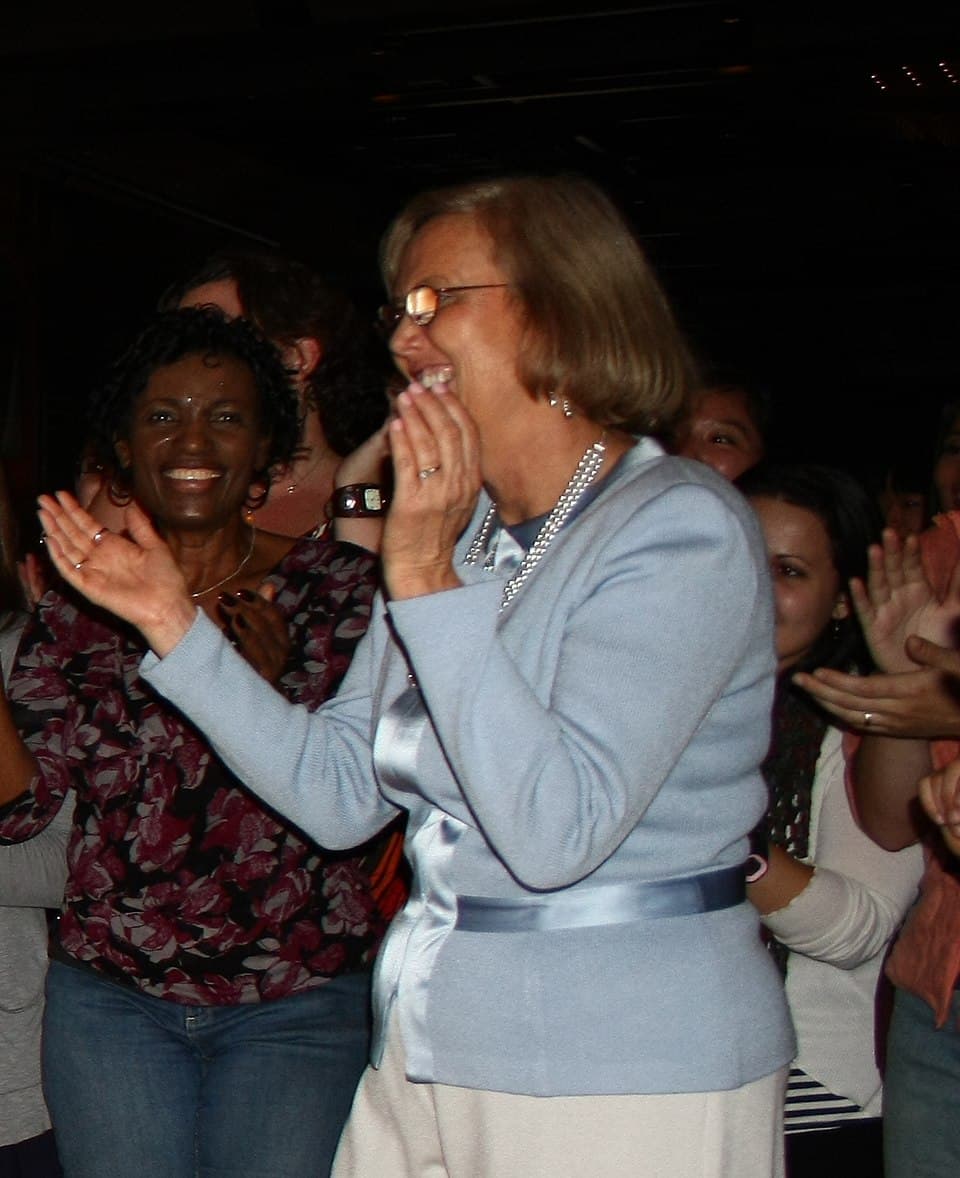
It is in the sunny patio of Xerox PARC, in Palo Alto, that Telle Whitney meets Anita Borg one afternoon in 1999. On the table, an open laptop still displays the day's messages from the Systers list, while the hum of workstations filters through the laboratory's half-open door. The two women have known each other for years — together they founded the Grace Hopper Celebration five years earlier. Telle comes without an official tape recorder, only with the desire to have her friend tell the story of the path that led her here.
—Anita, even before we knew each other, you launched Systers in 1987. Tell me: how did a simple email list grow so large?
You know, Telle, at first it was nothing — a few women I knew, a modem, my machine connected to ARPANET, well before the Web. I just wanted us to be able to talk to each other, because we were so few, so scattered, often alone in our teams. I wrote a very simple message: a place to share our experiences and support each other. And then one woman invited another, who knew three, who worked on three continents. In a few years, we were thousands. What moved me was not the technology — a mailing list is trivial — it was discovering how many women were waiting for exactly that without daring to say it. An electronic thread did what no institution had done: made us visible to one another.
A mailing list is trivial; what moved me was how many women were waiting for that without daring to say it.
—You defended your thesis at NYU in 1981, after your years in Europe. Were you, at that time, the person who would one day advocate as you do today?
Not yet, no. I was already over thirty when I got that doctorate, and I had spent years elsewhere, especially in Germany. My thesis was on computer memory systems — something very technical, very dry. But this zigzag path, this late entry into scientific circles, taught me in my own skin what it means not to belong by default. I was made to feel, often, that I was not the expected student. I didn't have the words to say it then. It was only later, thinking back on all that, that I understood: diversity is not a moral ornament, it is a condition of collective intelligence. My European detour gave me that conviction even before I had a cause.
This zigzag path taught me in my own skin what it means not to belong by default.
—You talk about those Unix workstations at DEC, in Maynard. What did those machines represent in your daily life as a researcher back then?
They were my whole world, Telle. I spent my days in front of those workstations, measuring, optimizing memory performance, green screen on black background, the clatter of a dot-matrix printer in the background. At Digital Equipment Corporation, in the 1980s, I was often the only woman in the machine room. I truly loved those workstations — the rigor they impose, the relentless logic that never lies. But it was also there, between compilations, that I began to build ties with other women in the field, exchanging our numbers, our frustrations. The machine fed me intellectually; the women around it fed me humanly. I eventually understood that you couldn't separate the two. A technical career without a human network, for a woman, was programmed isolation.
The machine fed me intellectually; the women around it fed me humanly.
—Remember 1994, when we imagined together the first Grace Hopper Celebration. We were only about fifty. Did you really believe in it that day?
You who were there, Telle, know that we had no idea what we were doing! We were a small handful in that room, and I remember wondering if we weren't ridiculous to dare such a name, that of Grace Hopper, that immense Navy programmer. But that was precisely the idea: to give women too isolated a place to count themselves, to see each other, to recognize themselves as a force. I saw researchers cry with relief when they discovered they were not alone. Fifty people, and already that electricity in the air. What we sowed there, you and I, went far beyond a conference. We were building living proof: that women in computing existed in numbers, and that it was enough to offer them a common roof for them to rise up.
I saw researchers cry with relief when they discovered they were not alone.
—Why did you insist that this conference bear the name of Grace Hopper, rather than remain an anonymous gathering of professionals?
Because names matter, Telle. A young woman entering computing looks for figures to hold onto, and the official narrative offers her almost none. Grace Hopper had programmed for the U.S. Navy, popularized the word debugging, opened paths that few knew. By giving her name to our gathering, we refused the erasure of women from the history of our professions. We were saying: here is our lineage, here are our foremothers. This is not a sentimental detail. When a student sees thousands of women gathered under the name of a pioneer, she suddenly understands that she belongs to a story, not an exception. She stops thinking of herself as an intruder. A name is an open door to a lineage — and we desperately needed that.
By giving her name to our gathering, we refused the erasure of women from the history of our professions.
—Right here, at Xerox PARC, you founded in 1997 your Institute for Women and Technology. What mission did you give it when you created it?
Two movements in one, Telle. On one hand, increase women's impact on technology; on the other, increase technology's positive impact on the lives of women worldwide. The two are inseparable. People sometimes ask me why I persist, why not let things evolve on their own. But nothing evolves by itself! It takes research, partnerships with companies, training programs, relentless will. Founding this institute, here, in the heart of Silicon Valley, was planting a flag in the middle of the kingdom that ignored us. I didn't want a grievance club. I wanted an instrument that produces data, evidence, measurable results — something no executive could brush aside by saying it's just feelings.
Founding this institute in the heart of Silicon Valley was planting a flag in the middle of the kingdom that ignored us.
—You advocate a numerical goal: 50/50 parity by 2020. Many find you too ambitious. Why cling to that number?
Because a number commits, Telle, where a pious wish commits to nothing. If I say "we should have more women," no one moves. If I say "half, by 2020," then everyone must ask where they stand and what they plan to do. I often use the mirror image: technology must reflect all of humanity that uses it. But if it is shaped by homogeneous teams, it will only meet the needs of half the world. This is not primarily a question of justice — it is a question of effectiveness, of innovation. Studies show it: diverse teams find better solutions. Technology designed without women is simply incomplete technology. So yes, I aim for 2020, and I know it is audacious. But aiming low is already giving up.
Technology designed without women is simply incomplete technology.
—Faced with an executive who tells you this is all about good conscience, what argument do you keep to convince them?
I don't talk to them about morality, Telle — I talk to them about their product and their market. Software designed by a uniform group will carry the blind spots of that group. It will forget uses, needs, contexts that no one in the room has ever experienced. That is a design flaw, not a matter of opinion. When I sit at those roundtables, at MIT or elsewhere, I lay out the numbers: diverse teams produce better solutions, period. The executive who ignores this leaves intelligence on the table and cedes ground to competitors. I am not asking for charity for women. I am asking that we stop wasting half the available brains. Curiously, the effectiveness argument opens doors that the justice argument left closed for twenty years.
I am not asking for charity for women. I am asking that we stop wasting half the available brains.
—When you see Systers today bringing together women from such distant time zones, what do you feel deep down, you who started it alone?
A kind of happy dizziness, Telle. In the morning, I open my inbox and find questions posted overnight by an engineer in India, a reply sent from Germany, advice from Australia. One woman asks how to negotiate her salary, ten others answer within hours. This network never sleeps, because the sun always rises somewhere on one of us. I simply plugged in a modem one day in 1987; the women themselves did the rest. I take no personal glory from it — I am only the one who held the door open. The most beautiful thing is knowing that a young woman somewhere, tonight, feels less alone because others, whom she will never meet, are watching with her.
This network never sleeps, because the sun always rises somewhere on one of us.
—We talk about the future, but I sense you are rushed, as if time is running out. Why this urgency, Anita?
Because time is always short, Telle, for a fight that should already be won. Every year that passes without progress is a generation of little girls learning, without ever being told, that these machines are not for them. I cannot accept that. There is so much to do — the institute to grow, the conference to expand, companies to convince one by one. I work as if tomorrow were not guaranteed, because deep down, none of our tomorrows ever is. What I wish is that what we have built together does not depend on a single person. Promise me that if one day I slow down, you will hold the helm. This movement must be stronger than any one of us, otherwise it will have been just a flash in the pan.
I work as if tomorrow were not guaranteed, because deep down, none of our tomorrows ever is.
This imaginary interview was generated by artificial intelligence from sources documented in Anita Borg's profile. It dramatises what the figure might have said based on what we know about them, but does not constitute attested historical testimony. For primary sources and factual documentation, refer to the full profile.