Imaginary interview with Anne Frank
by Charactorium · Anne Frank (1929 — 1945) · Literature · 5 min read
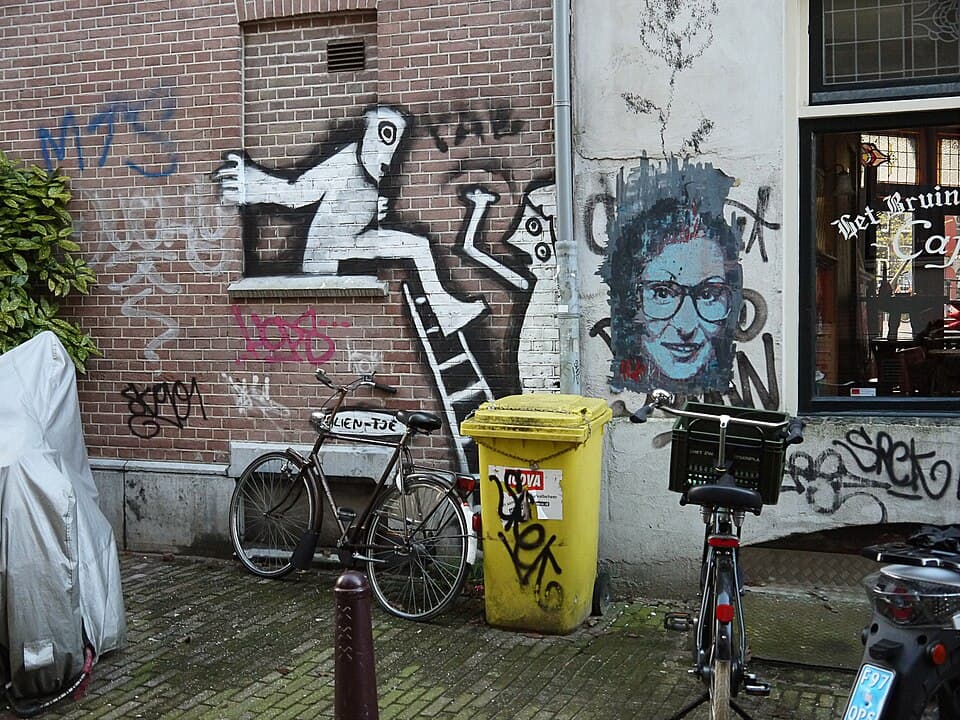
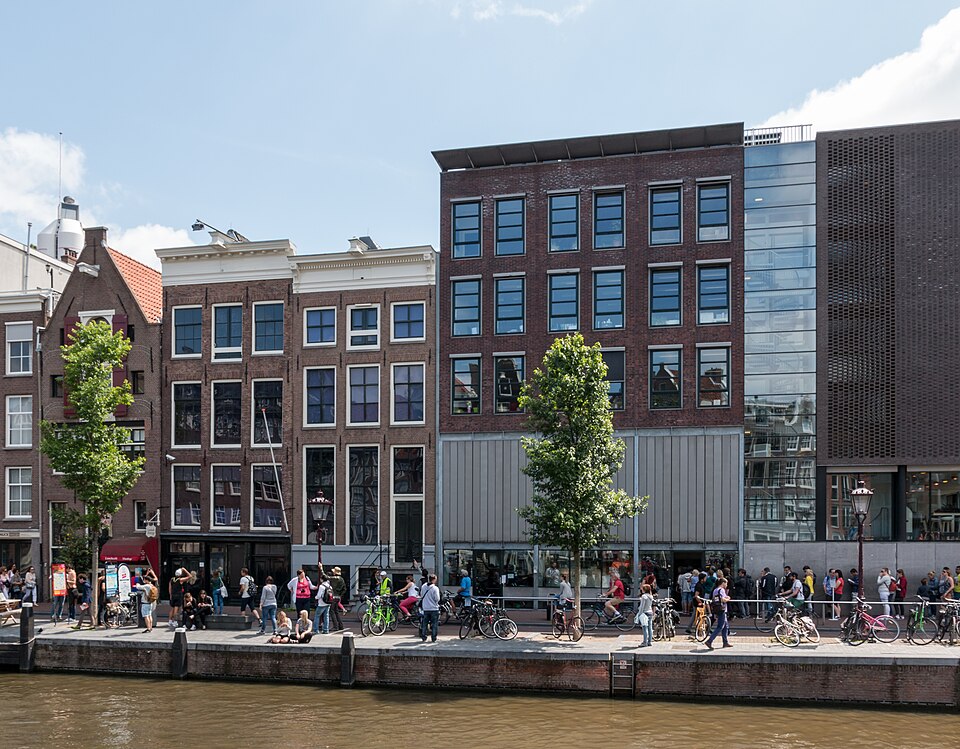
Amsterdam, summer 1944. At the back of a commercial building at 263 Prinsengracht, behind a bookcase that swings on its hinges, a fifteen-year-old girl receives us in the dimness of a room with blacked-out windows. A red-and-white checked notebook on her lap, Anne Frank agrees to speak—in a low voice, for downstairs, in the warehouse, the employees are still working.
—This checked notebook you hold—how did it come into your life?
On June 12, 1942, for my thirteenth birthday, I was given this notebook covered in red-and-white checked fabric, fastened with a little lock. I loved it at once, more than all my other presents. Very soon, I no longer treated this notebook as a mere object: I gave it a name, Kitty, and began writing to it as to a friend to whom you confide everything, without shame or reserve. It's strange, perhaps, that a girl should speak like this to blank pages. But I had no one to tell these things to—neither my fears nor my anger at Mother. Kitty never interrupted me. She listened.
—Before you disappeared into this hiding place, what made you go underground?
Before the Annex, there was the yellow star. From spring 1942, all Jews over six had to sew it prominently on their clothing—a piece of cloth that marked you in the street as a being apart. Then the bans fell, one after another: no more trams, no more cinemas, curfew, compulsory Jewish school. But what precipitated everything was the summons received by my sister Margot—a paper ordering her to report for supposed work in Germany. We knew what that word hid. The next day, we went into hiding. You don't answer such a summons; you disappear.
You don't answer such a summons; you disappear.
—What does it mean, concretely, to live hidden day after day in these few rooms?
Our hiding place had an iron rule: from eight-thirty to five-thirty, when the warehouse employees worked just below us, the slightest sound could betray us. A cough, a sneeze, a flush pulled at the wrong moment, and everything would collapse. Imagine eight people holding their breath for entire days, walking in socks, not daring even to fill a pan. I learned to read lying on my bed, to study without making a chair creak. Silence, which should be a rest, became an exhausting discipline. In the evening, when the workers finally left, it was as if the whole house began to breathe again with us.
—How is this hiding place arranged, and how do eight people fit into such a small space?
The door to our refuge is concealed behind a swinging bookcase, built by one of our protectors: you swing it open to enter, and from the outside it's just an ordinary shelf full of files. Behind it, a few cramped rooms on two levels, the windows permanently blacked out so that no light, no gaze can filter through. I share my room with Fritz Pfeffer, a dentist who arrived after us—a methodical man with whom I have to negotiate every hour spent writing at the little table. Living eight people in such a small space means learning the nerves of others by heart. You end up recognizing the sound of every step on the stairs.
—What does writing bring you, in such confinement?
Writing has never been a girl's pastime for me. Here, it is a deliverance. I confided to Kitty one day in April 1944: "When I write, I get rid of everything, my sorrow disappears, my courage is reborn. But here's the essential question: will I ever be able to write something great, will I ever become a journalist or a writer?" That's exactly how I feel. When quarrels break out at the table, when fear grips my throat, I go up to my pages and the storm calms. Paper does not judge. It takes everything—shame, rage, ridiculous hope—and gives it back to me lightened.
—How did you go from a simple diary to the idea of a real book?
In March 1944, we heard on the radio an appeal from Gerrit Bolkestein, the Minister of Education in exile in London. He asked that diaries, letters, ordinary testimonies be preserved, because history, he said, is not written only with official documents. This appeal moved me deeply. I suddenly understood that my checked notebook could be much more than a girl's secret. So I began to reread, correct, and copy my pages onto loose sheets, choosing my words more carefully, as one prepares a book. I already had the title in mind: Het Achterhuis, the House Behind.
My checked notebook could be much more than a girl's secret.
—You don't only write your diary, it is said—what are these other pages?
The diary is not everything. I also write tales, fables, little childhood memories—my stories, as I call them, which I dream of one day collecting in a volume. It is another way to escape these walls. I have a fountain pen to which I am very attached, faithful companion of all these pages. The day it fell into the stove and burned, I mourned it almost like a friend; I even wrote a little funeral oration in its honor. That may seem trivial to you. But when you own almost nothing, the smallest object becomes precious, and a pen that runs across the paper is already a little bit of freedom.
—What connection do you keep with the outside world from your hiding place?
Our only link to the outside is the radio set. In the evening, after the employees leave, we go down to the office and huddle around the set to listen to the BBC and Radio Orange, the voice of the free Netherlands. Every bulletin is scrutinized, weighed, commented on for hours: where are the Allies, how many more kilometers, how many more months. It is hope canned, distributed in tiny doses. Hearing that voice reminds us that beyond the blacked-out windows, another world continues to exist—and that it has perhaps not entirely forgotten us.
It is hope canned, distributed in tiny doses.
—What does the announcement of the Normandy landings mean to you?
On June 6, 1944, the radio announced the Normandy landings. What a day! In the Annex, we hardly dared to believe it—liberation, at last, seemed possible, perhaps even before the end of the year. That summer, despite the fear that never leaves us, I keep a strange confidence. I wrote in mid-July: "I see the world gradually being turned into a desert, I hear the approaching thunder that will destroy everything, I feel the suffering of millions of people, and yet, when I look at the sky, I think everything will be all right." I truly believe that. Even hidden, I have never stopped looking at the sky.
—How would you describe the fear that accompanies this hidden existence?
We are what in Dutch are called onderduikers—literally those who "dive under water", who erase themselves from the surface of the world to escape the roundups. We are not alone: thousands of Jews are hiding like this in the Netherlands, with strangers, in attics, farms, back rooms. At night, I hear in my mind the sound of boots, the razzia that carries off entire families to Westerbork, then eastward. Living hidden is living suspended: grateful to still be here, and eaten up with guilt for being so when so many others are not. The fear of being discovered never fully falls asleep.
This imaginary interview was generated by artificial intelligence from sources documented in Anne Frank's profile. It dramatises what the figure might have said based on what we know about them, but does not constitute attested historical testimony. For primary sources and factual documentation, refer to the full profile.