Imaginary dialogue between Mahinda and Ashoka
by Charactorium · Ashoka (303 av. J.-C. — 231 av. J.-C.) · Politics · Spirituality · 6 min read
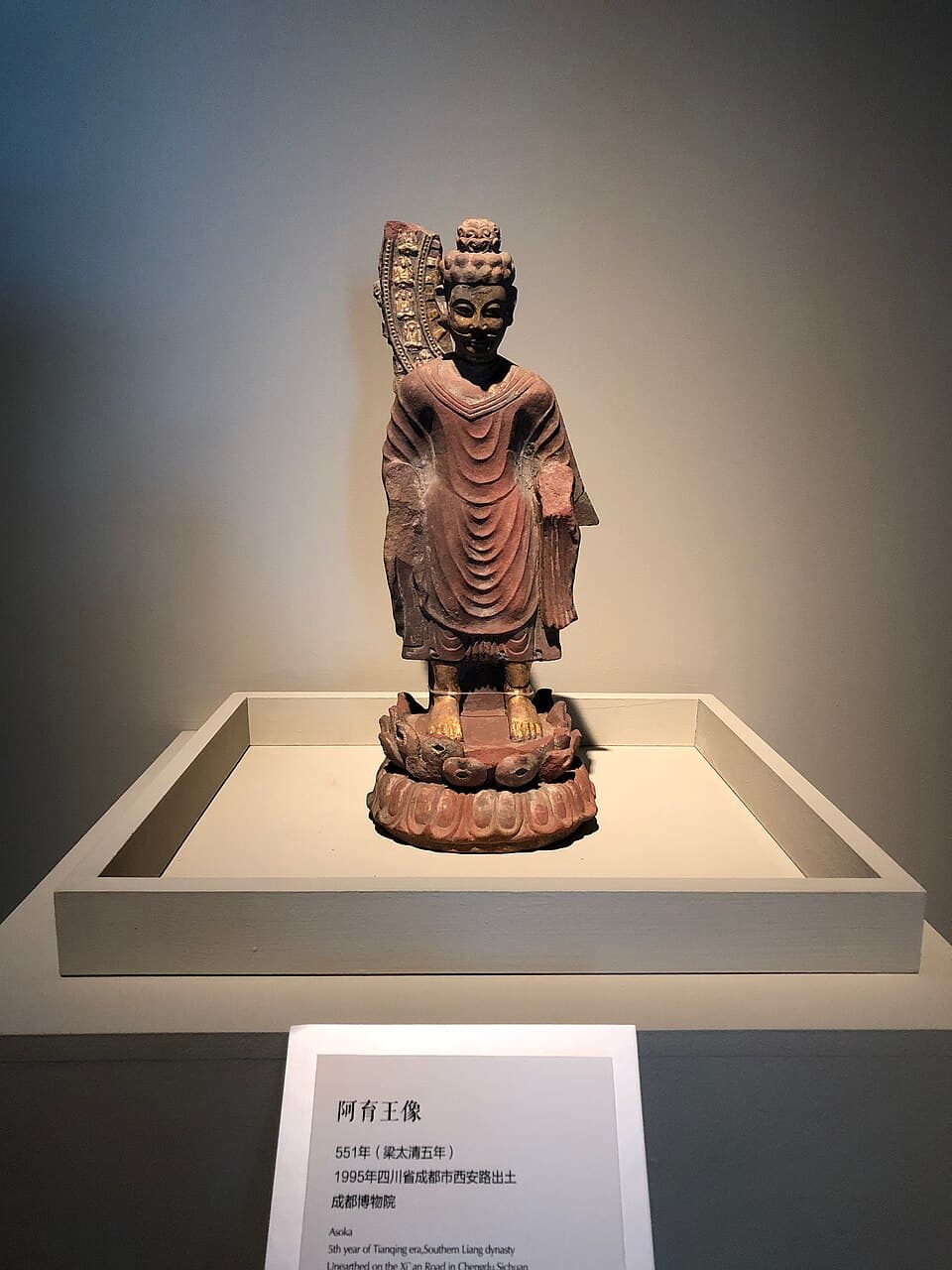
It is under the trees of Pataliputra, in a palace courtyard where the air smells of sandalwood and hot dust, that Mahinda meets his father. It is around 250 BCE, a few days before the son leaves to carry the word of the Buddha across the seas, to the island of Lanka. The old emperor still holds a report from a mahamatra in his hand. The son, for his part, comes not as a prince: he comes as a monk, seeking from his father's mouth the source of that Dharma which he is about to spread far and wide.
—Father, even before I took the robe, you spoke to me of Kalinga. When you returned from that war, what had changed in you?
You were a child, Mahinda, but you saw my face on my return. I had won. Kalinga was mine. And yet I had the dead counted: a hundred thousand fallen by the sword, a hundred and fifty thousand torn from their land, and many more carried off by the hunger and disease that follow armies. I walked on that field and I understood that every brahmin, every father of a family, every beast slain weighed upon me. Victory tasted of ashes. I had that remorse carved in stone so that no one after me would believe that a king should take pride in such carnage. That day, the war drum fell silent, and I heard something else.
I had won, and yet victory tasted of ashes.
—You could have kept that turmoil to yourself. Why make it a way of governing the whole empire?
Because a remorse that stays in a man's heart dies with him, my son. I wanted it to become law. I appointed mahamatras of the Dharma, officials who do not collect taxes but watch over the welfare of the people, over prisoners, over the elderly. I had wells dug along the roads, trees planted for shade and healing herbs, care opened for men and for beasts. And I bound myself: let them come to me at any hour, whether I am eating or resting in my chambers. A king's debt to his subjects knows no hour of rest. Conquering lands was easy; conquering the trust of a people demands every day of my life.
Conquering lands was easy; conquering the trust of a people demands every day of my life.
—You who chose stone rather than parchment: why carve your word so high, so hard, in the rock of cliffs?
Parchment burns, Mahinda, men's memory unravels. But a polished rock, a sandstone pillar twelve cubits high, lasts as long as the mountain. I wanted the farmer of the South and the merchant of the Northwest to be able to stop and hear the Dharma in his own language. So I had it written in Prakrit, in Brahmi, and as far as the borders where Greek and Aramaic are spoken: at Kandahar, they call me King Piodasses. These are not war orders or tribute lists. They are words of virtue that even my great-grandsons can read. Stone does not lie and does not forget. My voice wanted to cross time better than my body ever will.
Parchment burns; but a sandstone pillar lasts as long as the mountain.
—Some at court whisper that an emperor should not speak like a moral teacher. Did that ever stay your hand?
What do they whisper, my son? That a king must be silent and strike? I struck, and you know what came of it. No, it never stayed my hand. A sovereign who does not teach virtue only fills his granaries. In my edicts I do not hide behind a title: I confess my past faults, I state my duty, I name compassion, generosity, truthfulness. Some see weakness in that; I see the only strength that does not turn against the one who wields it. Courtiers want feasts and hunts; I prefer conversations with sages and monks at dusk. Let them judge me: the stone will keep my words, not their whispers.
A sovereign who does not teach virtue only fills his granaries.
—In a few days, I leave for the island of Lanka with the word of the Buddha. Father, why send the Dharma so far from our borders?
Because truth has no border, Mahinda, and because I entrust you with what is dearest to me. A kingdom ends where its rivers end; the Dharma can cross seas. I have sent messengers to the Greek kings of the West, to the mountains of the North, and now my own son and daughter Sanghamitta will carry the Law to the South. What the sword never could take, a gentle word will win. Go, and do not go as a conqueror: go as a servant. Teach by example, heal, listen, despise no belief of the islands. The day a fisherman of Lanka understands ahimsa better than my generals, I will have won my only true victory.
What the sword never could take, a gentle word will win.
—It is said that you had the ancient stupas reopened to disperse the relics of the Blessed One. Was that not disturbing their rest?
So it is said, and I do not deny it. The Buddha's relics slept in a few monuments, guarded by few. What use is a lamp hidden under a bushel? I wanted a stupa to rise in every region of the subcontinent, so that the humblest villager could circumambulate a sacred place without crossing an empire. That was not disturbing a rest, Mahinda, but multiplying a presence. At Sanchi, you have seen the great dome I had erected: it calls pilgrims as honey calls bees. I built so that faith would not be the privilege of capitals. What is buried enlightens no one; what is shared illuminates a world.
What use is a lamp hidden under a bushel?
—You have reduced the animals slaughtered at your own table. Is that really an emperor counting his peacocks, or a man seeking to wash himself clean?
Both, my son, for a king is also a man. Once thousands of beasts were killed daily for the palace kitchens; today, barely a few, and I hope one day none at all. How can I order ahimsa to my people if blood flows freely under my own roof? The virtue one does not practice at home is but hollow stone-speech. I have given up great hunts, meat feasts, entertainments that rejoice in death. My table is of rice, lentils, fruits, and milk. It is not penance, Mahinda: it is consistency. A master who preaches gentleness must first eat it.
The virtue one does not practice at home is but hollow stone-speech.
—At Sarnath, where the Blessed One first turned the wheel, you erected a pillar crowned with four lions. What did you mean by that image?
You know that place, Mahinda: it is where the Law first set forth in the world. I wanted to mark that land with a sign that speaks without words. Four lions, back to back, gazing in the four directions: for the Dharma must roar toward all horizons, not by threat but by voice. Beneath them, the wheel — the Dharmachakra — that which the Buddha set turning and which no one can stop. The lion speaks the strength of the just; the wheel speaks the Law that advances. I placed this crowning above my edicts so that the passerby might understand at a glance: here rules not fear, but the order of good. A king can have lions carved; only the Dharma makes them peaceful.
The lion speaks the strength of the just; the wheel speaks the Law that advances.
—Do you truly believe that these stones, these wheels, and these lions will still speak when we are no longer here to explain them?
I hope so more than anything, my son. A man dies, a dynasty crumbles — I am not foolish enough to believe the Mauryas eternal. But a well-chosen symbol outlives the one who erected it. The wheel turns without me; the lion watches without my hand. If in a thousand years a child stops before one of my pillars and asks his father what this wheel means, then the Dharma will have crossed the wall of time. I did not carve my name for my glory — the Beloved of the Gods is but a title — but so that the Law might have a stone face when voices have fallen silent. Go, carry that face to Lanka: it is my share of eternity that I place in your hands.
A man dies, a dynasty crumbles; but a well-chosen symbol outlives the one who erected it.
—One last thing, father, before my departure: if Kalinga had not broken your heart, would you ever have known the Buddha?
That is a monk's question, Mahinda, and it stings me. The truth, I believe, is that Kalinga did not give me the Dharma: it opened my eyes to see it. The Law was there before my war, as the sun is there before the blind man recovers sight. I had to touch the depth of blood to lift my head toward something else. I do not bless that war — never — but I cannot deny that it was the threshold of my conversion. That is why I tell you: do not wait, you, for a disaster to teach you compassion. You have the chance to leave already enlightened. Carry that light where it is not yet known. And think sometimes of this old king who had to lose everything to learn to want nothing.
Kalinga did not give me the Dharma: it opened my eyes to see it.
Read further
This imaginary interview was generated by artificial intelligence from sources documented in Ashoka's profile. It dramatises what the figure might have said based on what we know about them, but does not constitute attested historical testimony. For primary sources and factual documentation, refer to the full profile.