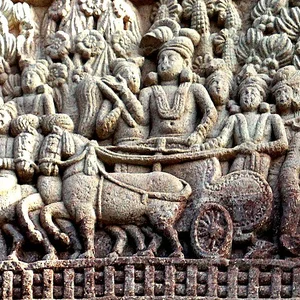

Ashoka was the third emperor of the Maurya dynasty, ruling over nearly the entire Indian subcontinent in the 3rd century BC. Shaken by the carnage of the Kalinga War, he converted to Buddhism and promoted a policy of non-violence (ahimsa) and tolerance. He spread his moral precepts, carved on stone edicts, throughout his empire.
Frequently asked questions
Famous Quotes
« All religions should reside everywhere, for all of them desire self-control and purity of heart.»
Key Facts
- Ascends the Maurya throne around 268 BC, succeeding his father Bindusara and his grandfather Chandragupta
- Leads the bloody conquest of Kalinga around 261 BC, which prompts his conversion to Buddhism
- Has the Edicts of Ashoka carved on rocks and pillars, the first major written records of India
- Promotes the dharma, ahimsa (non-violence) and sends Buddhist missions as far as Ceylon and the Hellenistic world
- Dies around 232 BC; his empire declines after his death
Works & Achievements
Corpus of moral inscriptions carved into stone across the empire, the first major written sources of Indian history and the foundation of the policy of Dharma.
A masterpiece of Mauryan sculpture, whose capital has become the national emblem of India.
A program of government founded on non-violence, religious tolerance and the welfare of subjects, implemented by special officials (Dharma mahamatras).
Dispatch of missions to Sri Lanka, Central Asia and the Hellenistic kingdoms, transforming a regional religion into a great universal religion.
Massive building of Buddhist monuments, including the Great Stupa of Sanchi, shaping the religious landscape of the subcontinent.
Creation of wells, plantations of medicinal trees, and hospitals for both humans and animals along the roads, according to his own edicts.
Anecdotes
After the Kalinga War (around 261 BC), Ashoka was reportedly horrified by the 100,000 dead and 150,000 deportees mentioned in his own edicts. This trauma drove him to renounce wars of conquest: it is one of the rare cases in history where a victorious emperor publicly expresses his remorse.
Ashoka had his moral messages engraved on rocks and polished stone pillars throughout his empire, some standing over 12 metres tall. These edicts, composed in several languages and alphabets (Prakrit, Greek, Aramaic), are among the oldest deciphered written texts of India.
The famous capital with four lions from Sarnath, which crowned one of his pillars, became the official emblem of the Republic of India in 1950. The wheel (*chakra*) depicted on it now adorns the Indian flag.
According to Buddhist tradition, Ashoka had the ancient stupas opened to redistribute the Buddha's relics among 84,000 new monuments, thereby spreading Buddhism throughout the subcontinent and beyond.
Ashoka sent Buddhist missionaries as far as Sri Lanka — where his son Mahinda and his daughter Sanghamitta are said to have introduced the religion — and even to the Hellenistic kingdoms, making him one of the first great international propagators of a religion.
Primary Sources
One hundred and fifty thousand people were deported, one hundred thousand were killed and many times that number perished. Immediately after the annexation of Kalinga, the Beloved of the Gods felt a deep remorse.
The Dharma is good. But what is the Dharma? It is having few faults and many good deeds, compassion, generosity, truthfulness and purity.
Everywhere the Beloved of the Gods has provided two kinds of care: care for people and care for animals. He has had medicinal herbs planted and wells dug along the roads.
Ten years having passed, King Piodasses (Ashoka) made known piety to men; and from that time on he made men more pious, and everything thrives throughout the whole earth.
Key Places
Capital of the Mauryan Empire and seat of Ashoka's power, one of the largest cities in the ancient world.
Kingdom conquered by Ashoka in a deadly war that brought about his moral conversion and his embrace of Buddhism.
A site near Varanasi where the Buddha gave his first sermon; here Ashoka erected the famous pillar with its lion capital.
A site home to the Great Stupa, one of the oldest stone Buddhist monuments, whose initial construction is attributed to Ashoka.
The northwestern frontier of the empire, where a bilingual Greco-Aramaic edict of Ashoka was discovered, testifying to the reach of his influence.
The Buddha's birthplace, in present-day Nepal, which Ashoka visited on pilgrimage and marked with a commemorative pillar.
Typical Objects
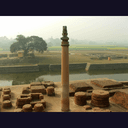
Monolithic column of polished sandstone, 12 to 15 metres tall, erected throughout the empire to carry the engraved edicts. Topped with a capital adorned with symbolic animals.
📷 CC BY-SA 2.5 · Wikimedia Commons ↗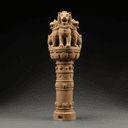
Sandstone sculpture crowning a pillar, depicting four lions standing back to back on a base adorned with wheels and animals. It has become the emblem of modern India.
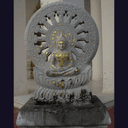
A many-spoked wheel symbolising the Buddhist law set in motion by the Buddha. Ashoka made it the emblem of his moral policy.
📷 CC BY-SA 3.0 · Wikimedia Commons ↗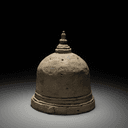
A hemispherical monument housing relics of the Buddha. Tradition credits Ashoka with the construction of thousands of stupas, including the one at Sanchi.
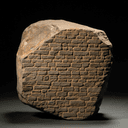
A moral inscription cut directly into the stone of cliffs and boulders, written in Prakrit and sometimes in Greek or Aramaic so that it could be read by all the peoples of the empire.
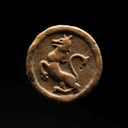
Insignia of imperial power used to authenticate the decrees and the centralised administration of the Mauryan Empire.
School Curriculum
Vocabulary & Tags
Key Vocabulary
Daily Life
Morning
The emperor began his day early, receiving reports from his spies and officials. His edicts state that he wanted to be available at any hour for the affairs of state, even during his meals or in his private quarters.
Afternoon
The afternoon was devoted to administering the vast empire: audiences, judicial decisions, and supervision of the mahamatras tasked with looking after the welfare of the people. He sometimes inspected the public works ordered in his name.
Evening
The evening might be devoted to meditation and the study of Buddhist teachings, or to conversations with monks and sages. Ashoka encouraged moral reflection rather than the traditional entertainments of the court.
Food
After his conversion, Ashoka greatly reduced the consumption of meat at court: one edict declares that only a few animals were still slaughtered for the royal kitchen, compared to thousands before. The diet was based on rice, lentils, vegetables, fruits, and dairy products.
Clothing
The emperor wore rich fabrics of cotton and silk, adorned with gold jewelry and precious stones reflecting his rank. After his conversion, tradition describes him adopting a certain plainness inspired by Buddhist ideals.
Housing
Ashoka resided in the vast palace of Pataliputra, described by Greek visitors as a marvel of wood and stone, surrounded by gardens, pools, and ornately carved columns rivaling the palaces of Persia.
Historical Timeline
Period Vocabulary
Liens externes & ressources
Références
Œuvres
Édits sur rocher et sur pilier
vers 257-243 av. J.-C.
Pilier aux lions de Sârnâth
vers 243 av. J.-C.
Politique du Dharma
vers 260-231 av. J.-C.
Diffusion internationale du bouddhisme
vers 250 av. J.-C.
Construction de stupas et monastères
vers 250 av. J.-C.
Œuvres de bienfaisance publique
vers 257 av. J.-C.
Rechercher
See also
Related Characters
Akhenaten
1400 av. J.-C. — 1335 av. J.-C.
Amenhotep III
1399 av. J.-C. — 1350 av. J.-C.
Amon
663 av. J.-C. — 639 av. J.-C.

Aten
Ay
1400 av. J.-C. — 1400 av. J.-C.
Bathsheba
1008 av. J.-C. — 936 av. J.-C.