Imaginary interview with Ashoka
by Charactorium · Ashoka (303 av. J.-C. — 231 av. J.-C.) · Politics · Spirituality · 6 min read
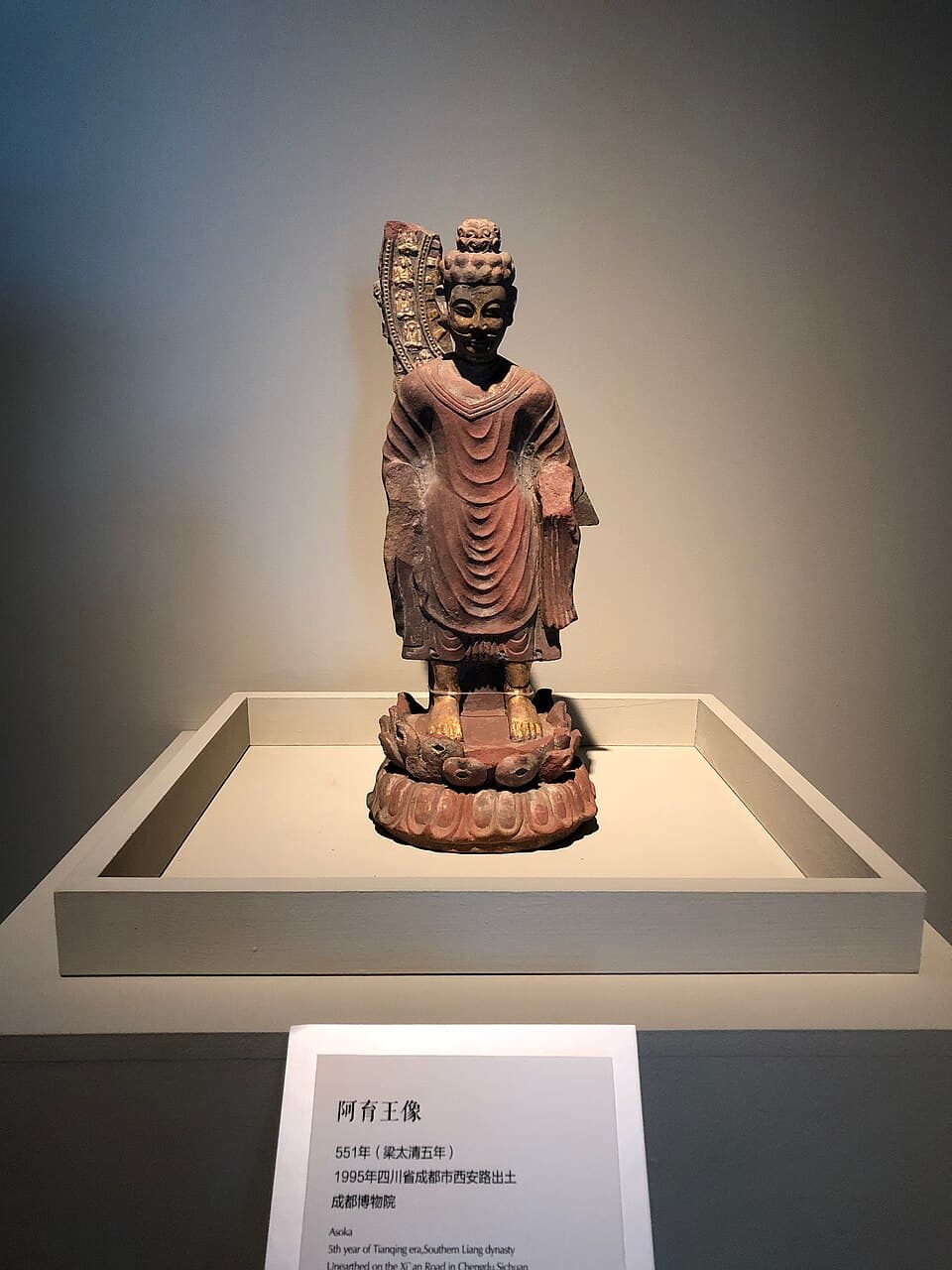
Under a canopy of unbleached cotton, in a pavilion of the palace of Pataliputra, the emperor receives visitors at the hour when the Ganges turns ochre. A polished sandstone pillar waits nearby, ready to be inscribed with his words. He speaks softly, in the voice of a man who has counted his dead.
—How do you keep the memory of the Kalinga War?
I do not keep it: it keeps me. Around my eighth year of reign, I sought to subdue Kalinga, that proud coast that refused my seal. The victory was total, and that is my shame. I had the very numbers carved in rock, without softening them: 'One hundred and fifty thousand people were deported, one hundred thousand were killed, and many times that number perished.' A king usually hides his charnel houses; I carved mine in stone so that no one, myself first, would forget them. On the evening of the surrender, walking among the stretchers, I understood that a victor can be the most vanquished of all. That day, the Beloved of the Gods — the title I give myself — ceased to believe in the war drum.
A victor can be the most vanquished of all.
—What, in that carnage, turned your life around?
The silence afterward. On the banks of the Daya, the brahmins wept, children sought hands that no longer existed, and the vultures knew no remorse. I had this phrase inscribed, which I never read without trembling: 'Immediately after the annexation of Kalinga, the Beloved of the Gods felt profound remorse.' An emperor who confesses his regret on the stone of his empire — my advisors saw it as weakness. I saw it as my only real victory. From this wound was born Dharma — not as a doctrine learned in a monastery, but as a debt contracted toward a hundred thousand dead. Since then, I conquer only hearts, and that conquest sheds no blood.
Since then, I conquer only hearts.
—Why did you choose stone rather than parchment to carry your word?
Because parchment flatters scribes and dies with them, while rock speaks to plowmen for a thousand years. I had columns of sandstone raised, twelve cubits high, polished like a mirror, to the very borders where my voice no longer reaches. On one of them I had my most naked question engraved: 'Dharma is good. But what is Dharma? It is having few faults and many good deeds, compassion, generosity, truthfulness, and purity.' I do not write for scholars, but for the cowherd who stops in the shade of the pillar and deciphers in Prakrit, in his own speech, what his king expects of him. A law that cannot be read is but a palace whim.
Rock speaks to plowmen for a thousand years.
—Your edicts speak Greek and Aramaic as far as the western marches. Why so many languages?
Because an empire has but one heart but a thousand mouths. At Kandahar, at the gates of the kingdoms still ruled by Alexander's heirs, my words were useless in Brahmi: there they think in Greek, they pray in Aramaic. So I had the same piety carved in two scripts on a single rock. The Greeks call me Piodasses, and the inscription says that after ten years 'he made men more pious, and everything prospers on the whole earth.' That is my pride: that a merchant from Bactria and a fisherman from Kalinga read, each in his own language, the same demand for virtue. Dharma knows no boundary of skin or throat; to confine it to a single alphabet would betray it.
An empire has but one heart but a thousand mouths.
—What does sending missions as far as Sri Lanka and beyond represent for you?
The admission that a hoarded treasure rots, and a given treasure multiplies. I sent to Sri Lanka what I held dearest: my own children, Mahinda and Sanghamitta. She carried across the waters a sapling from the tree under which the Buddha attained enlightenment. A father who loves his son keeps him; a king who loves the world sends him far away. I dispatched other messengers to the Greek kings, not to levy tribute, but to offer a way of living without harming. Some will call me ambitious; I reply that a sovereign's ambition should never aim higher than the good of the living. What Chandragupta my grandfather had taken by war elephant, I returned through gentle speech.
A hoarded treasure rots, a given treasure multiplies.
—It is said that you reopened the ancient tombs of the Buddha. What were you seeking?
To bring the sacred closer to the people. Tradition says I had the first stupas opened to share the relics of the Blessed One into countless new stupas — they speak of eighty-four thousand, a number that above all conveys the immensity of my desire. At Sanchi, I had a dome of brick and stone raised where the poor pilgrim could circumambulate the relic as the wheel turns around its hub. Some saw hubris; I saw a geography of peace. Let each province have its place of contemplation, let no one have to cross the empire to bow before calm. Building tombs that soothe rather than fortresses that threaten: that is how a king redeems his former battles.
A geography of peace, not fortresses that threaten.
—How does one concretely govern an empire in the name of non-violence?
Through the well more than the spear. I had this inscribed, and I hold it as a vow: 'Everywhere the Beloved of the Gods has provided two kinds of medical care: care for humans and care for animals. He has had medicinal herbs planted and wells dug along the roads.' An empire is measured not by the extent of its conquests but by the shade of its trees and the coolness of its cisterns. I had banyans planted for the traveler, healing plants sown, shelters built for the weary beast. Ahimsa is not a prayer murmured with closed eyes: it is a well dug at the right distance, a road that lets no one die of thirst. That is my policy, as tangible as water.
An empire is measured by the shade of its trees.
—You instituted officials of a new kind. What role did you entrust to them?
I appointed Dharma mahamatras, inspectors not of taxes but of consciences. Their duty is not to count sacks of rice, but to ensure that an old person is assisted, that a prisoner is treated humanely, that no sect oppresses another. I myself remain available at all hours: let the people's affairs be brought to me during my meal, in my chambers, even in the garden — a subject's urgency does not observe my schedule. I also reduced the slaughter in my own kitchen; where thousands of animals fell daily for my table, almost none remain. A king who demands gentleness from his officials without first imposing it on his own plate is but a crowned hypocrite.
Inspectors not of taxes, but of consciences.
—Tell us about the pillar you erected at Sarnath, where the Buddha first preached.
Sarnath is not a place chosen lightly: it is where the Blessed One once set in motion the Wheel of Dharma through his first sermon. I had to plant there a sign worthy of that awakening. I crowned my column with four back-to-back lions, facing the four horizons, as if right speech must roar toward all points of the sky. Beneath them, the wheel — the Dharmachakra — reminds that true sovereignty does not crush, it rolls and advances. A lion, among kings, symbolizes devouring strength; I wanted mine to roar a strength that protects. The polished sandstone reflects the sun of Sarnath as my reign, I hope, will reflect a little of the Buddha's light.
True sovereignty does not crush, it rolls and advances.
—If you imagined being read in a century, what would you want to remain of you?
Not my provinces, which will fall apart like anything built by hands — I already sense that my Maurya dynasty will not last long after me. What I wish to leave is the silent roar of my lions and the slow turning of the wheel carved beneath them. That in a thousand years a people, whoever they may be, look at this capital of Sarnath and read there not the pride of a conqueror, but the repentance of a man who preferred the well to the spear. If a single king, reading me, renounces a single war, then the hundred thousand dead of Kalinga will not have cried out in vain. I do not ask to be admired; I ask that I be followed on that path.
Let them read there not the pride of a conqueror, but the repentance of a man.
Read further
This imaginary interview was generated by artificial intelligence from sources documented in Ashoka's profile. It dramatises what the figure might have said based on what we know about them, but does not constitute attested historical testimony. For primary sources and factual documentation, refer to the full profile.