Kids interview Ashoka
by Charactorium · Ashoka (303 av. J.-C. — 231 av. J.-C.) · Politics · Spirituality · 5 min read
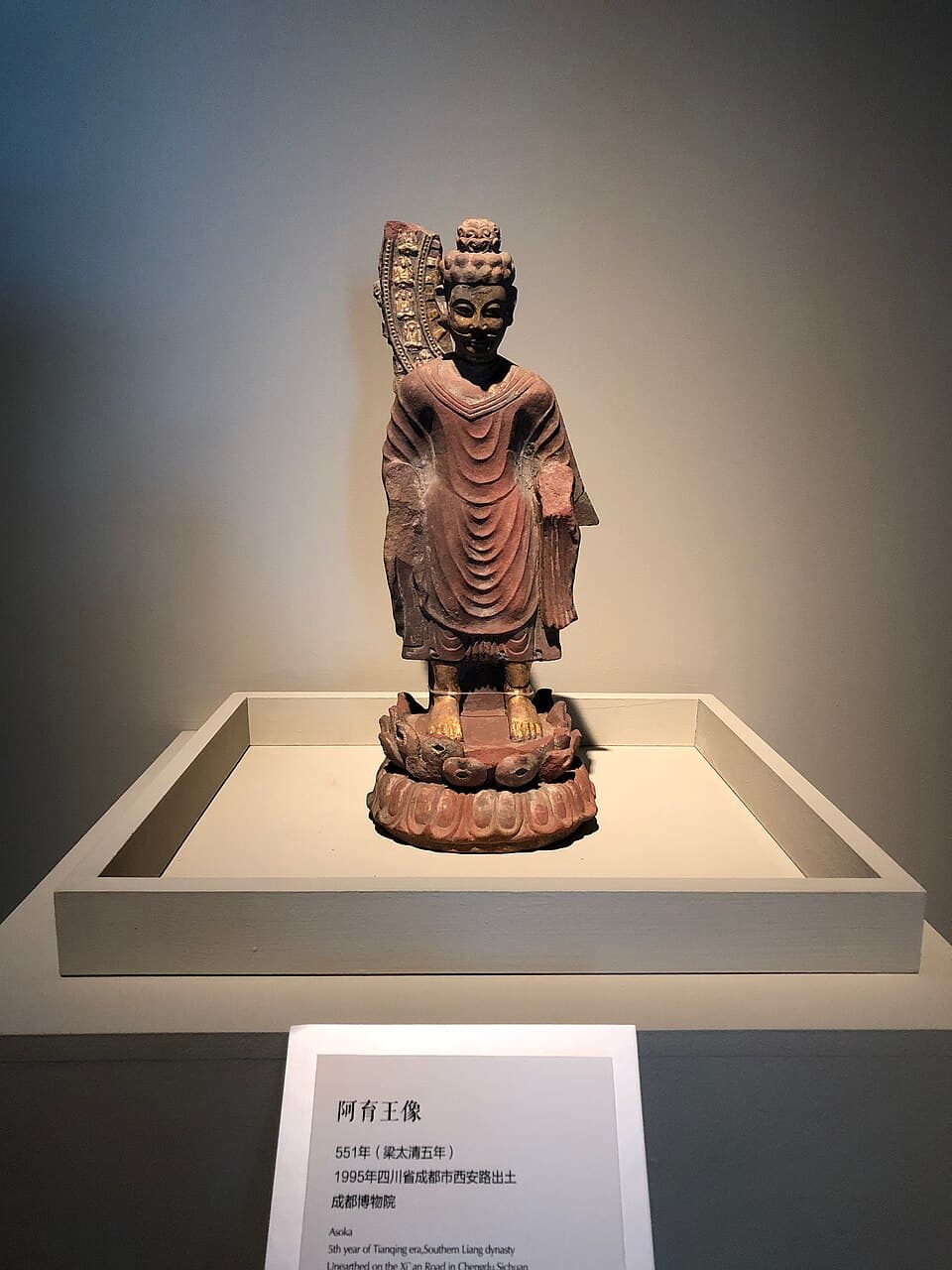
Two twelve-year-old students visit, with their class, an exhibition on ancient India. In front of a great stone pillar topped with lions, an old emperor with a gentle gaze awaits them. His name is Ashoka, and he very much wants to tell them his story.
—What was the Kalinga war like?
You know, my child, I won that war — and never has a victory hurt me so much. Kalinga was a kingdom by the sea, to the east. I wanted to add it to my empire. But imagine entire fields covered with bodies, as far as the eye can see. In my carved stone, I had it counted: about one hundred thousand dead, and one hundred fifty thousand taken far from their homes. I walked on that ground after the battle, and the silence crushed my heart. That day, something broke inside me. A king who wins should be proud. I felt only grief.
I won that war, and never has a victory hurt me so much.
—How sad were you after that battle?
I wasn't just sad, my child. I was ashamed. They called me the Beloved of the Gods — a fine title, meaning 'he whom the gods cherish.' But what gods love a man who makes so many families weep? So I did something very rare for a king: I spoke my remorse aloud, before my entire empire. I had carved in rock that this carnage pained my heart. Imagine an emperor who admits, on stone: 'I was wrong.' Few have dared it before me. That day I chose the path of the Buddha, which refuses to kill.
—Why did you write on stones and not on paper?
Good question! In my time, people wrote on palm leaves or bark. But these rot, and the wind carries them away. I wanted my words to last a very long time. So I had my messages carved in rock and on great pillars of polished sandstone — some taller than six men standing! They are called my edicts. The artisans carved each letter in a script called Brahmi. Imagine shiny columns set along the roads, where everyone could read my advice on kindness. Stone does not lie — and it does not die.
—How could people who didn't speak the same language understand you?
My empire was vast, and not everyone spoke the same language! So I had my edicts written in the people's languages, the Prakrits, the ones actually spoken in the streets and fields. And where foreigners lived, far to the west near Kandahar, I had the same stone carved in two languages at once: Greek and Aramaic. Imagine a Greek merchant who stops, reads in his own language, and understands the king of India! That was my whole idea: that no one be left out. A message has value, my child, only if it is understood by the farmer as well as the traveler from afar.
—How do you rule such a large country without instilling fear?
You know, many kings rule by fear. I wanted to rule by kindness — I called it the Dharma, the law of goodness: telling the truth, being gentle, not causing suffering. But a king alone cannot watch over millions of people. So I appointed special officials, the Dharma mahamatras. Imagine men who travel from village to village, not to collect taxes, but to check that the elderly, prisoners, and poor are treated well. They were my eyes and my heart on the roads. A good king does not count his soldiers. He counts those he has helped.
A good king does not count his soldiers; he counts those he has helped.
—Is it true you took care even of animals?
Yes, and I am proud of it! I had carved in stone that I wanted two kinds of care: for humans, and for beasts. Along the great roads, I had wells dug so that travelers and their animals could drink. I had trees planted for shade, and healing herbs where there were none yet. Imagine walking for days under the burning sun of India, and suddenly finding a cool well and a tree. To me, a sick goat or a tired donkey also matter. Everything that lives can suffer. So everything that lives deserves to be cared for.
—What did you eat at an emperor's table?
Before, my child, my kitchen was terrible for animals! Thousands of beasts were killed every day for the court meals. After choosing the path of the Buddha, I had a promise carved: to reduce all that. Soon only a few animals were still prepared — and even those, I hoped would one day stop. On my plate, there was mostly rice, lentils, vegetables, fruits, and yogurt. Imagine large dishes fragrant with spices, colorful like a market. One can be an emperor and eat simply. I learned that true wealth is not in bloodshed.
—In the evening, what did you do before sleeping?
In the evening, I did not seek parties or dancers, like other kings. I sat in silence to meditate — that is, to calm my mind, breathe, reflect on my actions of the day. Sometimes monks came to speak to me about the Buddha's teachings. We spoke of ahimsa: not harming any living being, either by hand or even by thought. Imagine the flickering light of an oil lamp in a great stone hall, and an emperor sitting on the floor, simply. In the morning, one governs. In the evening, one looks within. A man who never reflects always ends up doing harm.
—Is it true you sent your children very far away?
Yes, and that took courage — for them and for me. I sent my son Mahinda and my daughter Sanghamitta across the seas, to the island of Sri Lanka, far to the south. Not with an army, but with words of peace, to spread the Buddha's teaching. Imagine a long voyage by boat, on unknown waters, without knowing if you will return. Tradition says my daughter even took a cutting from the sacred tree under which the Buddha found wisdom. You see, I no longer sent soldiers to conquer lands. I sent my own children to offer an idea.
—Why did you build so many monuments?
Ah, the stupas! They are great round monuments, like domes of stone and brick, which house relics — very small precious remains of the Buddha. Tradition says I had the old ones opened and redistributed those relics into eighty-four thousand new stupas! A huge number, almost a dream. The most beautiful is the one at Sanchi, which can still be seen. Imagine hills all over the empire, each crowned with a white dome, where people came to pray and slowly walk around it. I wanted the Buddha to be present in every region, not just in my capital of Pataliputra.
—How did you hope to be remembered?
You know, I did not do all this for my glory. At Sarnath, where the Buddha gave his very first teaching, I erected a pillar crowned with four stone lions, back to back, each gazing at a horizon. They stand guard, strong and calm at once. I would like to be remembered not as the warrior of Kalinga, but as the man who changed. Stones eventually fall, empires pass — even mine will pass one day. But perhaps a good deed never fades. If a child like you, long from now, chooses gentleness over anger, then my edicts will not have been carved in vain.
Empires pass, but a good deed never fades.
Read further
This imaginary interview was generated by artificial intelligence from sources documented in Ashoka's profile. It dramatises what the figure might have said based on what we know about them, but does not constitute attested historical testimony. For primary sources and factual documentation, refer to the full profile.