Imaginary interview with Athena
by Charactorium · Athena · Mythology · 7 min read
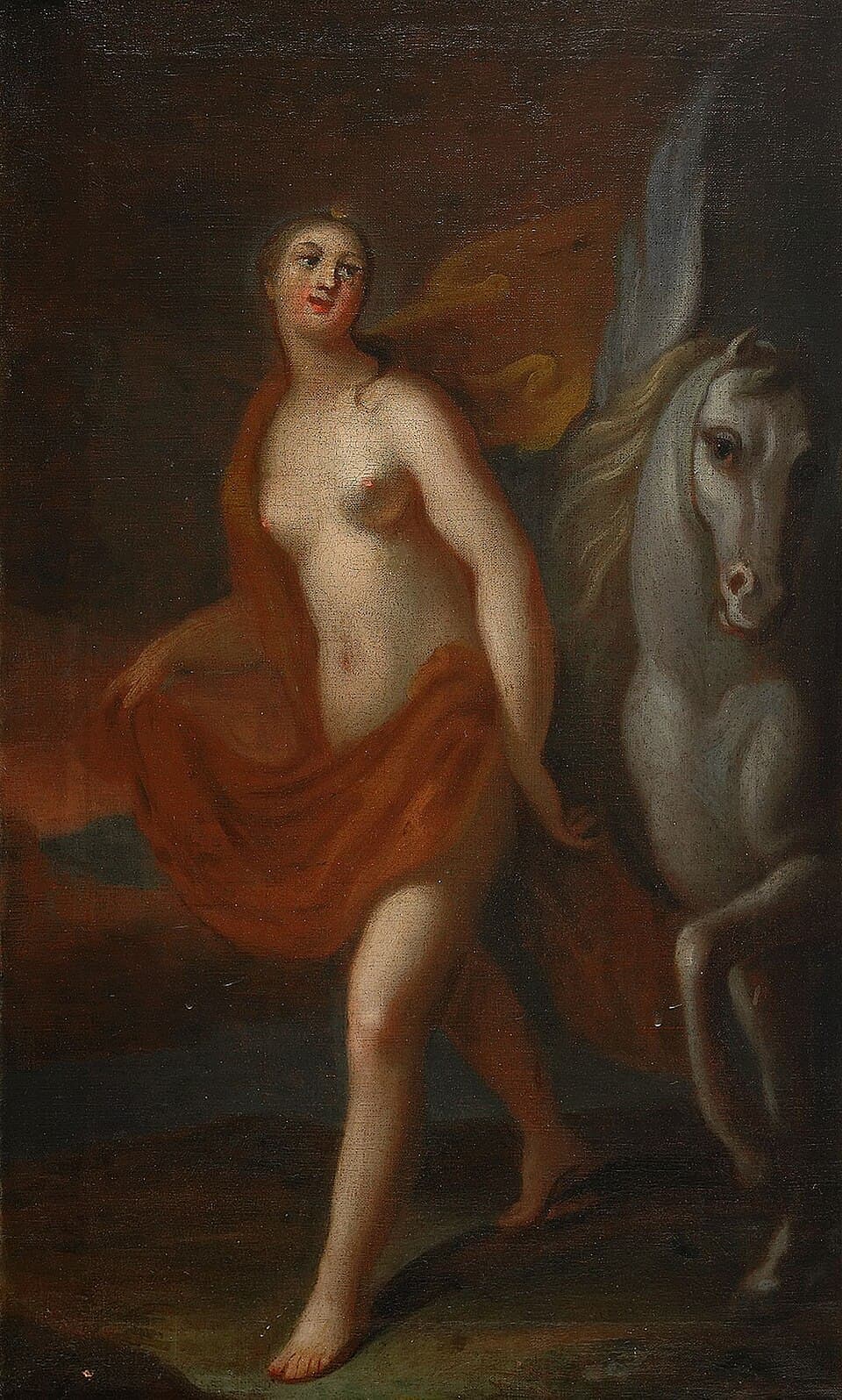
We find her on the Acropolis at first light, before the city below has roused itself from sleep. The great chryselephantine statue within the Parthenon — gold, ivory, and twelve meters tall — is the work of mortal hands, but the stillness filling this space is older and more deliberate. Athena receives this interview with the patience of one who has never needed to hurry: intelligence, she will tell you, begins with silence.
—Of all the stories told about you, the strangest may be your birth — you did not come from a womb, but emerged fully armed from the forehead of Zeus himself. How do you hold that origin?
I do not hold it as a story — I was there, though 'there' is not quite the right word for what precedes ordinary time. My mother Metis was the wisest of all beings; Zeus knew she would bear children surpassing even him in power, so he swallowed her entire before I could arrive by any conventional path. What Hesiod understood, and set down in the Theogony, is that I emerged from the mind of the highest god already formed — armored in gold, as he tells it, with the other immortals watching in something approaching awe. What the poets cannot fully convey is what it means to carry one's mother inside the mind of absolute power, and then to burst from that mind complete. No childhood of confusion, no slow education in what is right versus what is merely expedient. I came into the world the way a thought arrives: sudden, whole, and already armed.
I came into the world the way a thought arrives: sudden, whole, and already armed.
—If you entered existence already knowing, does wisdom mean something different to a goddess who was never ignorant — or does the knowing still have to be used?
Born knowing is not born finished — there is a distance between capacity and its exercise that even the immortals must cross. My mother Metis gave me the inheritance; the long cycles of watching men like Achilles choose fury over judgment, watching cities destroy themselves through pride, watching generals mistake the spectacle of battle for its purpose — that is where understanding deepens into something harder and more useful. The Parthenon above us did not spring from the earth because its builders possessed intelligence in the abstract. They had the capacity, then they applied it against resistant stone, and then they made something that endures. Wisdom without deployment is only potential. I am not the goddess of potential. I am the goddess of intelligence committed to an end.
—The sculptures on the west pediment of the Parthenon depict your contest with Poseidon for the patronage of this city. Why an olive tree — rather than a river, a harbor, or perpetual winds for the fleet?
Poseidon struck the rock of the Acropolis with his trident and a salt spring burst upward — powerful, theatrical, the kind of gesture that impresses an audience quickly. I planted an olive in the same rocky earth. The Athenians deliberated, as they deliberate everything, and they chose the olive. Not because I outrank the god of seas, but because I understood what a city of human beings actually requires. Salt water cannot be drunk, cooked with, or traded for grain. The olive yields oil for light, for nourishment, for medicine, for the lamp burning in every household from Marathon to the furthest edges of the known world. I did not win a contest. I demonstrated, in terms any child can weigh, what it means to think before you act.
—The sacred olive on the Acropolis was burned by the Persians in 480 BC — and yet it reportedly grew back from the stump within a day. What does that story say about what you actually are to this city?
It says that a gift of the mind cannot be permanently destroyed. The Persians burned Athens — they burned the temples, the first tree I planted in the ancient contest. And the stump sent up a new shoot before the ashes had cooled. I am not a monument. Monuments can be pulled down, melted, defaced. I am a capacity that this city holds within itself — the disposition toward reflection, toward craft, toward the argument made with evidence rather than the argument made with a sword. The Erechtheion was built precisely over the place where that sacred olive grew, because the Athenians understood that the contest between Poseidon and me was never fully resolved. It continues every time this city decides whether to reach for brute advantage or for lasting usefulness.
—In Homer's Iliad, you descend physically from Olympus to seize Achilles by the hair at the moment he is about to draw his sword against Agamemnon. Why intervene at precisely that instant?
Because he was about to destroy everything with a single stroke — not only himself, but the entire Greek effort at Troy. Achilles was the finest warrior of his generation: fast, relentless, burning with a divine fire. And in that moment before the assembled host, he was prepared to murder the king of kings over a matter of stolen honor. I descended and seized his golden hair — he alone could see me — and I told him to sheathe the sword. Not because Agamemnon deserved his prize. He did not. But the hero who withdraws the blade today and wins the argument in words will be more feared, and more heeded, tomorrow than the hero who kills today and is put to death for it. I do not prevent fighting. I decide when fighting serves its purpose.
I do not prevent fighting. I decide when fighting serves its purpose.
—You are described as the constant protector of Odysseus across twenty years of wandering. What was it in him that held your attention so steadfastly?
Odysseus did not ask me to love him for his sword arm — Ajax had a sword arm, and it availed him very little in the end. Odysseus asked with his mind. Each time a god placed an obstacle between him and Ithaca, he thought before he moved: the Cyclops, the courts of the dead, the suitors filling his hall. He lied, certainly; he wept strategically; he built things with his hands when hands were what the situation required. But every stratagem served a single destination — home, restored order, the proper shape of things. That is not mere cunning; that is intelligence placed in service of a worthy end. Ares would have charged the Cyclops' cave directly and died in the dark. Odysseus sharpened a stake and waited for darkness. I protect those who protect themselves with thought.
—Every image of you reaches for the same cluster of objects: the aegis bearing the Gorgon's face, the spear, the owl. What do these things carry that words about you cannot?
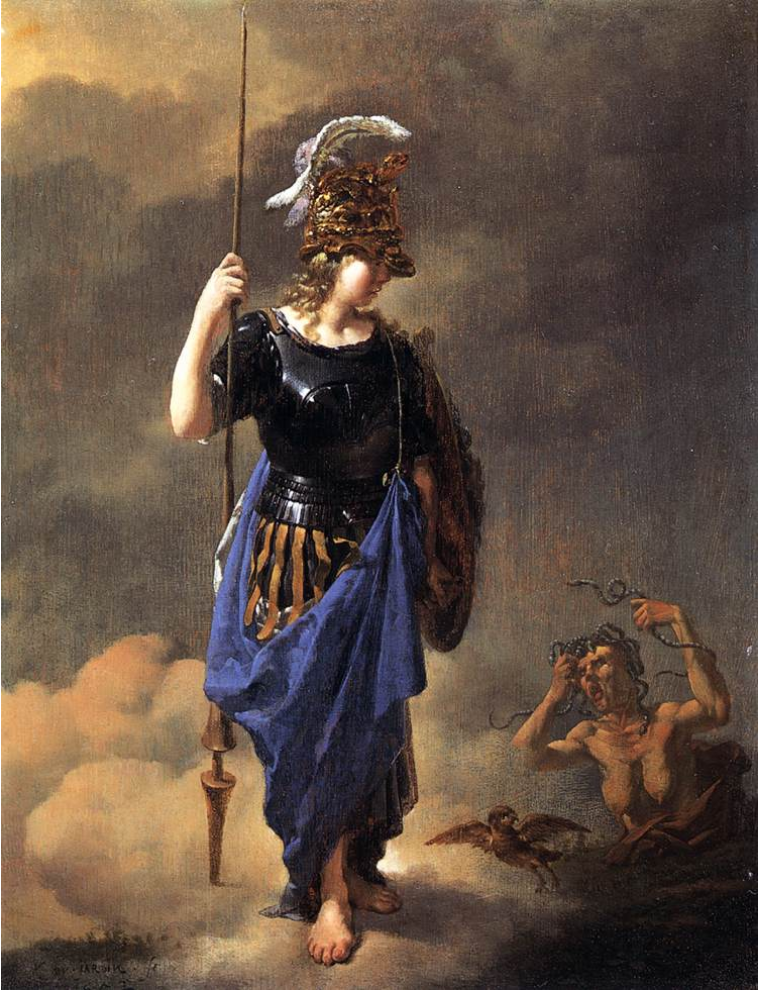
The aegis holds the head of Medusa at its center — the most paralyzing force in the world, the glance that turns to stone, worn by me as armor rather than wielded as a weapon. I have made terror into protection. Think about what that means. The Corinthian helmet I wear is bronze and functional, without ornament — war is not a ceremony. And the owl: she sees in absolute darkness, turns her head to perceive what faces away from her, hunts through silence rather than speed. She is not the emblem of wisdom as an abstraction but of perception under difficult conditions, which is the only kind that matters. These objects were not chosen by sculptors seeking decorative contrast. They are the grammar of what I am — each one a statement about how intelligence actually operates when it is serious.
—Every four years at the Panathenaea, the women of Athens weave a great peplos — a garment for a goddess who will never wear it in any ordinary sense. What is actually being offered?
The peplos is woven over four full years between the great festivals — embroidered with the scene of the Gigantomachy, the battle in which I stood beside Zeus against the forces of disorder — and carried up the Acropolis on a ship-cart, folded like a sail. That I cannot wear it the way a mortal dons a robe misses the point entirely. The offering is the making: the years of sustained attention, the accumulated skill, the collective act of an entire city turning its hands and minds toward a single object of devotion. I preside over the transformation of raw material — wool, thought, effort — into something coherent and enduring. Every shuttle passing through every warp thread in Athens is, in its small way, an address to me. The garment is the prayer. Not the garment presented — the garment made.
—You are credited with having given mortals the art of weaving itself. Why is that craft — thread, loom, pattern — held by the same goddess who governs strategy and war?
Because those who see war and weaving as separate domains have understood neither properly. To weave is to hold two systems simultaneously in the mind — warp and weft, tension and release — and to impose order upon disorder thread by thread. The loom requires calculation, pattern recognition, and the patience to let a plan unfold across time rather than seizing the conclusion prematurely. A general planning a campaign does precisely the same: he holds two armies, two terrains, two sets of constraints, and finds the path through. I taught the women of Athens to weave not as a concession to domestic life but as a training in disciplined thought. The hand that moves the shuttle is rehearsing the same intelligence that moves forces across a field. I do not govern separate domains. I govern one quality of mind expressed across many materials.
—There is also the story of Arachne, the weaver from Lydia who declared herself your equal — and was transformed into a spider. How do you account for what happened to her?
Arachne was genuinely gifted — I will not pretend otherwise, because pretense serves no one and the tradition is clear on her skill. Her hands moved with a grace that mortals rarely achieve. But she did not claim merely to weave well; she claimed to owe nothing to what came before her — not to the goddess who brought this art into the world, not to the lineage of women who passed it down through generations, not to the accumulated knowledge without which no individual talent can operate. I offered her the chance to reconsider. She refused. She weaves still, endlessly, as she desired — only she cannot stop, and her web is built not for beauty or intention but from instinct alone. The punishment was not an act of divine temper. It was a demonstration that to sever yourself from the source of your own capacity is not freedom.
To sever yourself from the source of your own capacity is not freedom.
—Looking across all you have observed — the wars, the heroes counseled, the cities that rose and fell — what is the distinction that finally matters most: between intelligence and wisdom, or between wisdom and power?
Power without direction is Ares at his worst: pure force, no destination, a river that floods every season rather than irrigating anything. Intelligence without purpose is the sophist spinning fine arguments for whoever pays. Wisdom is what happens when intelligence chooses its direction well — not once in a fortunate moment, but as a repeated practice, a disposition that becomes, through use, a second nature. Odysseus had intelligence; he became wise through twenty years of choosing correctly when easier paths were close at hand. Achilles had the intelligence to understand this — he was not a fool, only impatient — and that impatience cost him everything that mattered. The owl does not see all things; she sees clearly what she turns to look at. That is what I ask of the cities and the heroes I protect. Not omniscience. Not invulnerability. Clarity, applied consistently, under pressure.
This imaginary interview was generated by artificial intelligence from sources documented in Athena's profile. It dramatises what the figure might have said based on what we know about them, but does not constitute attested historical testimony. For primary sources and factual documentation, refer to the full profile.