Kids interview Athena
by Charactorium · Athena · Mythology · 5 min read
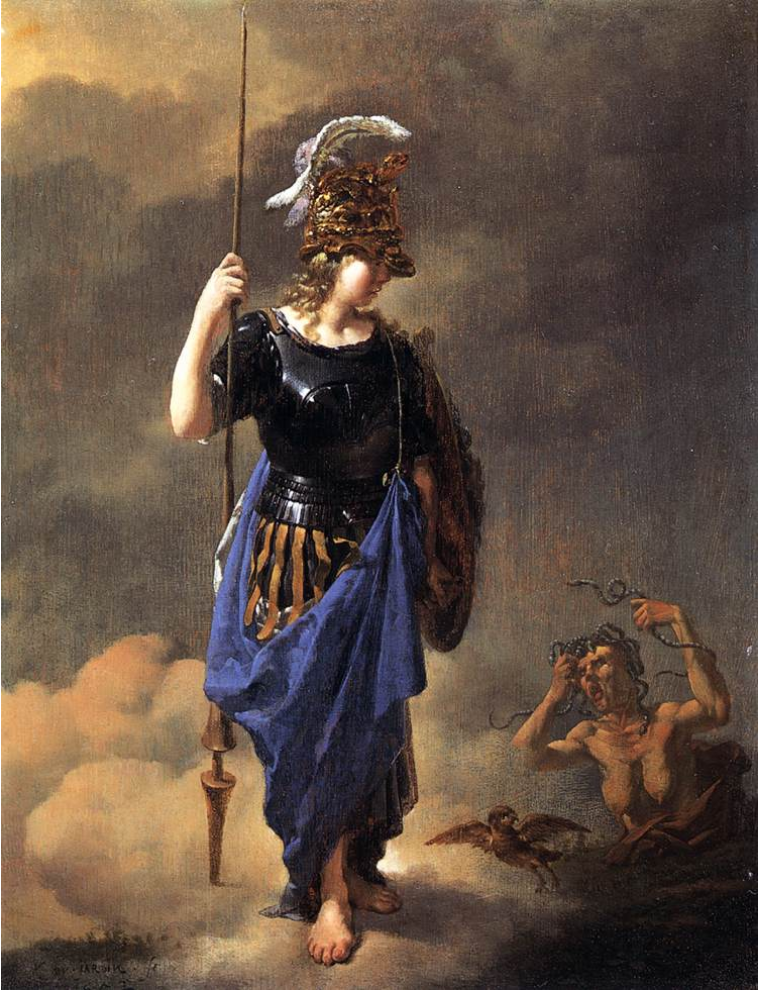
Two twelve-year-olds are on a school trip to the Acropolis of Athens. Standing before the ancient columns of the Parthenon, they notice a tall figure in gleaming armour — an owl perched on her shoulder, a lance in hand, grey eyes calm and luminous. She crouches slightly to meet their gaze, smiles, and waits for the first question.
—How were you actually born? We heard it was from someone's head?
Ha — that question always makes mortals go a little pale! Here is how it happened. My father Zeus had swallowed my mother Metis, goddess of wisdom, because a prophecy warned that her child would surpass him in power. But wisdom cannot simply be destroyed. She kept growing inside him, quietly forging armour for me. One day, Zeus's head throbbed so terribly that the blacksmith-god Hephaestus split it open with an axe. And out I leapt — fully armed, aegis, lance, helmet and all. Hesiod tells it in the Theogony: every immortal god froze in astonishment. I was born of pure thought, not of a cradle. That is, perhaps, what I am.
I was born of pure thought, not of a cradle.
—Did you feel sad, growing up without a real mother?
That is a kind question, and I have thought about it for a very long time. I never knew Metis as you would know a mother — her voice, her warmth. But her wisdom lived inside me from my very first breath. Imagine carrying someone's light without ever seeing their face. What I did not have, I built for myself. I learned the craft of the loom, studied the movements of armies, watched the owl — my sacred bird — wait in silence before it acts. Perhaps growing up without a mother taught me one thing above all: how to become a guide for others. That became my purpose.
—How did you beat Poseidon to become protector of Athens?
It was less a battle, more a contest of gifts. Poseidon and I each had to offer something to the city, and the people would judge. He drove his trident into the rock of the Acropolis — and a spring of water burst from the stone. Impressive! But it was saltwater, useless for drinking. I knelt and planted a single olive tree. Think about what one olive tree gives: oil for cooking and for lamps, wood for ships, fruit to eat, leaves to crown the victors. The city chose the olive. And from that day, it carried my name. The whole story was later carved onto the Erechtheion, the temple just over there.
—What does it feel like to have an entire city named after you?
Warm — that is the only word I find. When I walk through Athens, I see the oil lamps glowing in the evening, the artisans painting amphorae with scenes from my legends, children running past the temple columns. Every four years, the whole city holds the great Panathenaic festival in my honour. Hundreds of citizens weave me a new ceremonial robe — a peplos — and carry it up to the Acropolis in a procession that fills every street. It is not about pride. It is about belonging, together, to something larger than any single person. A city that honours wisdom honours itself.
—You protected Odysseus for ten whole years — what was the hardest moment?
Watching him weep. There is a period when Odysseus is stranded far from home, staring at the sea each morning with red eyes, longing for Ithaca. The gods have rules — I cannot simply lift a hero and carry him to safety. My role is to inspire, to breathe courage into him when he is ready to surrender. The Odyssey calls me the grey-eyed goddess, always watching, always thinking before acting. The hardest truth I learned from Odysseus is this: you cannot give strength to someone. You can only help them find what they already carry inside. He had far more than he knew.
—Why do you think being clever matters more than being strong in a war?
Look at Ares — raw power, blind fury, always charging first and thinking never. He loves the roar of battle for its own sake, and when the battle is over, rubble is all that remains. In the Iliad, Achilles — the mightiest warrior alive — was about to draw his sword against Agamemnon in blind rage, in the middle of their own camp. I descended from Olympus, invisible to all except him, and seized his golden hair. One man's fury can shatter an entire army. One calm decision can save thousands. Strength wins a single fight. Strategy wins the war — and then builds the peace that follows.
Strength wins a single fight. Strategy wins the war — and builds the peace that follows.
—Did you really turn a girl named Arachne into a spider? That seems really harsh...
I understand why it surprises you. Arachne was a mortal weaver — genuinely extraordinary, I admit that freely. But she publicly boasted that she surpassed me, and when we held a contest, she wove a tapestry designed to mock and humiliate the gods. Her skill was real. Her intent was cruelty. Ovid tells the story in the Metamorphoses: she was transformed so that she might weave forever, as a spider does. But think carefully about what that means. I did not punish her gift — gifts are sacred. I responded to her choice to use a talent as a weapon against others. What your hands can do matters. What you choose to make with them matters more.
—Why did you invent the loom? Isn't weaving just... housework?
Ha! I am so glad you asked that. The loom is a thinking machine. To weave, you must hold hundreds of threads in your mind at once — which crosses which, what pattern emerges row by row. Lose focus for a moment and everything tangles. It is strategy made visible with your hands. A single cloth can carry a whole story: a border pattern, a colour, a symbol worked deep into the fabric. I taught mortals the craft of weaving because cloth means warmth, trade, ceremony, and memory. A peplos can honour a goddess. A sail can carry an explorer. A shroud can give a king his dignity. That is not housework. That is civilisation.
—What was it like to see the giant golden statue that Phidias made of you?
I watched Phidias work for years inside the Parthenon, though he could not see me. Twelve metres tall — my face carved in ivory, my armour plated in gold, my eyes set with precious stones. In my open hand, a small figure of Nike, goddess of Victory, holding a crown. Mortals who entered had to tilt their heads far back to meet my gaze. That is the feeling I wanted: not fear, but awe at something immense and calm. The statue was finished around 440 BC, during the age of Pericles. And yet — the real me does not live in gold or ivory. The real me fits inside a single thought.
—What do you most want us to remember about you?
That wisdom and courage are not opposites — they are the same thing, seen from different angles. I am both the goddess of strategy and the goddess of the loom, both the protector of warriors and the teacher of weavers. What I most want you to carry away is simple: your mind is your shield. Not because it keeps pain away — it does not. But because it helps you understand what is happening, and choose your next step with care. My sacred owl does not fly in blinding daylight. She waits. She watches. She moves at exactly the right moment. Try to be a little like the owl.
Your mind is your shield.
This imaginary interview was generated by artificial intelligence from sources documented in Athena's profile. It dramatises what the figure might have said based on what we know about them, but does not constitute attested historical testimony. For primary sources and factual documentation, refer to the full profile.