Kids interview Claude Lévi-Strauss
by Charactorium · Claude Lévi-Strauss (1908 — 2009) · Philosophy · Sciences · 5 min read
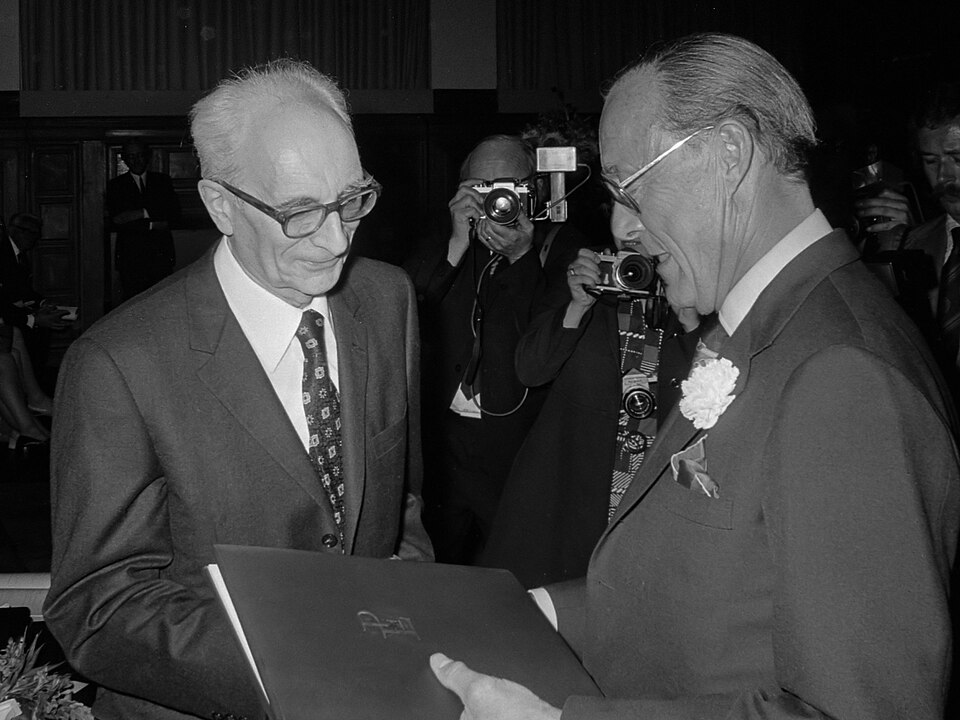
Two middle school students, on a field trip, push open the door of an office lined with books and index cards. An old man of a hundred years awaits them, his pipe set beside him. He smiles, moved that children have come to listen to him.
—Is it true that you almost starved to death in the Brazilian forest?
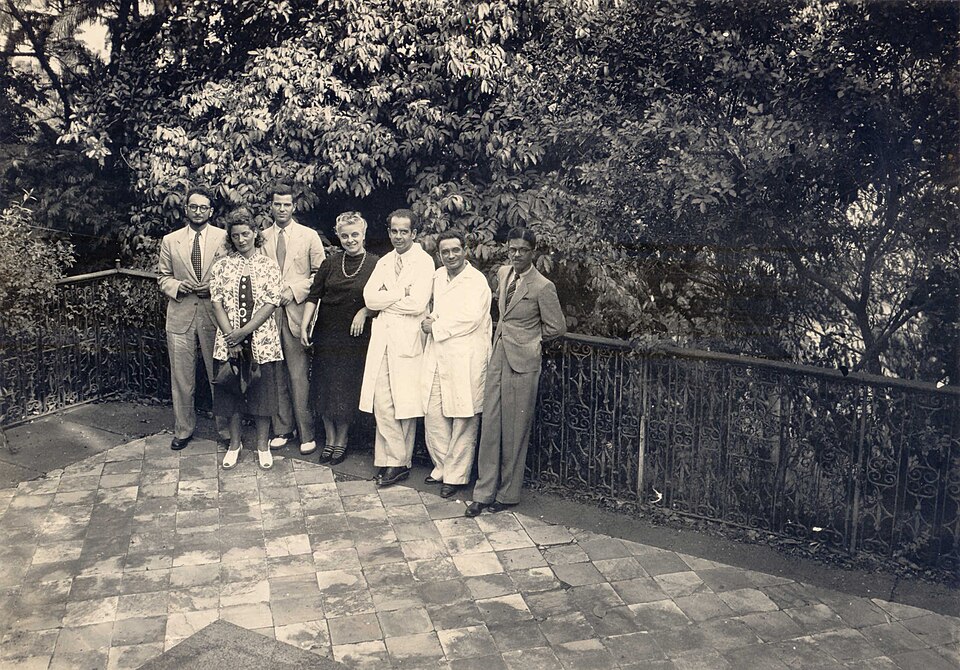
You know, my child, it's quite true. I had gone to the Mato Grosso, a vast wilderness in Brazil, to live among the Nambikwara. Imagine a forest where the food you bring eventually rots. One day, there was nothing left. So I ate grilled spiders and grasshoppers. At first, I was scared, my stomach turned. But hunger teaches you fast. It wasn't a game: an ethnologist is someone who goes to live among a people for a long time to understand them from the inside. To do that, you have to accept eating what they eat. Otherwise, you remain a tourist.
Hunger quickly teaches you to eat what others eat.
—Did you write everything down in a notebook? And did you take photos?
Yes, all the time! I had field notebooks that I filled in the evening by firelight. I wrote down what I had seen, and I also drew: the shape of a village, a sacred object, a mask. And I had a camera, heavy as a brick. Imagine, you had to aim, wait for the light, and you only knew when you got back if the picture turned out. Those photos of the Bororo and the Nambikwara are treasures today, because those peoples have changed a lot. My notebook was my memory. Without it, I would have forgotten everything. An ethnologist who doesn't write in the evening loses his day.
—Why did you have to leave France during the war?
It was in 1941, a very dark time. France was occupied, and the Vichy government persecuted Jews. I was Jewish, my child. Staying meant risking my life. So I fled, like so many others. Imagine: you leave your home, your language, your friends, and you board a ship without knowing if you'll ever return. I was lucky, an American foundation offered me a scholarship to teach in New York. I was afraid, of course. But sometimes, it's in misfortune that you make encounters that change your whole life. And that's exactly what happened to me there.
—What encounter changed your life in New York?
Ah, that one I'll never forget! At the great New York library, I met a scholar named Roman Jakobson. He studied the sounds of languages, what is called phonology. He showed me something magnificent: a word is made of tiny sound bricks, and these bricks are organized according to hidden rules. Suddenly, I understood! And if the stories that peoples tell, myths, were built the same way? I invented a word for it: the mytheme, the smallest brick of a myth. Imagine a wall: each stone alone says nothing, but together they stand. This idea, Jakobson gave it to me without knowing it.
A chance encounter can open a door you've been looking for all along.
—Is it true that you debated with a great poet on the ship?
Yes! On the cargo ship that carried me into exile, there was André Breton, the leader of the Surrealists, those artists who loved dreams and the strange. We spent the crossing debating, sometimes until night. He said: art is a revelation, a flash that shows you hidden beauty. I replied: no, it is science that unveils what is hidden, by patiently searching for the structures beneath things. We disagreed, but what a pleasure! You know, my child, arguing with respect is one of the most beautiful things in the world. You always learn from someone who thinks differently than you.
You always learn from someone who thinks differently than you.
—How did you manage to study so many stories at the same time?
With index cards, my child! Imagine hundreds of small cards spread across my table. On each one, I wrote an Amerindian myth, or just a piece: an animal, a fire, a journey. Then I moved them, brought them closer, like assembling a giant puzzle. And then, suddenly, I saw similarities emerge between very distant peoples. That's what I called transformation: the same story turned inside out like a glove as it passed from one village to another. I put all that into a great work, the Mythologiques, four thick books. Without my cards, I would never have seen those invisible threads between stories.
—Is it true that music helped you write your books?
Enormously! I loved Wagner and Rameau, great composers. In the evening, I listened to their music, and I listened especially to how it was built. For a melody is notes that return, respond to each other, invert. Exactly like myths! So I had a slightly crazy idea: to build my books like pieces of music. My chapters bore the names of musical forms, fugue or sonata. The first volume was called The Raw and the Cooked — the raw is nature; the cooked is what humans transform by fire. You see, my child: to understand the stories of humans, you sometimes need the ear of a musician.
A myth is built like a melody: themes that return and invert.
—Why did you say that no people is better than another?
Because it's the truth, and it needed to be shouted. In 1952, I was asked to write a text to combat racism, Race and History. In my time, many people still believed there were 'superior' and 'backward' peoples. What dangerous nonsense! I had lived among the Nambikwara: they had almost nothing, yet their thought was rich, subtle, intelligent. I wrote this sentence I cherish: 'World civilization cannot be anything other than the coalition, on a global scale, of cultures each preserving their originality.' Imagine a garden: its beauty comes from all the flowers being different.
The beauty of a garden comes from all the flowers being different.
—Did it annoy you when people mocked other peoples?
Yes, deeply. There is a word for this flaw: ethnocentrism. It means judging others by your own rule, as if our way of living were the only normal one. Imagine a child who would laugh at a classmate because he eats differently or dresses differently. That's exactly it, and it's sad. I, among the Bororo of Brazil, learned the opposite: to look without mocking, to understand before judging. Every people has its reasons, its beauties, its logic. The traveler who returns feeling superior has understood nothing. True travel, my child, is not feeling better. It's becoming able to put yourself in someone else's place.
Understand before judging: that is the whole journey.
—If we remember one thing from you, what would it be?
What a beautiful question! You know, I spent my whole life searching for a hidden order beneath things: beneath stories, beneath families, beneath masks. I understood that humans, everywhere on Earth, think with the same intelligence, even if they don't have the same tools. So if you must remember one thing from this old man, remember this: what matters is not having all the answers. It's knowing how to ask the right questions, the ones no one has dared to ask yet. Keep being astonished, my child. That is the most precious treasure. The day you stop being astonished, you truly stop living.
The most important thing is not to have the answers, but to ask the real questions.
This imaginary interview was generated by artificial intelligence from sources documented in Claude Lévi-Strauss's profile. It dramatises what the figure might have said based on what we know about them, but does not constitute attested historical testimony. For primary sources and factual documentation, refer to the full profile.