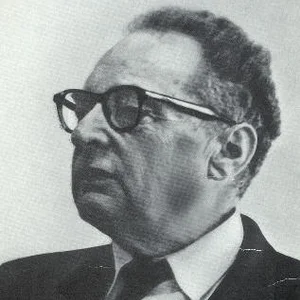

Russian-American linguist and theorist, a major figure of structuralism. Founder of the Prague Linguistic Circle, he revolutionized phonology and proposed a model of the functions of language that left its mark on the linguistics, poetics, and humanities of the 20th century.
Roman Jakobson(1896 — 1982)
Roman Jakobson
États-Unis, Union soviétique, Tchécoslovaquie, Empire russe, Russie soviétique
6 min read
Frequently asked questions
Famous Quotes
« Language means in order to communicate, and poetry is the aesthetic use of language.»
Key Facts
- Born in Moscow in 1896, he took part in Russian formalism and the Moscow Linguistic Circle (1915).
- Co-founder of the Prague Linguistic Circle in 1926, a cradle of structural phonology.
- Fled Europe and settled in the United States in 1941, teaching at Harvard and later MIT.
- Devised the famous diagram of the six functions of language (1950s-1960s).
- Died in Cambridge, Massachusetts, in 1982, having influenced Lévi-Strauss and structuralism.
Works & Achievements
A school of thought that lays the foundations of modern phonology and the structural analysis of language.
A foundational study showing that the sound changes of a language follow a logic of system.
A demonstration that the acquisition of language in children and its loss in aphasics follow symmetrical laws.
The theory of distinctive features and the famous distinction between the metaphoric and metonymic axes of language.
A text presenting the model of the six functions of language, which became a classic taught in French-language classes.
A collection translated into French that spread his thinking to the general public and to European structuralists.
A joint study applying linguistic methods to a poem, a model of interdisciplinary analysis.
Anecdotes
Born in Moscow in 1896, the young Roman Jakobson frequented Russian Futurist circles and became friends with the poet Vladimir Mayakovsky. This passion for avant-garde poetry would stay with him all his life: for him, studying language and studying poetry were inseparable.
Fleeing the upheavals of Russia, he settled in Prague, where in 1926 he co-founded the Prague Linguistic Circle. It was there that modern phonology was born, with the revolutionary idea that the sounds of a language are defined by their differences (the famous “distinctive features”).
In 1939-1941, fleeing the Nazi advance, Jakobson crossed Europe from country to country — Denmark, Norway, Sweden — before setting sail for the United States. As a refugee in New York, he met the anthropologist Claude Lévi-Strauss, and their exchanges would give rise to structural analysis in the humanities.
Jakobson liked to repeat that he was “a linguist, and that nothing concerning language was foreign to him.” He had mastered around a dozen languages and could, it is said, deliver a lecture switching from one to another depending on his audience.
His famous diagram of the six functions of language (1960) is taught today in French classes: in it he shows that every message fulfills several roles at once — to inform, to express an emotion, to act upon another person, or simply to play with the form of words (the “poetic” function).
Primary Sources
The set (Einstellung) toward the message as such, the focus on the message for its own sake, this is what characterizes the poetic function of language.
Language, in its most economical and most efficient aspect, rests on a limited number of binary oppositions, the distinctive features.
The phoneme is not a sound, but a bundle of differential features that distinguish the meaningful units of a language.
I have always been convinced that linguistics without poetics, like poetics without linguistics, are equally unthinkable.
Key Places
Jakobson's native city, where he grew up and took part in the Futurist and linguistic circles before his exile.
The Czech capital where, in 1926, he co-founded the Prague Linguistic Circle, a cradle of structural phonology.
His place of refuge in 1941; there he taught at the École libre des hautes études and met Claude Lévi-Strauss.
Where he became a professor in 1949, spreading structural linguistics across the United States.
The institution where, from 1957 onward, he brought together linguistics, acoustics, and the cognitive sciences.
The city where he spent his final years and died in 1982.
Liens externes & ressources
Références
Œuvres
Cofondation du Cercle linguistique de Prague
1926
Remarques sur l'évolution phonologique du russe
1929
Kindersprache, Aphasie und allgemeine Lautgesetze (Langage enfantin et aphasie)
1941
Fundamentals of Language (avec Morris Halle)
1956
« Linguistique et poétique » (Closing Statement)
1960
Essais de linguistique générale
1963
Analyse structurale des poèmes (avec Lévi-Strauss, « Les Chats » de Baudelaire)
1962