Imaginary interview with Élisabeth Vigée Le Brun
by Charactorium · Élisabeth Vigée Le Brun (1755 — 1842) · Visual Arts · 6 min read
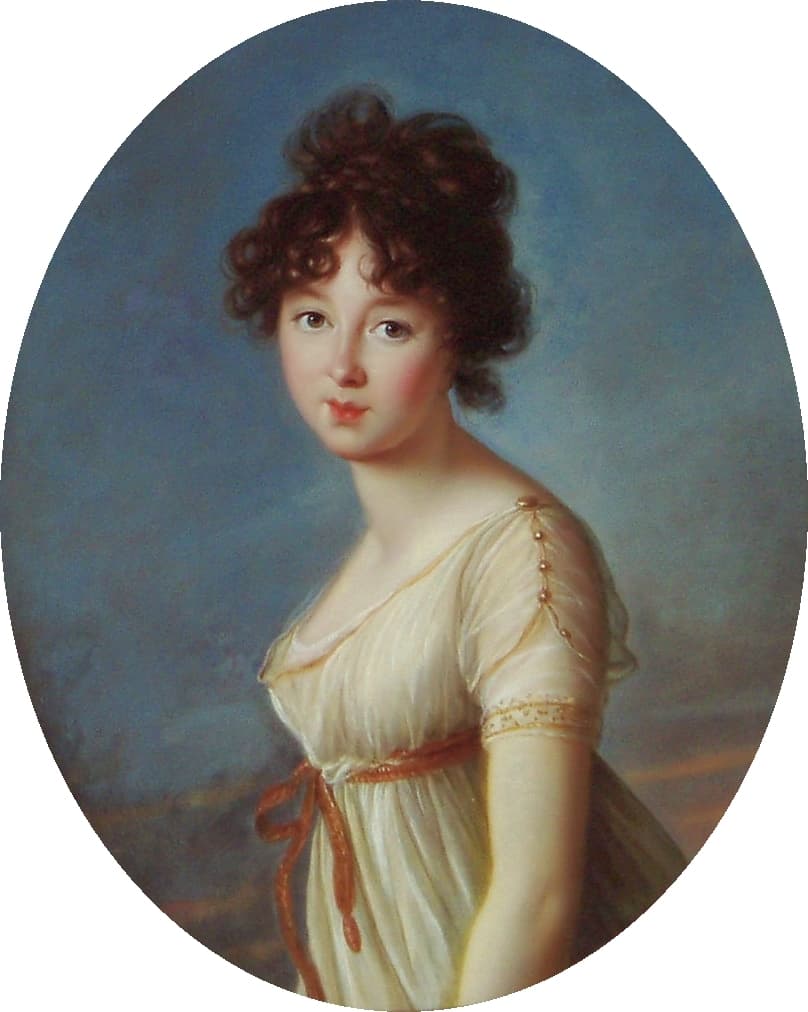
Paris, a spring morning, in the high-windowed studio on the rue du Gros-Chenet. The light falls just right—the light she waits for each day for her flesh tones; on the easel a barely sketched portrait dries. Élisabeth Vigée Le Brun sets down her palette, still fragrant with oil, wipes her fingers on a cloth, and consents to remember.
—Do you remember your first meeting with Marie Antoinette?
It was in 1778. I was summoned to Versailles, and my hand trembled a little as I arranged my brushes before a queen. But she had a simple kindness that disarmed: she laughed at my shyness, hummed during the sittings, spoke to me about her children. I painted her about twenty times in eleven years—first in grand court dress, then in more natural attire, as trust grew between us. I worked quickly, that was my nature, and she marveled at it to anyone who would listen. Those sessions were not stiff audiences but almost conversations between two women, one holding the scepter, the other the palette. I have kept from those mornings a tenderness that time has never erased.
—What happened at the 1783 Salon with that portrait of the queen deemed scandalous?
I had painted her in a simple white muslin dress, tied with a ribbon, a straw hat on her head—just as she liked to appear at Trianon, far from the pomp of panniers. To my eyes it was grace itself, the triumph of the natural over the artificial. But when the canvas appeared at the Salon, there was an outcry: people whispered that the queen of France had been shown in a chemise, in her undergarments, like a commoner undressed. The political thrust hid behind the reproach of etiquette. The painting had to be taken down before the end of the exhibition. That day I understood that a piece of painted fabric could weigh more than a pamphlet, and that a woman was never just a face: she was also an emblem that everyone wanted to bend to their cause.
A piece of painted fabric could weigh more than a pamphlet.
—How did you repair such an outburst?
I had to respond, and quickly. I painted the queen again in the same bust pose, but this time dressed in a dignified gray silk gown, holding a rose in her hand: that was Marie-Antoinette with a Rose, also in 1783. The image gained in majesty what it perhaps lost in audacity. Many copies were made for the embassies, because a court needs an official, reproducible, reassuring face. Thus I learned the secret craft of the court portraitist: not just to paint a woman, but to fabricate a figure, both accessible and sovereign. The rose in her hand said everything the muslin had imprudently left unsaid: here reigns a queen, but a queen one can love.
—Why did you paint Marie Antoinette surrounded by her children in 1787?
Because the time was no longer for grace, but for rescue. Pamphlets were overwhelming the queen; she was called the Austrian, said to be cold and spendthrift. In 1787, I was commissioned to paint a grand state portrait to show her as she was in private: a mother. I seated her in the midst of her children, one on her lap, and beside her a cradle that the little Dauphin points to—for a child died while I was painting, and I had to erase his face and leave that cradle empty. Marie-Antoinette and Her Children was meant to touch the hearts of the people. I do not know if it did; History would soon overtake my brushes. But I had put into it all the tenderness an image can carry to defend a woman whom people were bent on hating.
History would soon overtake my brushes.
—They say you had a secret for painting skin. What was it?
The secret, if there is one, lies in a refusal: never pure black. Black extinguishes the flesh, makes it earthy, dead; I preferred warm tones, russets, colored grays that I mixed in advance on my palette, even before the model sat down. And then the light—everything depends on it. I received my models in the morning, because only natural light reveals the transparency of a complexion, that blood one senses under the skin. A cheek is not pink: it is ten trembling nuances. I spent hours waiting for that quiver, applying my touch only at the right moment. It is a work of patience more than genius, and I believe my portraits have lived for that reason: one can breathe in them.
A cheek is not pink: it is ten trembling nuances.
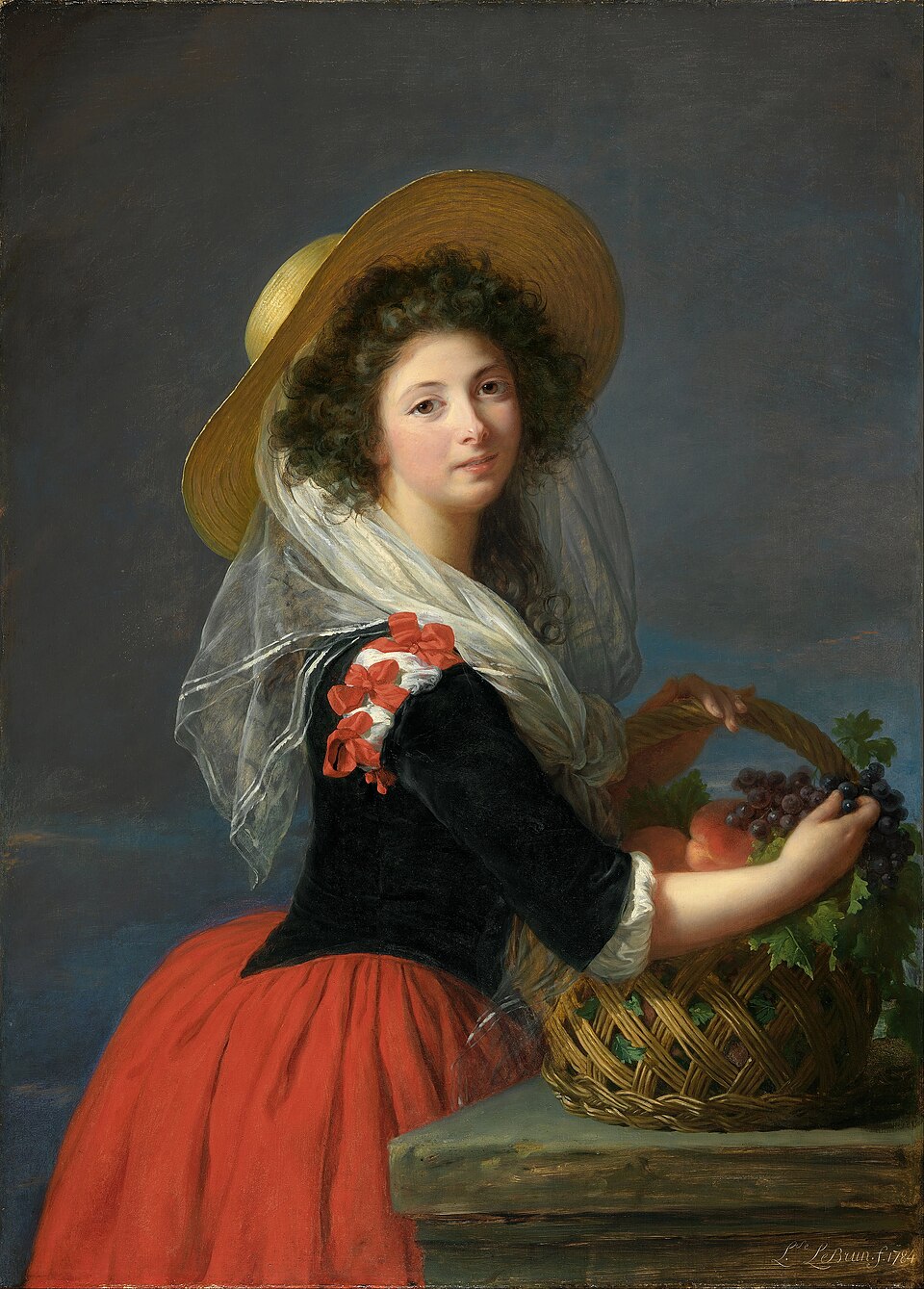
—Your Self-Portrait in a Straw Hat struck people's minds. Where did that image come from?
From a dazzlement. In Antwerp, before a portrait by Rubens—that woman in a hat whose brim casts a shadow, yet the face remains bathed in light—I felt a challenge seize me. How to achieve that, shadow and radiance together? Back home, I painted my own Self-Portrait in a Straw Hat, in 1782, palette and brushes in hand, gaze straight ahead, wearing a large hat that played with the sun. It was not vanity, or not only: it was a declaration. I placed myself, a woman, in the lineage of the masters; I claimed my craft in broad daylight. A woman holding her brushes and daring to look you in the eye—that, in those days, was almost as striking as the painting itself.
—How did you enter the Royal Academy in 1783?
Through a narrow and contested door. To be received, one had to present a reception piece, and a woman was not admitted on simple portraits—a genre deemed minor. So I painted an allegory, Peace Bringing Back Abundance, a noble and mythological subject, to prove I could compose something other than faces. On May 31, 1783, the minutes of the Royal Academy recorded me as an academician. But nothing was simple: I was reproached for my connections at court, people whispered that my husband, a picture dealer, harmed me through his trade. Entering was less a consecration than a narrowly won battle. I understood that talent, for a woman, was never enough: one also had to overcome the suspicion of having been pushed by patronage rather than by one's own brush.
—You were not the only one received that day, I believe?
No—and that caused the most stir. On the same day, Adélaïde Labille-Guiard was also received, whom people liked to pit against me, as if two women painters could not coexist without tearing each other apart. The Academy tolerated only four women in its ranks, no more, and here they were admitting two at once! Some academicians protested that our talent was exaggerated by our connections, that fashion promoted us more than merit. We were compared, measured, watched for our claws. The truth is that we painted differently, and that world was simply not used to counting women by twos. I carried that label of rival all my life, even though I never sought anything but to do, in my corner, the best work possible.
—How did you experience the upheaval of 1789?
Strangely, through a party. On the very evening of July 14, 1789, I was hosting at my home on the rue du Gros-Chenet a Greek-style supper: my guests draped in antique style, dishes served as in a fable, a little music. An innocent artist's folly! Later it was used as proof of my taste for luxury and the elite, an incriminating piece. By October, I took to the road with my little Julie, disguised as a simple traveler, heavy-hearted, soon classified among the émigrés whose property was confiscated. I thought I was leaving for a few months; it turned out to be twelve years. One never knows, when closing one's door one morning, that one will not reopen it until one has grown old, nor that the world left behind is already disappearing.
—This exile was, they say, a triumph. How did you go through it?
The courts of Europe opened their doors to me one after another—Rome, Naples, Vienna, then Saint Petersburg, where I stayed six years. Russia lavished me: I painted the nobility, the imperial family, and was elected a member of the Imperial Academy of Fine Arts, a rare honor for a foreigner and even rarer for a woman. It was there that I painted the Portrait of Countess Golovine, still admired—that movement of the shawl, that half-turned gaze. Exile was a heartbreak, but it made me a painter of all Europe, not just of Versailles. Everywhere I found the same aristocratic faces, the same salons, the same French language—as if a dying world were rendezvousing, in flight, in my paintings.
—At the end of it all, what kept you going, from one end to the other?
Love of the craft, quite simply. In my Memoirs, written past seventy years, I confessed this, which is the truth of my life: 'I had such a passion for my art that, often, when beginning a portrait, I did not take time to eat. I worked from morning to evening without noticing the hours passing.' More than six hundred sixty portraits, and each one was an encounter. My dearest is perhaps the one where I embrace my daughter Julie—Self-Portrait with Her Daughter Julie—because I put into it what the court never asked of me: simple tenderness. They thought me a painter of queens; above all, I was a woman who passionately looked at faces, and who never knew how to tire of it.
A woman who passionately looked at faces, and who never knew how to tire of it.
Read further
This imaginary interview was generated by artificial intelligence from sources documented in Élisabeth Vigée Le Brun's profile. It dramatises what the figure might have said based on what we know about them, but does not constitute attested historical testimony. For primary sources and factual documentation, refer to the full profile.