Imaginary interview with Gabriela Mistral
by Charactorium · Gabriela Mistral (1889 — 1957) · Literature · 6 min read
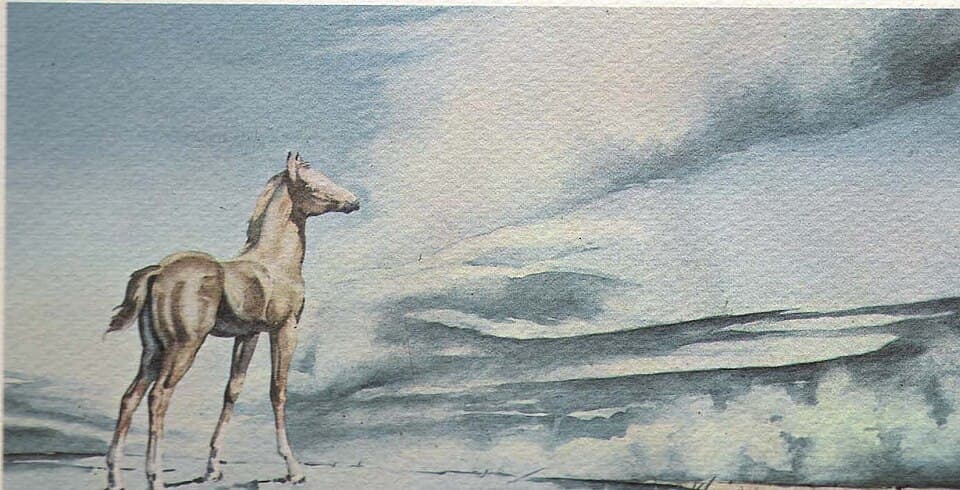
Elqui Valley, one evening of the austral winter. On the terrace of a low house in Vicuña, a woman in a dark shawl watches the mountains turn violet. She has placed her notebook on her knees, as every night since childhood, and agrees to speak — slowly, in the manner of someone who has long taught children who had neither books nor shoes.
—How does one become a schoolteacher at fifteen, without a diploma, in the rural schools of Chile?
One becomes it because one hungers to teach before having the right to do so. At fifteen, I already held chalk before children from hamlets where people counted on their chapped fingers. The escuela normal had closed its doors to me: I was judged too free-spirited, my readings worried those gentlemen on the commissions. So I learned by teaching, and taught in order to learn. My school textbook, I corrected by lamplight, adapting it to the harvests and seasons of these arid valleys, for you do not teach an Andean child with images from a Santiago salon. It was only in 1910, after a special exam granted me like alms, that I received my teaching certificate. The schoolmistress is the most sacred of professions: it is there that a people entrusts what is most precious to it, its children and its future.
I learned by teaching, and taught in order to learn.
—Why did you keep throughout your life such a visceral bond with the rural school, even after becoming famous?
Because one does not break free from one's first love. The consular halls of Madrid or Naples never made me forget the smell of damp wood in a countryside classroom at daybreak. I wrote my pedagogical reports with the same care as my poems; for me, the sentence that teaches and the sentence that sings spring from the same source. When Mexico called me in 1922 to reform its schools alongside José Vasconcelos, I did not sit in offices: I traveled through villages, opened rural libraries, placed books in the hands of indigenous children who were considered negligible. A teacher who sits behind a title teaches nothing more. Mine still walks, shawl on her shoulders, toward the last school at the end of the path.
—Do you remember what drove you to write an entire book of lullabies, Ternura?
Lullabies are the first poetry of a people, the one sung before learning to read. In 1924, I wanted to give back to children what mothers give them in the dark: a rocking, a voice, the promise that someone is watching. Meciendo / el mar sus millares de olas, / meciendo al divino viento, / yo meció a mi niño — I listened to the sea rocking its thousands of waves and I rocked my child to the same rhythm. Everything in Ternura comes from that: the round, the hand game, the cradle song. They thought me austere, and I was before adults; but before a cradle, my tongue became all gentleness. In Mexico I saw little indigenous children learn to read through these nursery rhymes — that was my true glory, long before the medals of Europe.
Lullabies are the first poetry of a people, the one sung before learning to read.
—What would you say to those who see poetry for children as a minor genre?
I would tell them that they have never looked a child in the eye. Nothing is more demanding than writing simply without writing foolishly. A round holds the world in four lines: the sea, the wind, the mother, sleep. It is in rural schools that I understood this, seeing that a poorly made poem bores a child more surely than a polite adult lets on. Tenderness is not a weakness, it is a discipline. My collection Ternura has been translated into many languages, but I never wrote it for scholars: I wrote it for mothers' laps and dormitory mats. Whoever despises childhood despises the root; and you cannot grow any tree by cutting its roots.
Tenderness is not a weakness, it is a discipline.
—Your first major collection bears a terrible title, Desolación. Where did that pain come from?
It came from very far, and very close, at once. Desolación, in our language, is absolute solitude, the land without anyone. When the book appeared in New York in 1922, I had put into it a love pain, a struggling faith, and that luminous aridity of the Elqui Valley that resembles the soul when it has lost everything. Yo no tengo soledad / es mi desolación a nadie dada — I have no solitude, I wrote, I have a desolation that I give to no one. It was not a complaint; it was a state of being, dry and burning like my mountains. I learned very early that pain, if named with precision, ceases to be a shame and becomes a material. Mine, I worked like one works clay.
Pain, if named with precision, ceases to be a shame and becomes a material.
—Thirty years later, you published Lagar. Why that title of winepress for your last book?
Because in the end, life presses the soul as one presses the grape and the olive. Lagar is the winepress: the instrument that crushes to make flow. In 1954, I had behind me too many graves, and especially that of my Juan Miguel, that son I had raised and whom I lost in Petrópolis in 1943; one does not fully recover from a dead child. So I wrote poems more bare, darker, where only the juice of experience remains. From Desolación to Lagar, it is the same movement: suffering that one does not flee, that one puts under the millstone until it yields something drinkable. I do not believe in poetry that turns away from pain; I believe in poetry that presses it to the last drop.
—You served as honorary consul all over the world. How does one live as a nomadic diplomat?
One lives with a suitcase and a diplomatic passport more traveled than rested. Chile made me honorary consul — a position granted for merit rather than career — and I carried that title from Madrid to Lisbon, from Naples to New York. It seems like prestige; it was mostly modest rooms where I set up a corner to write and pray, a few books, a plant, an object from Chile so as not to forget where I came from. But that passport served me for something other than socializing: I spoke everywhere for the rights of women and children, in Geneva as elsewhere. A diplomat who had only defended borders would have wasted her time. I crossed borders to defend those who have none, the little ones and the voiceless.
I crossed borders to defend those who have none.
—Did that wandering life, far from the Elqui Valley, ever distance you from your roots?
Never, because you carry your valley as you carry your language. In the consular houses of Italy or Brazil, I kept my Chilean countryside habits: waking early, eating frugally — dried vegetables, corn, bread — indifferent to the refinements of embassy tables. My rebozo on my shoulders, that shawl of the women of America, connected me to all those I had not forgotten. I lived in many cities without belonging to any; my homeland fit in an Andean valley, arid and luminous, and in the Spanish language I spoke to children. One can live forty years away from home without ever truly leaving, if one keeps a corner to write and a few objects that still smell of the country.
—In 1945, the Nobel. What did you feel as you went up to receive that distinction in Stockholm?
I felt that it was not to me they were giving it. In Stockholm, in December 1945, under that Northern cold so far from my valley, I took the medal knowing that my hands were only its custodians. I said it clearly: I am the direct representative of the poetry of Spanish America and I receive this reward in my capacity as representative of the Hispanic race and the Spanish language. First voice of our continent to be thus honored, I thought of the indigenous peoples, the anonymous schoolteachers, the children of rural schools. This medal did not weigh the weight of my glory but that of a debt: that of a language and a land that had too long been considered secondary. I drew no vanity from it — only one more burden to carry.
My hands were only its custodians.
—Why insist on speaking in the name of a continent, rather than in your own name as a poetess?
Because one does not become a poet alone; one inherits a voice. I came from a continent that was little read and even less listened to, where modernismo itself had had to conquer its right to exist against the salons of Europe. When Stockholm crowned me, I understood that any recognition that stops at a person is wasted. It was better that this light shine on the indigenous schools of Mexico, the valleys of Chile, the lullabies sung throughout Spanish America. I spent my life serving: first the children of the countryside, then, through this prize, an entire language. Poetry is not a property, it is a common good that one keeps for a moment before returning it. I returned it by saying: this Nobel is yours, peoples of the South, as much as mine.
Poetry is not a property, it is a common good that one keeps for a moment before returning it.
This imaginary interview was generated by artificial intelligence from sources documented in Gabriela Mistral's profile. It dramatises what the figure might have said based on what we know about them, but does not constitute attested historical testimony. For primary sources and factual documentation, refer to the full profile.