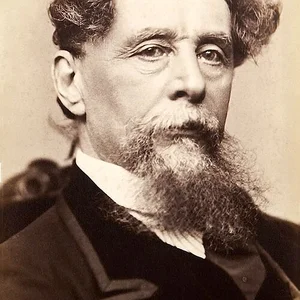

Charles Dickens was an English novelist of the Victorian era, regarded as one of the greatest writers in the English language. His novels, published in serial form, depict with realism and humanity the industrial society and social misery of his time.
Charles Dickens(1812 — 1870)
Charles Dickens
Royaume-Uni de Grande-Bretagne et d'Irlande
6 min read
Frequently asked questions
Famous Quotes
« It was the best of times, it was the worst of times.»
Key Facts
- Born in 1812 in Portsmouth, he had a childhood marked by his father's imprisonment for debt and by factory work at the age of 12.
- Publication of *Oliver Twist* (1837-1839), which exposed the plight of orphans and crime in London.
- Release of *David Copperfield* (1849-1850), a largely autobiographical novel.
- Publication of *A Christmas Carol* (1843), which helped shape the modern tradition of Christmas.
- Died in 1870 at Gad's Hill and buried in Westminster Abbey.
Works & Achievements
Dickens's first great success, a series of comic tales that made him famous overnight.
A novel exposing the plight of orphans, workhouses, and the London criminal underworld.
A moral tale about the redemption of the miser Scrooge, now a universal Christmas classic.
A partly autobiographical novel that Dickens considered his favorite.
A scathing critique of the slowness and absurdity of the English judicial system.
A condemnation of industrialization, factory labor, and cold utilitarianism.
A historical epic set in London and Paris during the French Revolution.
A coming-of-age novel following the social rise of young Pip and his disillusionment.
Anecdotes
At the age of 12, young Charles saw his father imprisoned for debt at the Marshalsea prison in London. Pulled out of school, he had to work ten hours a day in a blacking factory, pasting labels onto pots. This humiliation marked him for life and fed his novels filled with poor, exploited children.
Dickens was a true showman: he gave public readings of his own novels before packed houses, in England as well as in the United States. He performed the scene of Nancy's murder in Oliver Twist with such intensity that audiences shuddered — and these exhausting readings undermined his health.
In 1865, Dickens survived the Staplehurst railway disaster: his carriage was left dangling over a collapsed bridge. He came to the aid of the injured, then went back into the endangered carriage to retrieve the manuscript of the novel he was working on, Our Mutual Friend. He would remain traumatised by train travel.
In 1843, Dickens wrote A Christmas Carol in just a few weeks. Its success was immediate, and the book helped popularise many modern Christmas traditions — the family meal, generosity towards the poor, and the spirit of sharing.
An insomniac, Dickens roamed the streets of London at night, sometimes walking more than 30 kilometres until dawn. These long walks inspired the settings and characters of his novels, which he observed in the city's working-class districts and its slums.
Primary Sources
“Please, sir, I want some more.” — Oliver's line as he asks for a second bowl of gruel at the workhouse, which became the cry of all hungry childhood.
“Marley was dead, to begin with. There is no doubt whatever about that.”
“Whether I shall turn out to be the hero of my own life, or whether that station will be held by anybody else, these pages must show.”
“It was the best of times, it was the worst of times, it was the age of wisdom, it was the age of foolishness.”
“No words can express the secret agony of my soul as I sunk into this companionship... and felt my hopes of growing up to be a learned and distinguished man crushed in my breast.”
Key Places
Charles Dickens's birthplace, now a museum. He was born here on 7 February 1812.
A debtors' prison where Dickens's father was incarcerated in 1824. The place haunts his work, notably Little Dorrit.
The home where Dickens wrote Oliver Twist and Nicholas Nickleby. It is today the Charles Dickens Museum.
A country house Dickens had dreamed of owning since childhood and which he bought in 1856. He died here on 9 June 1870.
The town where Dickens spent a happy childhood before his family's financial difficulties. Its landscapes fed his imagination.
Dickens was buried here against his wish for a quiet funeral, in recognition of his national fame.
Typical Objects

Dickens wrote with a pen dipped in ink, filling thousands of pages. He took great care of his writing instruments and the layout of his desk.

A glass or porcelain vessel holding the ink. An indispensable tool for the writer at a time when the pen had to be refilled regularly.

Dickens's works appeared in monthly installments in cheap pamphlets, creating breathless suspense among readers. This format made literature accessible to as many people as possible.

A small pot whose labels young Charles pasted on at the factory where he was sent as a child. The object symbolizes the painful episode that marked his life and his work.

Before gas and electricity became widespread, Dickens worked in the evening by the flickering light of a lamp or a candle. Dim lighting was the lot of all of Victorian society.

A sloped wooden box used as a writing surface, which Dickens took along on his travels and his public reading tours.
School Curriculum
Vocabulary & Tags
Key Vocabulary
Tags
Daily Life
Morning
Dickens was a worker of iron discipline. Every morning, he shut himself in his study from nine o'clock until two in the afternoon to write, in complete silence. He demanded that nothing on his desk be disturbed: inkwell, pens, and trinkets all had to be in their exact places.
Afternoon
When afternoon came, he set off on long walks, often more than fifteen kilometres, through London or the Kent countryside. These walks helped him to think, to observe people, and to draw inspiration for his future characters.
Evening
The evening was devoted to family life, friends, and the theatre, which he adored. Dickens staged amateur plays, entertained a great deal, and later gave exhausting public readings of his novels.
Food
In the Victorian era, the table of a well-to-do gentleman like Dickens offered roast meats, fish, puddings, and cheeses, accompanied by wine or beer. Dickens loved to entertain and enjoyed fine food, but ate moderately on his writing days.
Clothing
Dickens took care of his appearance and liked flashy clothes, which stood out against Victorian sobriety. He wore a frock coat, a colourful waistcoat, a high-collared shirt, and a cravat, and in his later years sported a distinctive beard.
Housing
After a childhood marked by poverty, Dickens came to enjoy comfort thanks to the success of his books. He lived in comfortable London houses, then fulfilled his childhood dream by buying **Gad's Hill Place**, a vast country residence in Kent.
Historical Timeline
Period Vocabulary
Liens externes & ressources
Références
Œuvres
Les Papiers posthumes du Pickwick Club (The Pickwick Papers)
1836-1837
Oliver Twist
1837-1839
Un chant de Noël (A Christmas Carol)
1843
David Copperfield
1849-1850
La Maison d'Âpre-Vent (Bleak House)
1852-1853
Les Temps difficiles (Hard Times)
1854
Un conte de deux villes (A Tale of Two Cities)
1859