Kids interview Jean-Jacques Rousseau
by Charactorium · Jean-Jacques Rousseau (1712 — 1778) · Literature · Philosophy · 5 min read
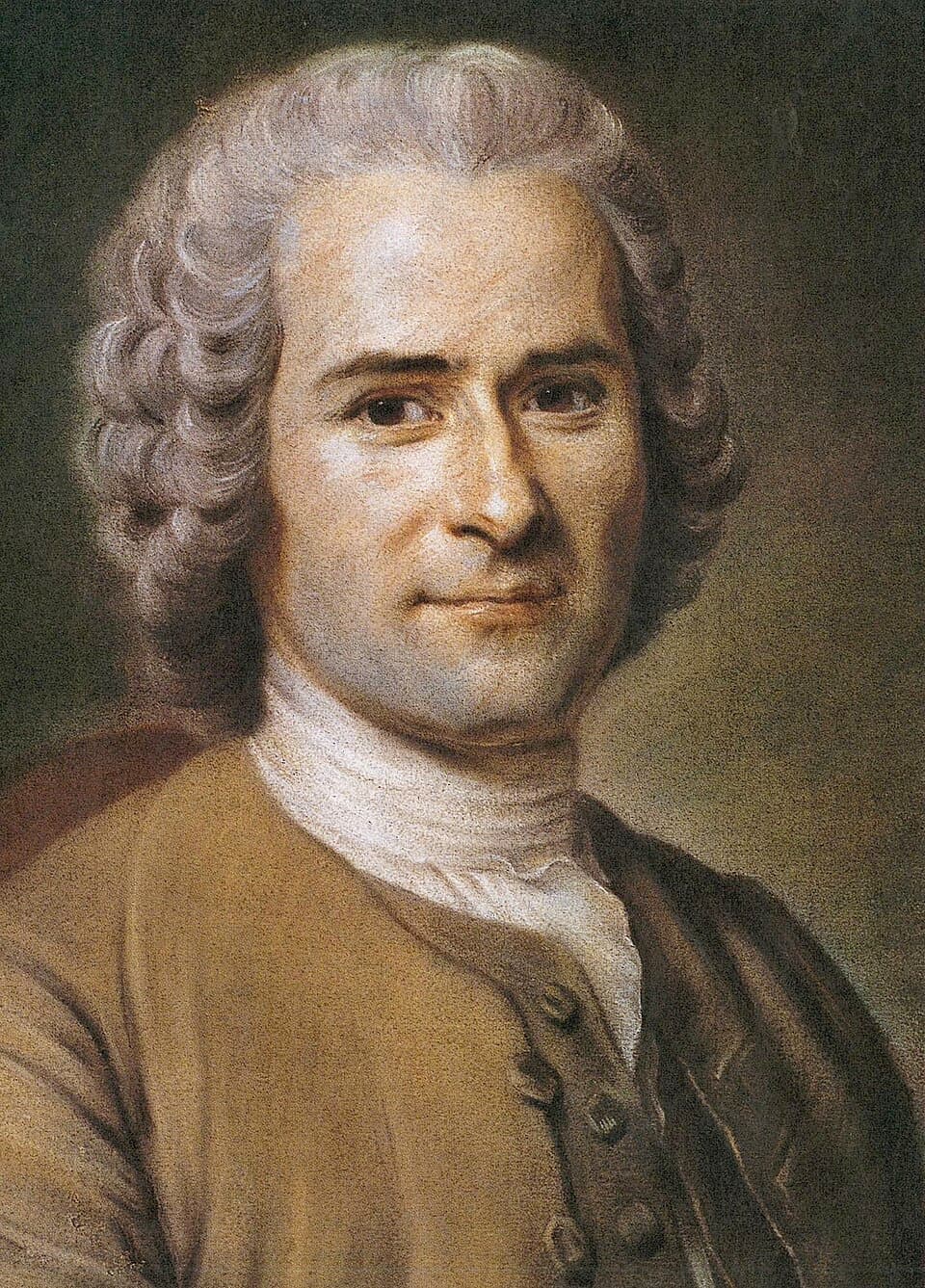
Two twelve-year-old visitors push open the door of a small house that smells of dried plants and music paper. An old gentleman in a strange caftan greets them, holding a tin box. He sets down his flowers, smiles, and invites them to sit down to answer all their questions.
—What was it like, the day you had your great idea on the road to Vincennes?
You know, my child, it was in 1749. I was walking to Vincennes to see my friend Diderot, who was locked up in prison. It was hot, I was tired. I sat down under a tree to catch my breath. I had a newspaper in my pocket, the Mercure de France. I opened it and came across a question from a competition: have the sciences and arts made men better? And then, all of a sudden, everything lit up in my head. I felt that the answer was no. Imagine a lightning bolt that strikes you without a sound. I cried, right there under the tree. From that day my first book was born.
Under a tree, a silent lightning bolt struck me: I understood my whole life in an instant.
—Why did you say that the sciences made people less kind?
Good question. Everyone in my time believed that the more you learn, the wiser and better you become. I dared to say the opposite. I wrote that in my Discourse on the Sciences and Arts, in 1750. I thought that man, at the very beginning, was simple and good. Imagine a child who always tells the truth because he doesn't yet know how to lie. Then we grow up, we learn to shine, to please, to hide what we think. We become clever, but not better. That's what scared me. That little book made me famous within weeks.
We learn to shine, but shining does not make the heart better.
—Is it true that you were a musician before becoming a philosopher?
Oh yes, and I was one all my life! Music was my true joy. In 1742, I had invented a new way of writing notes, using numbers instead of dots on lines. I presented it to the scholars of Paris. They found it clever... but too complicated to use. Oh well! I continued. I even composed a little opera, Le Devin du village. And you know what? It was performed before King Louis XV in 1752, and he liked it very much. Imagine a lovesick shepherd singing on stage: it was simple, tender, and it fulfilled me.
Before the great ideas, there was music, and music never left me.
—How did you earn a living when you were writing your books?
Not with my books, believe it or not! I wanted to remain free, dependent on no one. So in the mornings, I copied music scores by hand. I was paid by the page. It was humble, patient work, but it was honest. I preferred that to receiving money from a prince who would later demand flattery. Imagine copying for hours on end, note after note, in silence. My fingers would tire, but my mind remained my own. For me, a man who earns his bread with his hands owes nothing to anyone. That was my way of staying upright.
A man who earns his bread with his hands owes nothing to anyone.
—You wrote a book about how to raise children, right?
Yes, my greatest hope: Émile, or On Education, in 1762. In it I tell how to raise a child by letting him grow freely, instead of confining him to rules. For me, the child is not a little adult to be trained. He must run, touch, make mistakes, learn by himself. I wrote this sentence: Everything is good as it leaves the hands of the Author of things; everything degenerates in the hands of man. That means: nature does things well; it is we who spoil them. Imagine a tree that is allowed to grow instead of having all its branches twisted. That is my idea.
The child is not a little adult to be trained: he is a tree that must be allowed to grow.
—But is it true that you did not keep your own children?
You touch my greatest wound, my child. Yes. I had five children, and I left them at the Foundling Home. I had no money, no stable home; I thought myself incapable of raising them well. I lied to myself, thinking it was better for them. Later, my enemy Voltaire revealed it to everyone, and shame crushed me. I spoke of it in my Confessions, hiding nothing. How could the man who wrote about education do that? I have no good answer. I only ask you never to repeat my mistake.
I wrote about education, and I failed at my own: that is my greatest wound.
—Why were your books burned? That must feel strange.
Yes, it sends a terrible chill through your stomach. In 1762, I published two books at the same time: Émile and Of the Social Contract. In the latter, I said something dangerous for the time: true power belongs to the whole people, not to the king alone. In Paris as in Geneva, this was deemed unacceptable. My books were condemned, burned in the public square, and they tried to arrest me. I had to flee, like an outlaw, that is, a man chased from everywhere. Imagine having to leave your home in the middle of the night because your ideas frighten the powerful.
You can burn a book, but you can never stop the idea that has already taken flight.
—You were from Geneva; did you love your city?
Enormously! I was born in Geneva in 1712, and all my life I proudly signed 'citizen of Geneva'. There, the inhabitants had a say in city affairs; it was not a single king who decided everything. That marked me forever. That is where my strongest idea comes from: the general will, that is, what the people together want for the good of all. I even began my Social Contract with this sentence: Man is born free, and everywhere he is in chains. Imagine invisible chains, those of injustice, that we could undo together.
Man is born free, and everywhere he is in chains.
—What did you do to feel better when you were sad?
I would go for a walk and pick plants. Toward the end of my life, botany became my refuge. I carried a little tin box to store my flowers, and I would spend hours in the fields observing them, naming them. There, no more arguments, no more people who hated me. Just the grass, the sun, the silence. Imagine that every flower is a friend who never betrays you. When men had wounded me, nature always consoled me. I felt small and peaceful in its midst. That was my true happiness, the simplest of all.
When men had wounded me, nature always consoled me.
—What is the most beautiful memory of your entire life?
Ah, without hesitation: Île Saint-Pierre, on Lake Bienne, in 1765. I had just been driven out again, and I took refuge on that little island. I stayed only two months, but what months! In the morning I herborized, and in the afternoon I got into a boat. I let myself drift gently on the water, without rowing, just listening to the waves. Later, old and alone, I told all about it in my Reveries of the Solitary Walker. It was my last book, and I never finished it. If you remember one thing from me, my child: true happiness consists in very little.
True happiness consists in very little: a boat, the water, and silence.
This imaginary interview was generated by artificial intelligence from sources documented in Jean-Jacques Rousseau's profile. It dramatises what the figure might have said based on what we know about them, but does not constitute attested historical testimony. For primary sources and factual documentation, refer to the full profile.