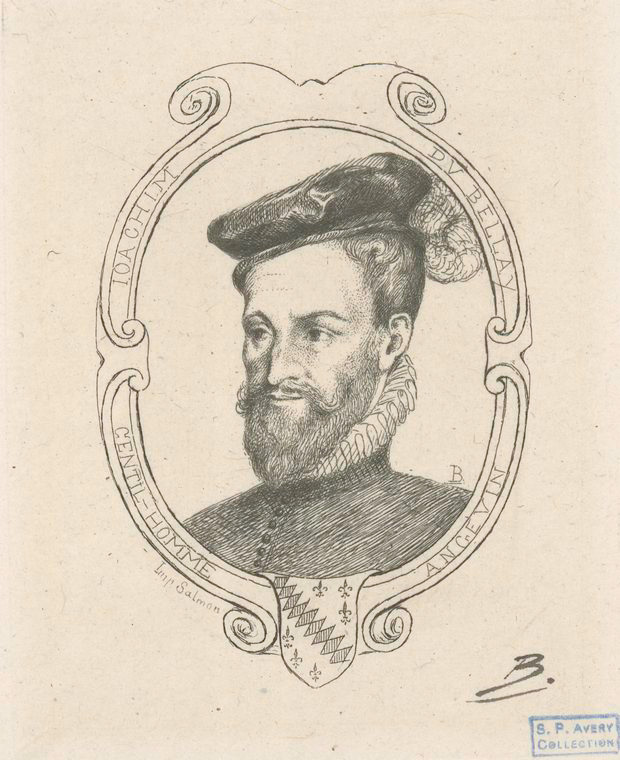
Kids interview Joachim du Bellay
by Charactorium · Joachim du Bellay (1522 — 1560) · Literature · 5 min read

Two twelve-year-old visitors push open the door of an old study, feathers and parchments everywhere. A gentle-looking poet awaits them, somewhat deaf, with an moved smile that anyone still takes an interest in him. He invites them to sit near the candle.
—Is it true you became a poet because of a meeting at an inn?
You know, my child, sometimes your whole life turns in a single afternoon. Around 1547, I was traveling, and I stopped at an inn in Le Perche. There, a young man spoke to me about Latin poets, his eyes shining. It was Ronsard. Imagine two boys discovering they share the same secret passion, as if each had found his brother. We left together to study at the Collège de Coqueret, in Paris, under a master named Jean Dorat. That's where our little band was born, which we called the Brigade, then the Pléiade. One inn, one meeting, and all of French poetry changed course.
Sometimes your whole life turns in a single afternoon.
—Were you a good student when you were little, like us?
Ah, no, not at all! I don't want to lie to you. I was born at the Château de La Turmelière, in Anjou, into a noble but poor family. My parents died when I was very small, and my older brother, who was supposed to take care of me, somewhat forgot about me. Imagine a child growing up almost alone, without real teachers. I didn't really start my studies until I was twenty! All my life, I believed other poets were better educated than me. So listen to me carefully: I made up for that delay with hard work and desire. You can start late and still succeed.
You can start late and still succeed.
—Why did you go to Rome, so far from home?
In 1553, my cousin, Cardinal Jean du Bellay, took me to Rome as his secretary. I thought I was leaving for glory, for the most beautiful city in the world. Imagine your excitement if you were taken to see a legendary land. And then... reality. From morning to night, I wrote boring letters, handled affairs that weren't mine. In the evening, in the palace near the Vatican, I thought of my little village of Liré, in Anjou. It was that sadness that made me write my most beautiful poems, Les Regrets. Pain, you see, sometimes knows how to turn into song.
Pain sometimes knows how to turn into song.
—What's your most famous poem, the one about Ulysses?
Yes! When I was in Rome, sick with homesickness, I wrote a sonnet. It begins: « Heureux qui, comme Ulysse, a fait un beau voyage ». You know Ulysses, that Greek hero who dreamed of returning home after the war? Well, that was me. I had the immense palaces of Rome before my eyes, and yet I preferred my little Liré a thousand times over, and the gentle air of the Loire Valley. Imagine: you live in a splendid castle, but you long for your simple room. That's what I wanted to say. Happiness is not always the greatest or the richest.
Happiness is not always the greatest or the richest.
—In Rome, what did you do in your free time?
I walked among the ruins, my child. Imagine broken arches, fallen columns, grass growing between the stones. I walked in the Forum, the great heart of ancient Rome, and I thought: here reigned the most powerful empire in the world, and nothing remains but stones. It makes you dizzy, you know. I wrote a collection about it, Les Antiquités de Rome. In one sonnet, I say one seeks « Rome in Rome » without finding it. The ruins taught me one thing: even the greatest eventually fall. Nothing is eternal, not even glory.
Even the greatest empires end up as stones in the grass.
—What was your house in Rome like? What did it smell like?
The cardinal's palace was immense, right near the Vatican. Imagine rooms with very high ceilings, libraries full of books, tapestries that smelled of dust and candle wax. In the morning, I got up before dawn to read Virgil and Petrarch, two poets I admired. At noon, we ate well: white bread, roast meat, Italian fruits, local wine. But all that luxury did not console me. I dreamed of the fish of the Loire and the cheeses of my childhood. My belly was full, but my heart was hungry for home.
My belly was full, but my heart was hungry for home.
—How did you write your poems? With what?
In the evening, my child, when work was done! I would sit at my table, a goose quill sharpened by hand, an inkwell, and a wax candle to see by. Imagine the silence of the night, just the scratching of the quill on paper. I would write a line, correct it, rewrite it ten times until it sounded right. A sonnet is a little poem of fourteen lines, very demanding: not a word too many. It was slow, patient, like cutting a precious stone. Beauty does not fall from the sky ready-made. It is worked, line by line.
Beauty does not fall from the sky: it is worked, line by line.
—Why did you want to write in French and not in Latin?
Ah, that was my great battle! In my time, scholars despised French. For them, only Latin was noble, worthy of great ideas. French, they called it the vulgaire, the language of the people, as if it were poor. That revolted me. In 1549, I wrote a strong text, the Défense et illustration de la langue française. I said: our language can be as beautiful as Latin! We just need to enrich it, invent new words. Imagine being told that your mother tongue is worthless. You would fight back, wouldn't you? Well, I fought with my poems.
Our language can be as beautiful as that of the Ancients.

—Did people like your text, or did it anger them?
Oh, it caused a scandal, my child! You see, in that book, I criticized the poets before us, like Clément Marot, whom many adored. I said we should stop simply translating the Ancients, and instead draw inspiration from them to do better. They called that imitation. Imagine a newcomer who arrives and says: « the old masters were wrong, follow me! ». Naturally, it grates. But without a little audacity, nothing ever changes. I was young, I had fire in my heart. And believe it or not, that little book really launched a new way of writing in France.
Without a little audacity, nothing ever changes.
—You became famous, so were you happy at the end?
That's a sad question, my child, but I'll answer you honestly. No. Back in Paris, I was becoming increasingly deaf. Imagine the world slowly fading around you, voices growing distant. And despite my reputation, I lived in hardship, without money. I hoped for a mécène, a rich protector who would help me, but he never came. I even wrote a satire, Le Poète courtisan, to mock those who flattered kings for gold. I died in Paris in 1560, at only 37. Glory, you see, does not always fill the belly nor warm the heart.
Glory does not always fill the belly nor warm the heart.
—How does it feel that people still read your poems today?
You cannot know how much that moves me, my child. In my lifetime, I thought I was forgotten, unloved, in the shadow of greater men. And now children, centuries later, still recite « Heureux qui, comme Ulysse ». Imagine: you plant a seed without knowing if it will grow, and one day a huge tree gives shade to people you never knew. That's what writing is. You speak to strangers in the future. So remember this lesson: what you create with your heart can live far longer than you. Words, they do not die.
What you create with your heart can live far longer than you.
This imaginary interview was generated by artificial intelligence from sources documented in Joachim du Bellay's profile. It dramatises what the figure might have said based on what we know about them, but does not constitute attested historical testimony. For primary sources and factual documentation, refer to the full profile.