Kids interview Jules Verne
by Charactorium · Jules Verne (1828 — 1905) · Literature · 5 min read
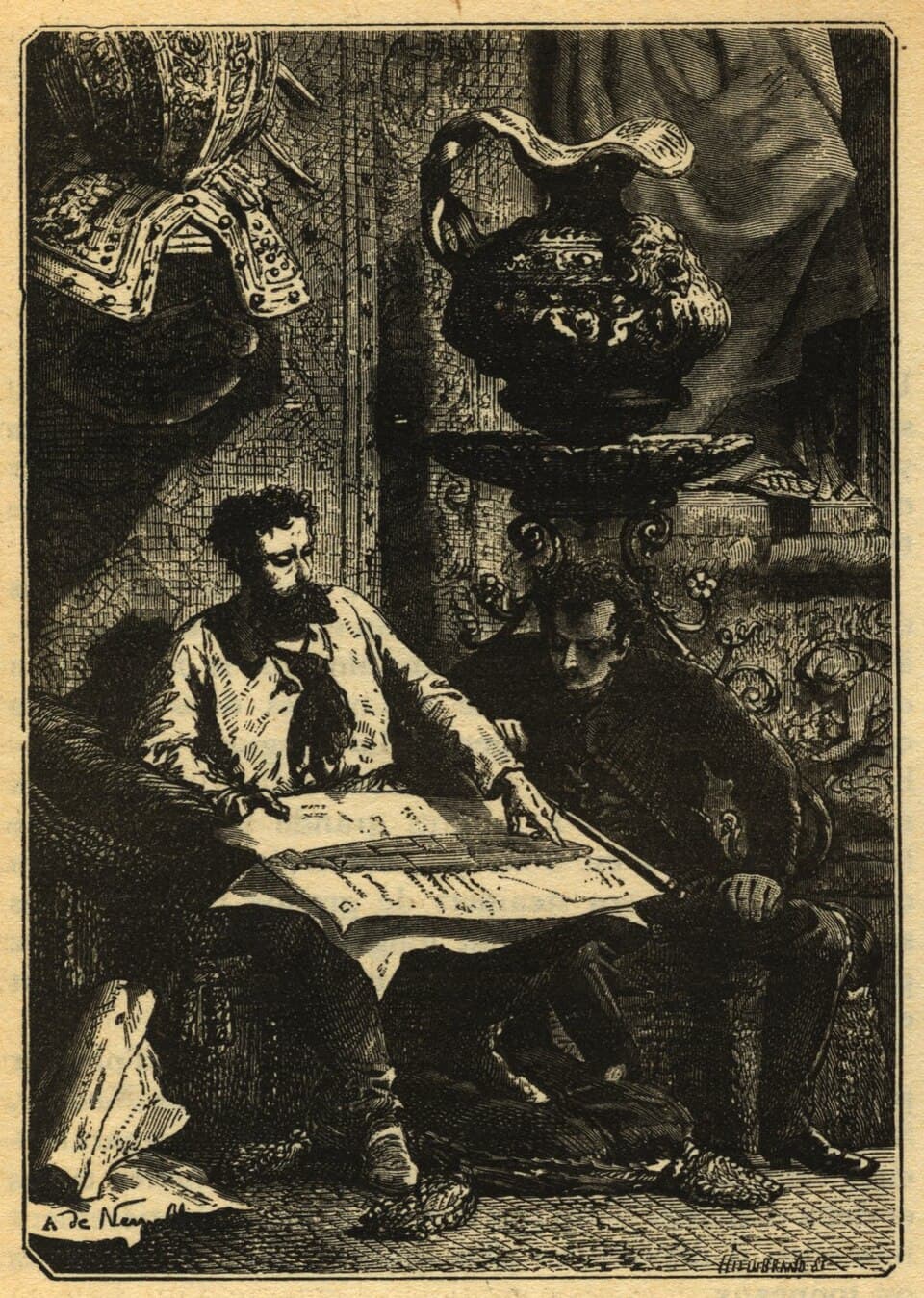
Two twelve-year-old visitors, on a school trip, pushed open the door of a large house in Amiens topped with a red brick tower. On the top floor, among maps and globes, an old gentleman awaits them with a smile. It is Jules Verne, and he is very eager to talk to them.
—Is it true that at age eleven you tried to run away on a ship?
You know, my child, it is quite true, and I am a little ashamed of it. I was eleven years old, in Nantes, and the port smelled of tar and spices from far away. One morning, I slipped onto a merchant ship bound for the Indies. Imagine a tiny kid among enormous sailors! My father caught me just in time, at Paimbœuf, further down the Loire. He was furious, and a little terrified too. That day, I made him a promise. And believe it or not, I kept my word all my life.
From now on, I would travel only in my dreams.
—Why did the port of your city make you dream so much?
Imagine a city where hundreds of ships arrive and depart every week. In Nantes, that was it. As a child, I would spend hours on the docks watching the sails. Each ship came from a place I would probably never see: Africa, America, distant islands. The sailors told stories of storms and strange beasts. You see, I didn't need to go far to travel: I just had to listen and imagine. All my childhood, that port was like a window open to the whole world. Later, I turned that window into novels.
—Did you really wake up at five in the morning to write?
Yes, every day, summer and winter, at five o'clock. It was still dark and cold. I had a light breakfast, then locked myself in my study, at the very top of my tower, until eleven o'clock. It was my sacred time. I wrote with a pen, in silence, while the city still slept. Do you find that hard? I loved those hours. The mind is fresh in the morning, like a blank page. That is how I was able to write over eighty novels. The secret is not genius, my child: it is sitting down every morning and starting again.
The secret is not genius, it is starting again every morning.
—How did you manage to put so much real science in your stories?
Ah, that is my great secret of the ant! In the afternoon, I did not rest. I read dozens of scientific journals and travel accounts. When an article interested me, I cut it out and filed it on an index card. In the end, I had thousands of cards classified by subject: volcanoes, stars, sea animals. Imagine a huge cabinet full of little papers! When I wrote a novel, I would go and pick from them. That way, my invented stories rested on real knowledge. My heroes traveled in imagination, but on solidly documented paths.
—Is it true that your very first book was initially rejected?
So true! And I almost gave up entirely. I had written Five Weeks in a Balloon, the story of a crossing of Africa in an aerostat — a big inflated balloon, you see, like the ones used in my time. A publisher, Pierre-Jules Hetzel, first rejected it. Imagine my sadness! But that man had an eye. He called me back, bought the manuscript, and published it in 1863. It was my first success. Without him, I think I would have put away my pen forever. So you see, a rejection is not always the end of the story.
A rejection is not always the end of the story.
—What did those famous Extraordinary Voyages mean?
That is the name Hetzel invented to gather all my novels into one great collection. The idea was beautiful: to tell the whole world through adventures, so that each reader would learn while having fun. Geography, volcanoes, stars, ocean depths... everything was to be covered. My books first appeared as serials: installments published week after week in newspapers. People waited impatiently for the next part, like you when someone tells you a story and stops at the worst moment! That collection became the work of my entire life.
—How did you guess that one day we would go to the Moon?
Oh, I didn't guess by magic, don't worry! In From the Earth to the Moon, in 1865, I imagined a journey to our satellite. My scientists sent their craft using a giant cannon. I was wrong about the method, of course. But I had read my cards well: the necessary speed, the launch point in Florida, the return to the ocean. You know, I deeply believed that science would eventually accomplish everything. What seems impossible today may become ordinary tomorrow. I wrote to prepare minds for those wonders to come.
What seems impossible today may become ordinary tomorrow.
—Captain Nemo and his submarine, did they really exist?
Not at all, and that is exactly where the dream begins! When I wrote Twenty Thousand Leagues Under the Sea, in 1870, a submarine — a ship capable of traveling underwater — was almost impossible, barely an idea in engineers' heads. I invented the Nautilus, a magnificent vessel, and its mysterious commander, Captain Nemo, who fled men to live in the depths. Imagine going down where no light reaches, among fish never seen before. The sea fascinated me: it is the vast desert where man is never alone.
—Is it true that you had your own boat to sail for real?
Yes, and I was as proud of it as a child! My boat was called the Saint-Michel III, a beautiful steam yacht. With it, I sailed the Mediterranean, hugged the coasts, made stops as far as Edinburgh, in Scotland. You see, I didn't just want to write the sea sitting at my desk. I wanted to feel it: the salt on my lips, the deck pitching, the wind pushing. All those sensations, I stored in my memory, then poured them into my maritime novels. I was a man of letters, but also a bit of a man of adventure.
I didn't just want to write the sea, I wanted to feel it.
—What was your favorite place by the water?
I really loved Le Crotoy, a small seaside resort on the Bay of the Somme. That's where I often moored my yacht. Imagine a large bay where the sea recedes very far, leaving kilometers of wet sand that glistens. Thousands of birds, the immense sky, the silence. I found there the calm and inspiration for my sailor tales. In the morning, I wrote; in the afternoon, I watched the water rise and fall. You know, a writer needs those places, where you dream with your eyes open. Nature has always given me more than books.
—If we walked into your house, what would we notice first?
You would first be surprised by my tower! My house in Amiens has a corner tower of red brick, and at the very top is my study. Entering, you would see maps all over the walls, terrestrial globes to follow the journeys of my heroes, a large astronomical telescope to look at the stars. On my table, a pen, an inkwell, and my piles of index cards. It smelled of paper and ink. It was my little kingdom, my motionless ship. From that room, without moving from my chair, I set off every morning for the ends of the earth.
—What would you like people to remember about you, later on?
What a beautiful question, my child. I would like to be remembered as a man who never stopped believing in knowledge and curiosity. I did not invent any machine, I did not explore any continent. But I gave thousands of young people the desire to understand the world and to explore it for real one day. If one of my novels pushed a child to become a sailor, scientist, or inventor, then I have succeeded in my life. Always keep within you that little flame that asks "why?" and "how?". It is what moves the world forward.
Always keep within you that little flame that asks why and how.
This imaginary interview was generated by artificial intelligence from sources documented in Jules Verne's profile. It dramatises what the figure might have said based on what we know about them, but does not constitute attested historical testimony. For primary sources and factual documentation, refer to the full profile.