Imaginary interview with Marguerite Duras
by Charactorium · Marguerite Duras (1914 — 1996) · Literature · 5 min read
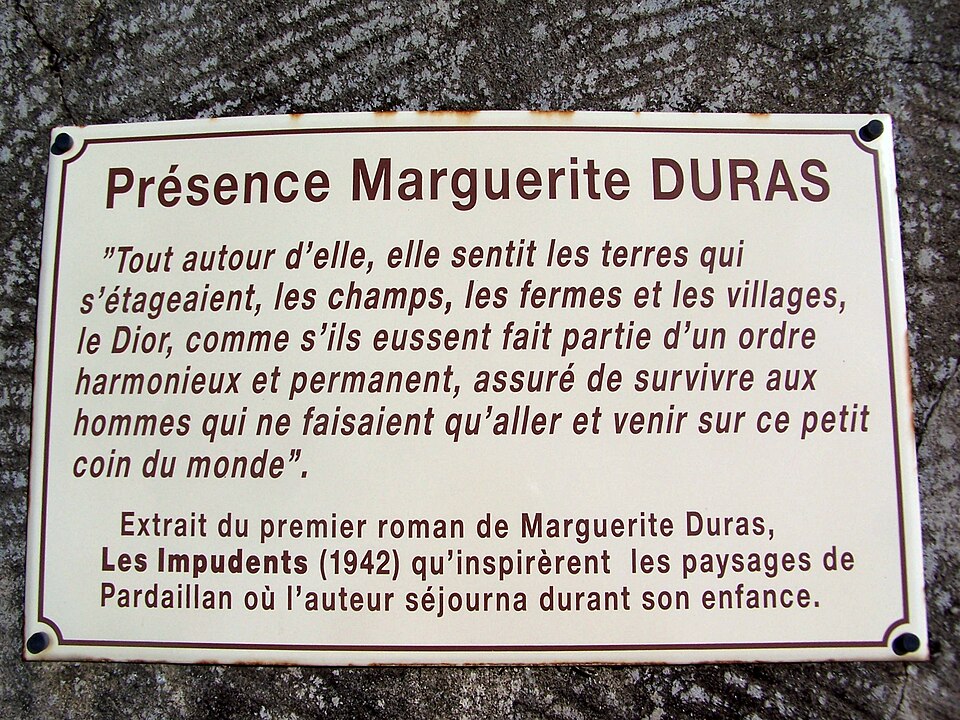
Rue Saint-Benoît, an autumn evening, late 1980s. The apartment smells of paper, cold tobacco, and tepid white wine. Marguerite Duras receives us in a bathrobe, a cigarette in her hand, her voice slow, pausing between each sentence with long silences she never tries to fill.
—Before being a pen name, who was little Marguerite Donnadieu?
A child born in Gia Dinh, in 1914, in a heat that no one here can imagine. My father died when I was four, and after him the Donnadieu family never stopped falling. My mother ruined herself on a concession that the Pacific flooded every year — I later turned all that story into The Sea Wall. We were white and poor, which in the colony was an almost shameful fault. I grew up between the river mud and social shame, and it was there, I think, that everything was decided. One only ever writes about what was missing very early on.
One only ever writes about what was missing very early on.
—How do you explain waiting seventy years to write The Lover?
Because it took all that time for the shame to become sayable. I was fifteen and a half on that ferry crossing the Mekong, and the man in the black limousine was Chinese, rich, and I didn't love him the way people think. "I am fifteen and a half. It is the crossing of a ferry on the Mekong. The image lasts the whole crossing of the river." There, that's the image I carried all my life. When the Goncourt came, in 1984, I was seventy, and the book went into forty languages. A consecration, yes, but arriving over the shoulder of an old woman who no longer expected anything.
—With Moderato Cantabile, in 1958, you break something. What exactly?
With the idea that a novel must say everything. Moderato Cantabile is a bourgeois woman, a café, a crime heard from afar, and between the two silences that I refuse to fill. Look at the beginning: "'Do you want to read?' asked the lady. 'No,' said the child. The lady was not surprised by this refusal." Everything is there, in what is not said. This was filed under the label of the New Novel, and fine, I accept that. But I wasn't theorizing anything: I was cutting. I removed explanation, psychology, chatter. What remains when you've removed everything, that's what I call writing.
I removed explanation, psychology, chatter. What remains, that's what I call writing.
—Why so many silences, cut sentences, repetitions in your language?
Because full speech always lies a little. I once said, in an interview with Michèle Porte, that "writing is also not speaking. It is keeping silent. It is screaming without noise." That's exactly it. People have spoken of blank writing in my regard, that word Roland Barthes liked — a stripped-down, neutral language without fat. My sentences are short because pain doesn't make long sentences. It returns, it stumbles, it repeats. I work at night, I reread in the morning, and I cross out everything that seeks to seduce the reader. What must remain is the lack, not the ornament.
—You are described as writing at night. What happens during those hours?
At night, there's no one left to judge you, not even yourself. I work at the typewriter, in the silence of rue Saint-Benoît, sometimes with a little music, sometimes nothing. During the day, I receive people, we talk, we drink, the apartment is full of people. But it's at night that sentences come, in a kind of concentration that resembles prayer, except there's no god at the end. In the morning, in my bathrobe, a black coffee in hand, I reread what the night has deposited. Often it's bad. Sometimes a line holds, and that one line justifies all the hours lost.
It's at night that sentences come, in a concentration that resembles prayer, except there's no god at the end.
—You have spoken openly about alcohol. What place does it hold in your writing life?
A place I neither want to excuse nor hide. Alcohol accompanied my nights like a companion one is ashamed of but cannot leave — white wine, whiskey, the bottle placed next to the machine. I spoke of it in The Lover, I never pretended. It comes from far away, from that Indochinese childhood where we lacked everything; one never truly fills what one was deprived of as a child. Alcohol doesn't make you write, don't believe that legend. It damages. But it kept at bay a certain terror of emptiness, and at night, emptiness, I know it well.
—During the war, you wait for Robert Antelme's return. How does one endure such a wait?
One doesn't endure it, one sinks into it. Robert Antelme, my husband, had been arrested by the Gestapo and deported to Dachau. We were in the Resistance, and then suddenly he was no longer there, and we had to wait for months without knowing. When he returned, in 1945, he weighed less than a child, you had to carry him, feed him spoon by spoon, teach him to live again. The liberation of the camps, for me, is not a date in History, it's a body I dared not recognize. People talk about war as a grand narrative; I kept only a gaunt face in a doorway.
The liberation of the camps, for me, is not a date in History, it's a body I dared not recognize.

—The War was born from forgotten notebooks. What does one feel rereading oneself like that, years later?
Dread, almost. "I found this diary in two notebooks from the blue cupboards at Neauphle-le-Château. I have no memory of having written it." That is the most exact truth I can tell about The War. These handwritten notebooks, I had stored them in my house at Neauphle-le-Château, and time had covered them. Opening them again, I discovered a woman who was me without being me, noting day after day the wait, the anguish, the love become unbearable. Publishing that in 1985 was letting that stranger from the past speak. There are texts one doesn't write: one receives them from oneself as from a dead person.
—With Hiroshima Mon Amour, you move from novel to cinema. What changes for the writer?
Everything, and nothing. When Alain Resnais asked me for that screenplay, in 1959, I didn't write images, I wrote voices. A French woman, a Japanese man, memory, forgetting, and that martyred city where love comes to collide with the unspeakable. The film opens with these words: "You saw nothing in Hiroshima. Nothing. — I saw everything. Everything." There is all my work in five lines: the impossibility of saying and the stubbornness to say anyway. This was linked to the New Wave, and the film won its award at Cannes. But what interested me was learning that speech, in cinema, can be stronger than what is shown.
I didn't write images, I wrote voices.
—In India Song, you radically separate voice and image. Why this dissociation?
Because that's how memory works: voices never match faces. When I directed India Song, in 1975, from my own play, I wanted bodies to be there, on screen, in the humid colonial India, while off-screen voices, out of frame, would speak of them as one speaks of ghosts. The 16mm camera filmed presences; the sound told an absence. Carlos d'Alessio's records held the thread. Many didn't understand it, some walked out of the theaters. But it is perhaps my truest film, because it doesn't lie about what memory is: an image that remains and a voice that fades away.
This imaginary interview was generated by artificial intelligence from sources documented in Marguerite Duras's profile. It dramatises what the figure might have said based on what we know about them, but does not constitute attested historical testimony. For primary sources and factual documentation, refer to the full profile.