Imaginary interview with Martha Graham
by Charactorium · Martha Graham (1894 — 1991) · Performing Arts · Culture · 6 min read

New York, a winter morning in a bare-walled Manhattan studio, a rehearsal piano in the corner, the smell of waxed wood and old sweat. Martha Graham, small and straight as a blade, receives us sitting cross-legged on the floor mat. She speaks slowly, weighing each word, as if language too must pass through contraction and release.
—How did the idea come to you to wrap yourself entirely in that tube of fabric for Lamentation?
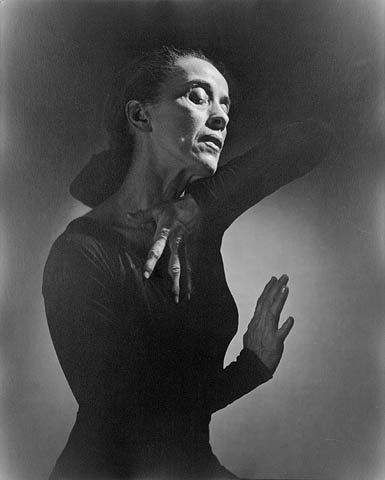
In 1930, I didn't want to dance grief, I wanted to be grief — the living statue of a mourning that no one names. So I took a tube of elastic jersey, that sticky material that hugs and distorts, and I enclosed myself in it, leaving only my face, hands, and feet exposed. Sitting on a bench, I pulled the fabric to the right, to the left, and the cloth became a second body, a prison of tension. The audience, accustomed to tutus and pointe shoes, didn't understand what they were seeing: no steps, no jumps, only an eight-minute twist. But it was there, in that tube, that I knew costume was not an ornament — it was the dramatic extension of the flesh.
I didn't want to dance grief, I wanted to be grief.
—Do you remember a reaction from the audience that struck you after this piece?
A woman came to me backstage, her face undone, unable to speak at first. Then she told me she had just lost a child and had never seen anyone express her own pain so exactly — her own intimate pain, the one she thought unspeakable. That is what I expected of dance: not applause, but recognition. My father, who was a doctor in Allegheny, used to say the body never lies. That evening, in the jersey tube, I understood he was right beyond medicine: a true movement reaches in the other the truth they dare not admit to themselves. Classical ballet embellished; I wanted to un-embellish, to return to the bone of emotion.
—You often mention your father. What did he pass on to you that still infuses your work?
He observed patients not for what they said, but for what their posture betrayed — a shoulder that shrinks, a hand that lies when the mouth smiles. As a child in Allegheny, I heard him repeat that the body never deceives, and that phrase became the foundation of all my technique. I based my art on this cycle I call contraction-release: the torso hollows around the solar plexus as if struck, then expands — the very breath of life, inhalation and exhalation made visible. Movement does not lie, I wrote in my notebooks; 'it is a form of truth that we cannot afford to lose in our world of false appearances.' My whole life, I have only translated the intuition of a country doctor.
The body never deceives — that phrase from my father became the foundation of everything.
—Many of your dancers describe your technique as an ordeal. Why such rigor in training the body?
Because a body is not a gift, it is an instrument, and an instrument is shaped. Every morning, before the city woke, I started on the floor — sitting, lying, rolling — working on contraction and release like a pianist on scales. Floor work, which ballet absolutely ignored, is for me the most dramatic space: that is where fall and rise play out, the earth that takes us and gives us back. I demanded absolute intensity from my dancers because the slightest complacency shows, is felt, contaminates everything. I was blamed for being harsh. But I asked nothing that I did not first impose on myself, until an age when others rest.
—In 1936, Germany invited you to dance at the Berlin Olympics. How did you make your decision?
Without hesitating a second. They offered me a huge stage, spotlights, the showcase of a regime that wanted to make the world believe it loved the arts. I refused, and I said it clearly: no true artist can lend their body to endorse that. How can you dance the freedom of gesture under the eyes of those who imprison bodies and minds? Several of my dancers and musicians were Jewish; sending them there would have been a betrayal. In New York, in this studio, we were already living through the Great Depression, we knew what fear of tomorrow is — but there are invitations you decline precisely because you have nothing to sell but your truth. Two years later, I choreographed the Declaration of Independence in American Document.
No true artist can lend their body to endorse such a regime.
—Tell us about the commission of Appalachian Spring. How was this spring that became a symbol of America born?
The Library of Congress, through the Elizabeth Sprague Coolidge Foundation, commissioned me, and I had Aaron Copland for the music. I sent him a scenario, a story of pioneers, a young bride and a preacher on new land; he sent me back a score clear as a spring, which would win the Pulitzer Prize in 1945. We premiered the piece in 1944, in the midst of war, and yet it breathes hope: a house barely built, a couple settling in, the American soil as promise. I never believed that art is born from a single head. A choreography, for me, is a dialogue — with the composer, with the sculptor, with the dancer — where each brings their language and the whole speaks with one voice.
—What did the sets by sculptor Isamu Noguchi, present in so many of your pieces, bring you?
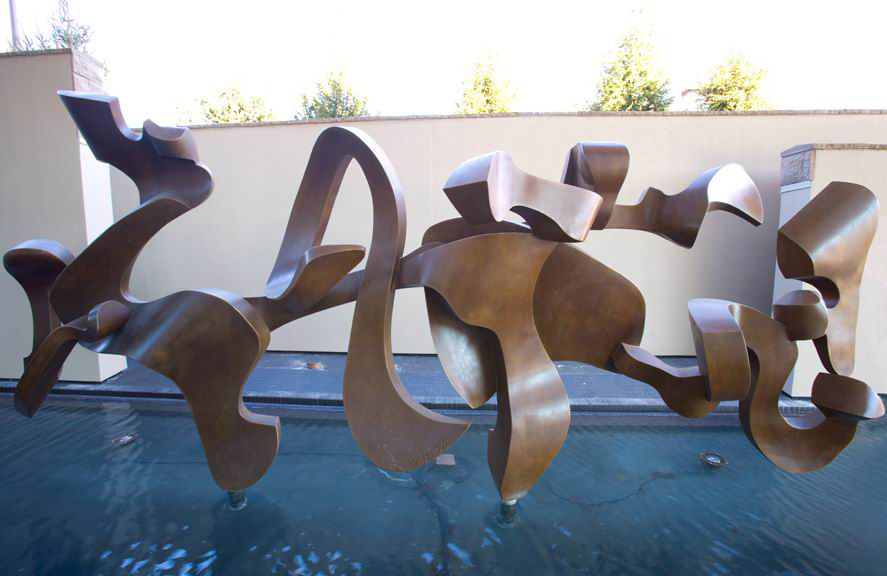
Isamu Noguchi did not make me sets, he gave me spaces to inhabit. For Appalachian Spring, a few lines of wood suggested a house without ever enclosing it; for Cave of the Heart, a golden structure became both dress and cage. His forms were spare, symbolic, never illustrative — they left full room for movement while charging it with meaning. We shared the same conviction: the essential is said with the least. He worked stone and metal as I worked flesh, seeking the right tension. In the evening, he would sometimes come to dinner here, with Copland, and we would remake the world — dance, sculpture, music, all in dialogue. His objects were part of my mental decor even before they were on stage.
—Why did you seek in Greek myth — Medea in Cave of the Heart — the material for your most intense works?
Because the Greeks dared to face what we hide: the jealousy that devours, the vengeance that disfigures a loved face. In Cave of the Heart, in 1946, I embody Medea not as a distant figure but as a woman of today consumed by envy, curled up in Noguchi's golden structure as in her own venom. Myth is not an antiquarian costume, it is a mirror: Medea is each of us at the moment when love turns to poison. I wanted a dance-theater, with characters, interiority, psychology — dance capable of carrying an entire tragedy. Ballet told stories of princesses; I wanted to dig into the cave of the heart, that dark place no one likes to go.
—With Clytemnestra in 1958, you dared a full evening. What drove you to that dramatic ambition?
I had spent years condensing an emotion into eight minutes; I needed to test whether dance could sustain a whole evening, like a play by Aeschylus. Clytemnestra, based on the Oresteia, offered me that: a dead queen who, in the Underworld, questions her own guilt and seeks redemption. It was my first full-evening ballet, in 1958, and undoubtedly the peak of my danced theater. I was not telling a plot, I was descending into a consciousness — shame, remorse, what twists at the bottom of a being. At that point in my life, I knew I would not have my dancer's body much longer; so I wanted to say everything, the weight of an entire existence, before the stage left me.
—At ninety-six, you still create Maple Leaf Rag, a light piece. What keeps you alive in creation?
I stopped dancing on stage in 1965, and that was a real mourning — but choreographing is still dancing with the bodies of others. In 1990, on a rag by Scott Joplin, I wanted a playful piece, to prove that modern dance is not condemned to gravity alone, that laughter too is a truth of the body. What keeps me standing, I have always felt this way: 'There is a vitality, a life force, an energy that is translated through you into action. And because there is only one you in all of time, this expression is unique. If you block it, it will never exist through any other means.' As long as this energy passes, I have no right to hold it back.
Choreographing is still dancing — with the bodies of others.
This imaginary interview was generated by artificial intelligence from sources documented in Martha Graham's profile. It dramatises what the figure might have said based on what we know about them, but does not constitute attested historical testimony. For primary sources and factual documentation, refer to the full profile.