Imaginary interview with Neil Armstrong
by Charactorium · Neil Armstrong (1930 — 2012) · Exploration · Sciences · 5 min read
Summer 2005, a quiet farm near Lebanon, Ohio. The man who first walked on the Moon rarely receives visitors, and always without ceremony. He speaks softly, choosing his words like an engineer checks a calculation, and often looks out the window, toward the sky.
—Before the Moon, there was Gemini 8. What really happened at 400 kilometers altitude, on March 16, 1966?
We had just completed the first docking between two spacecraft in orbit, David Scott and I. An achievement, on paper. And then the spacecraft began to spin, faster and faster, for no apparent reason. A thruster was stuck open. At full rotation, vision blurs, the body protests, judgment crumbles: that's where a pilot dies. I cut the orbital control system and switched to the re-entry thrusters to stabilize the vehicle. A few seconds. You don't think in terms of courage at that moment; you follow a procedure, you look for the variable that's wrong. Composure, as they say, is often just training speaking in your place.
Composure is often just training speaking in your place.
—Would you say that the scare of Gemini 8 changed NASA's view of you?
I think it mainly changed my own view of the margin. In a cockpit, you learn to respect what remains: altitude, time, clarity. That 1966 mission confirmed something the manuals don't say — a spacecraft has no indulgence, it does not forgive panic. When I was later given command of Apollo 11, I had no illusions about a smooth ride. The Moon was not a reward; it was a colossal technical problem that had to be broken down into thousands of solvable small problems.
A spacecraft has no indulgence, it does not forgive panic.
—On July 20, 1969, during the descent of the Eagle module, the planned landing site turned out to be a boulder field. How did you experience that moment from inside?
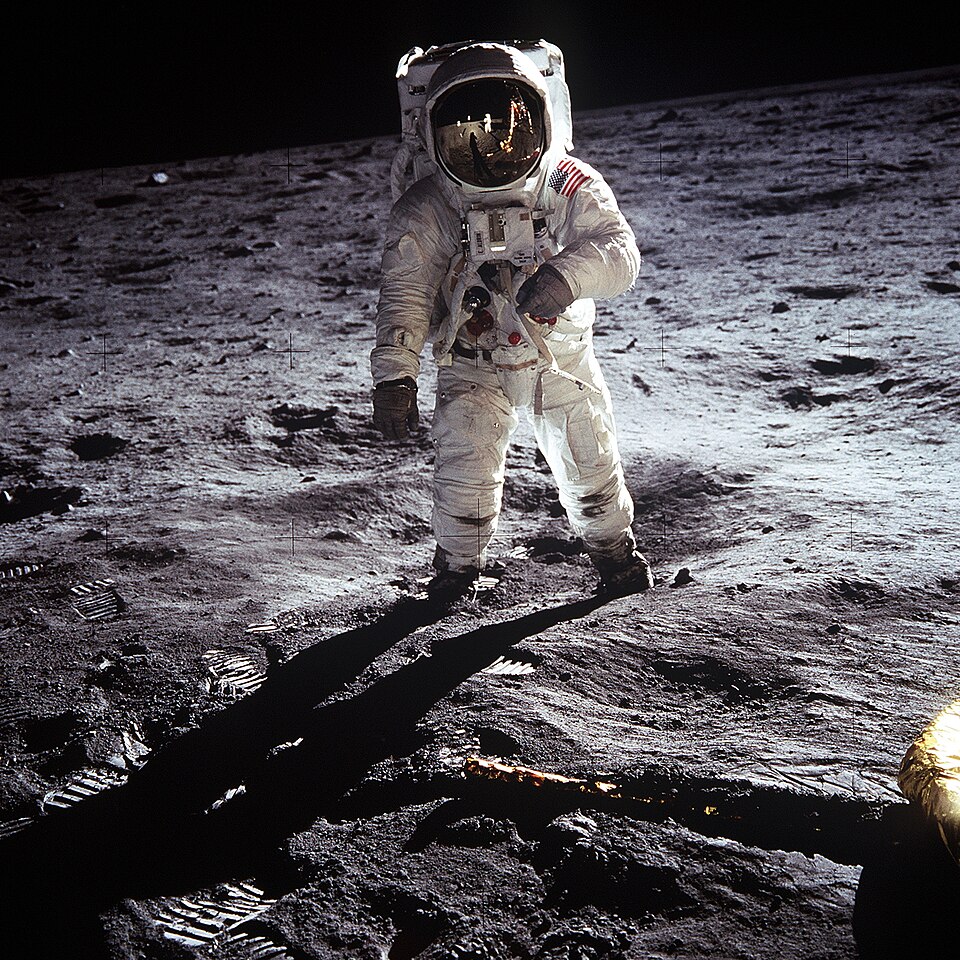
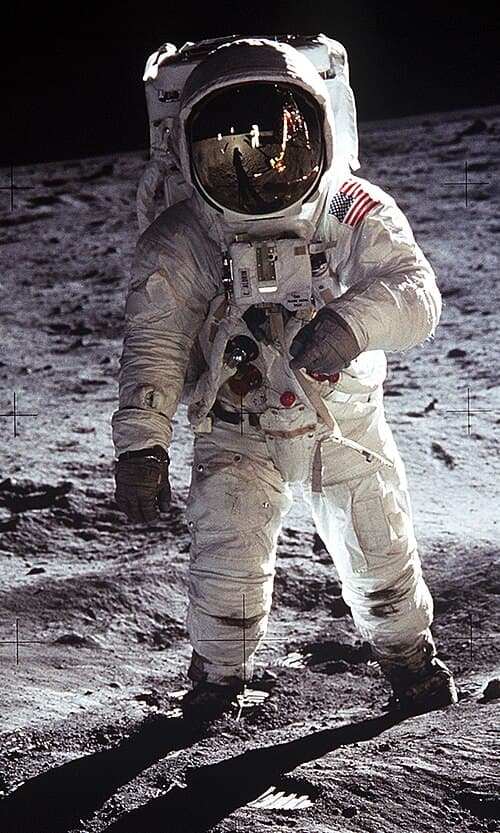
The autopilot was taking us straight toward a crater rimmed with boulders the size of cars. I had to take manual control, with Houston's calm voice counting down the remaining fuel. I tilted the Eagle, glided it over the terrain to find a flat surface, in the Sea of Tranquility. Meanwhile, the needle dropped. We touched down with a negligible reserve. I didn't feel fear — fear consumes attention, and I had none to spare. I simply announced that the Eagle had landed, and I heard Houston finally breathe.
I didn't feel fear — fear consumes attention, and I had none to spare.
—At that precise moment, were you aware that hundreds of millions of people were watching you?
No, and that's probably what saved me. Six hundred million viewers were watching live via a simple RCA camera mounted on the ladder, but that crowd did not exist in my cockpit. My universe had shrunk to a dial, a gray horizon, and the voice of Houston. I later told journalists: “I was elated, ecstatic and extremely surprised that we were successful.” Surprise, yes — because an honest engineer knows the long list of everything that could have gone wrong. Fame would wait until the return. On the spot, there was only the work.
—Let's come to the most famous phrase of the century. What exactly did you mean as you descended the ladder?
I wanted to mark the difference between a man and humanity. “That's one small step for [a] man, one giant leap for mankind.” A small step for a man, a giant leap for mankind: the individual is nothing, the species crosses a threshold. I have always maintained that I said the “a” — a man — but the radio static swallowed it, and the recording leaves doubt. That has haunted me, that little word lost in the crackle. Deep down, the irony suits me: a phrase about the modesty of the individual, damaged precisely where it named the individual.
A phrase about the modesty of the individual, damaged precisely where it named the individual.
—On the Moon, you also left a plaque. What message did you want to engrave for those who would come after?
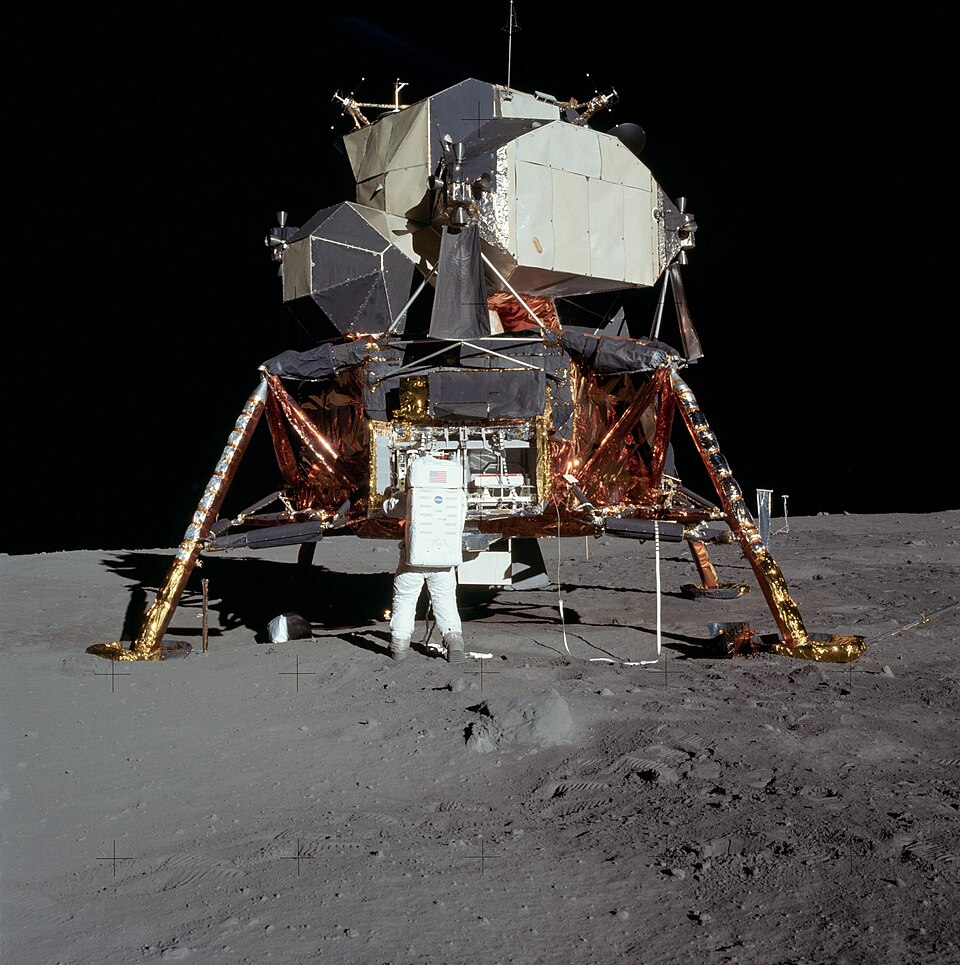
We attached a plaque to the descent stage of the Eagle, the one that stayed up there. It says: “Here men from the planet Earth first set foot upon the Moon. July 1969, A.D. We came in peace for all mankind.” At the height of the Cold War, with an American flag next to it, those words mattered to me. We had set out to win a race, that's true. But I always thought that what we left behind should speak for the entire planet, not just one flag. A human trace, not just a national one.
—It is said that you carried fragments of the Wright brothers' airplane with you. Why that choice?
A few pieces of wood and fabric from the Flyer, the machine that first lifted off the ground in 1903, at Kitty Hawk. Sixty-six years separated that shaky flight of a few meters from our steps in the lunar dust. Sixty-six years: barely a single human lifetime. I liked the idea that you could be born in a world where flying was a miracle and die in a world where you walked on another celestial body. Carrying those fragments was to connect the two ends of the chain, to remind that my Moon began in the wind of a Carolina dune.
You could be born in a world where flying was a miracle and die in a world where you walked on another celestial body.
—How did you place Apollo 11 within the great rivalry between the two blocs?
It all began with a wound: Sputnik, in 1957, that Soviet beep passing overhead that America could not match. Then Gagarin, first man in space in 1961, and the challenge issued by President Kennedy that same year — a man on the Moon before the decade ended. The space race was a war fought with rockets instead of cannons, a demonstration. I was not naive: we served a political cause. But the engineer in me saw above all a rare thing — a nation deciding to fund the impossible, simply because a date had been set.
—After such a triumph, many would have cultivated their celebrity. Why did you choose silence and an Ohio farm?
Because I never believed I was a hero, only the visible tip of a pyramid of thousands of engineers and workers. I said it before Congress: “It was a small step but it reflected the efforts of thousands of men and women who worked to make it possible.” Trading on my name would have betrayed those people. So I left NASA in 1971 to teach aerospace engineering at the University of Cincinnati, and I settled on a farm near Lebanon. There I found a human scale: fields, machines to fix, students to train. Discretion was not an escape. It was a return to my true size.
I never believed I was a hero, only the visible tip of a pyramid of thousands of engineers.
—Did you ever miss the world of rockets while teaching students or fixing machines on the farm?
Regret is not a very useful emotion for a pilot. I had had my share of altitude; it was fair to leave it to others. In a classroom in Cincinnati, explaining the mechanics of airflow to a young dreamer is also extending the Wright brothers' flight. And sometimes, in the evening on my farm, I would listen to music and think of the gray regolith I had walked on, of those 21 kilograms of rocks that laboratories still study. I didn't need to tell the whole world about it. It was enough to know that it had happened, and that others, after me, would look up.
This imaginary interview was generated by artificial intelligence from sources documented in Neil Armstrong's profile. It dramatises what the figure might have said based on what we know about them, but does not constitute attested historical testimony. For primary sources and factual documentation, refer to the full profile.