Imaginary interview with Nicolas Copernicus
by Charactorium · Nicolas Copernicus (1473 — 1543) · Sciences · 6 min read
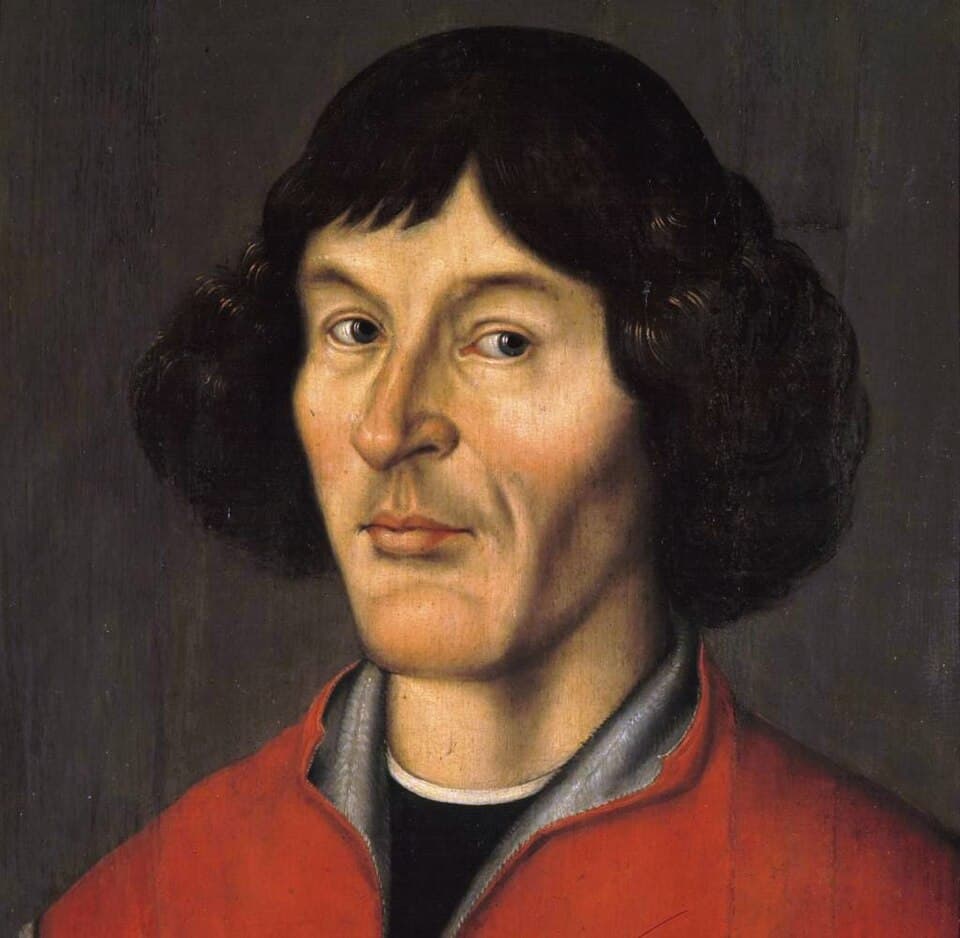
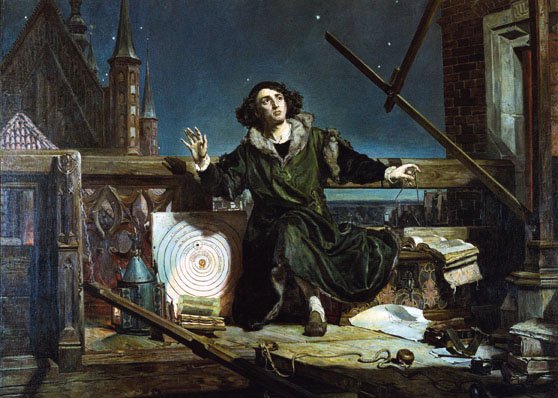
Frombork, on the shores of the Baltic Sea, a winter evening in 1542. In the brick turret where the wind whistles through the arrow slits, an old man in a canon's robe puts away his instruments. He agrees to answer our questions, a candle trembling near a manuscript he still hesitates to entrust to the printer.
—What drove you, as a young man, to doubt a model of the world that everyone took for granted?
It all began with a discomfort, almost a geometer's irritation. I had before me the Almagest of Ptolemy, that monument fourteen centuries old, and I found it ugly. To save the motion of the planets, they were made to run on epicycles—small circles perched on larger ones, a scaffolding so complicated that no mind loving harmony could find rest in it. I simply asked myself: what if we are not motionless at the center? In Bologna, around 1500, observing a lunar eclipse alongside my master Novara, I felt that what we took for the journey of the stars might only be our own motion. Moving the Earth meant restoring simplicity to the heavens.
I found the old world not false, but ugly: a scaffolding where harmony found no rest.
—How would you describe, to someone who knows nothing of mathematics, what you placed at the center of everything?
Imagine a lamp in the middle of a large hall. Must it be carried around the walls to light each guest, or is it not enough to set it in the center, from where it bathes everything in a single movement? I placed the Sun in the middle, that torch, and made the Earth revolve around it like the other planets. In my little manuscript, the Commentariolus, which I circulated around 1514 among a few learned friends, I set down seven propositions, including this one: all spheres revolve around the Sun as around their midpoint. This seems madness, I know—feeling the solid ground under your feet and asserting that it hurtles through space. But numbers do not tremble.
—With what means can a man claim to correct fourteen centuries of astronomy?
With very little, believe me, and that is my secret pride. I have no telescope that brings the stars closer—no one does. I climb to my turret, against the cathedral wall, and measure with the naked eye. My most precious instrument, I made with my own hands: a triquetrum, three long articulated pine rods, with which I measure the angle of a planet above the horizon. I also have an astrolabe and a graduated quadrant. Clear nights on the Baltic are rare and freezing; I sometimes wait weeks for a single useful observation. But patience makes up for the absent glass. What my eyes do not precisely see, calculation corrects. One corrects centuries through obstinacy, not miracles.
What my eyes do not precisely see, calculation corrects: one corrects centuries through obstinacy.
—What are your nights like, up there in the turret?
By day, I am another man: morning office, chapter accounts, the sick of the town in the afternoon. But when night falls on Frombork and the sky finally clears, I climb up. The cold bites, the ink sometimes freezes in the horn, and I must blow on my fingers between readings. I sight a planet, note its altitude, its time, then go back down to record it among my thousands of folios. These measurements, accumulated over thirty years, do not form a flash of genius but a slow sedimentation. That is how certainty is born: not from a sudden vision, but from a column of figures that finally admits no other explanation than the one we feared.
—You are presented as an astronomer, but your life was filled with other duties. How did you reconcile them?
Astronomer! My fellow canons would laugh to hear me called that. I am a canon of Warmia, and that is my estate: I recite the office, administer the Church's goods, draft deeds, defend our lands when the Teutonic Order covets them. I am also a physician—people come for a fever, a wound, and I know remedies better than epicycles in the eyes of the locals. The sky occupies only my stolen hours, those others give to sleep. My dark cleric's robe, I wear from morning to night; astronomy is but a cloak I don in secret at night. Perhaps it is better so: no one suspects an accountant of overturning the universe.
No one suspects a chapter accountant of wanting to overturn the universe.
—Rome itself once consulted you. What did they ask?
In 1516, the Council of Lateran realized that our calendar, inherited from Julius Caesar, was drifting: feasts no longer fell in their seasons, and Easter floated. Scholars were consulted, and they thought of me. I replied with a frankness that must have disappointed: the length of the year and the motions of the Sun and Moon are not yet measured with enough precision to reform without risking a new error. Before correcting the calendar, one had first to correct astronomy. It was an evasion, certainly, but also a program: all my work since has aimed only at making those measurements trustworthy. They asked me for a date; I answered that first the heavens must be refounded.
—You completed your great work more than ten years ago. Why delay its publication so long?
Because I am afraid, I admit it plainly. My De revolutionibus has slept, essentially finished since 1530, in a chest in this house. I fear the contempt that, they say, is deserved by those who advance propositions contrary to received opinions. That I be called mad, that I be cited from the pulpit for ridicule, that they wave against me some Scripture verse where Joshua stops the Sun—how does one stop what does not move? For thirty years, I preferred silence to mockery. A scholar is not a soldier: he has no armor but the accuracy of his calculations, and that does not protect against sarcasm. I long thought it better to entrust my ideas to a few friends than to the crowd.
Let them wave against me Joshua's stopped Sun—but how does one stop what does not move?
—What finally overcame your caution?
A young man, in 1539. Rheticus, a mathematician from Wittenberg, made this entire journey to my Baltic to see me, he a Lutheran and I a canon—the age has such ironies. He became passionate about my folios like a thirsty man at a spring. It was he who, last year, published a first summary, the Narratio Prima, to test the mood of scholars before risking the entire work. The reception was not the burst of laughter I feared. So I yielded. His fervor warmed my old fear. Without that obstinate boy, my book would have remained in its chest, and would have died with me, like so many thoughts that never found their printer or their courage.
—Do you sometimes think about what will become of this book once you are no longer there to defend it?
Often, now that my strength declines. I dedicated the work to Pope Paul III himself, out of prudence and respect: so that no one could say I conspire against the Church, I who have served it since childhood. I will probably never know how I will be read. If I could imagine that a century after me, men take up these calculations, correct them, surpass them—that would be my true legacy, not praise but rectifications. A living work is one that one dares to amend. I believe I will hold these printed pages in my hands at the threshold of death, and that will suffice: to have posed a question so vast that others will take generations to close it.
—If posterity were to remember only one thing about you, what would you wish it to be?
Not audacity, but method. They may remember the scandal—the Earth torn from its throne, man displaced from the center of the world. But what matters to me is the manner: having preferred numbers to authorities, patient observation from my turret to the assertions of Ptolemy, however venerable. I kept many old ideas, you see: my planets still run on circles, on those orbes once thought crystalline. I did not overturn everything. I only moved one point—the center—and watched what the calculations said. Let them remember this: one has the right to question even what fourteen hundred years have sanctified, provided one does so with rule and compass in hand.
One has the right to question what fourteen hundred years have sanctified, with rule and compass in hand.
This imaginary interview was generated by artificial intelligence from sources documented in Nicolas Copernicus's profile. It dramatises what the figure might have said based on what we know about them, but does not constitute attested historical testimony. For primary sources and factual documentation, refer to the full profile.