Imaginary interview with Ra
by Charactorium · Ra · Mythology · 5 min read
Before dawn, on the first hill of the world, where the east pales, the barque already waits. The sun god consents to a halt, the golden disk still low on the horizon, and agrees to speak of his endless crossing. Around him, the air holds its breath.
—Before you, they say, there was nothing. How did the world begin?
Before me, there was only Nun, the motionless ocean, without shore or light. I stood alone on the first emerged hill, and I engendered myself — no father shaped me, no womb bore me. From my own substance I drew Shu, the breath, and moisture, and from them were born the sky and the earth, then the long line of the gods. That is why at Heliopolis, which my priests call Iunu, I am called the primordial source of all that breathes. Each morning, when I rise on the horizon, I merely repeat that first gesture: drawing the world from nothingness, again and again, so that it does not fall back into the dark water from which I brought it.
Drawing the world from nothingness, again and again, so that it does not fall back into the dark water.
—They say your true name is a secret. Why hide it, even from the other gods?
My true name, the one I carry in my deepest self, no one knows — not even the gods who surround me in the barque. My priests know this: to know a god's true name is to hold a part of his power in your hands. So I keep mine sealed in my chest like a fire kept under ash. They call me Ra, they call me Khepri at dawn, Atum at dusk — but these are only the faces I consent to show. The secret name is the key to my creative strength, and to give it up would be to give myself up entirely. That is why, in the temples of Heliopolis, I am invoked by a thousand titles and never by that one.
—Describe one of your days, from sunrise to evening.
Each dawn, I board the Mandjet, my day barque, at the eastern horizon. My divine crew surrounds me, and Shu, my son, parts the air before the prow to open my path. Then I cross the twelve hours of light, from east to west, pouring my heat on the fields so that grain may grow and men may live. At noon, at the highest point of the sky, my power is at its peak and the priests place their offerings in the sanctuaries. Then I decline toward the west, and there awaits my second barque, the Mesektet, the night barque. My journey has no end: it is the very beat of time, the restless coming and going that maintains the order of the world.
—And at night? What happens when you disappear in the west?
At night, I leave the world of the living and enter the Duat, the underworld where the dead sleep. My barque glides on black waters, and there Apophis awaits me, the great serpent of chaos, coiled to swallow my light. Every night the battle begins anew: my crew pierces him with spears, cuts him, pushes him back, and I pass. If he were to prevail even once, dawn would not return and the world would return to nothingness. But order — Ma'at — must triumph, and it triumphs. At morning, I am reborn in the east in the form of the scarab Khepri, washed of darkness. Men think the sun simply rises; they do not know the war I waged to give it back to them.
Men think the sun simply rises; they do not know the war I waged.
—You are sometimes depicted as a scarab, sometimes with a falcon's head. Who are you really?
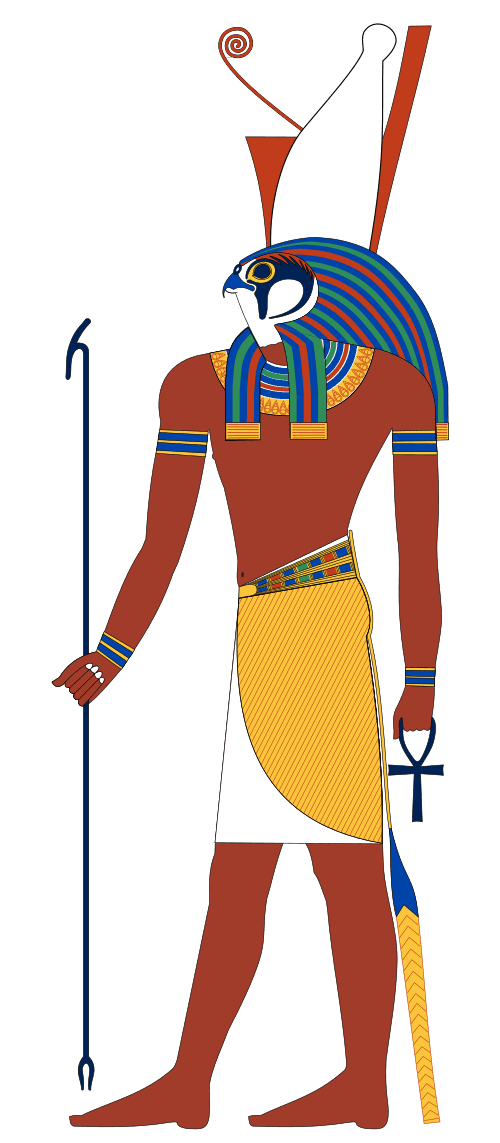
I am not a single face, but a perpetual metamorphosis. At dawn, I am Khepri, the scarab who rolls the rising disk as the insect rolls its ball of earth — an image of rebirth, for from that ball always comes new life. In full day, I bear the falcon's head, the piercing eye that dominates the sky, crowned with the golden disk encircled by the cobra. At evening, aged, I become Atum, the god who ends. My priests have carved these forms on temple walls so that everyone may recognize the hour of the god simply by his face. For the sun is never the same: it is born, grows, matures and dies in a single day, then begins again.
—Tell us about that golden disk you wear on your forehead, and that temple carved for you in Nubia.
When I unite with Horus of the horizon, I am called Ra-Horakhty, and it is under this name that I shine above the golden throne. At Abu Simbel, in Nubia, Ramses had a temple carved so precisely that twice a year my rays penetrate to the very back of the sanctuary to touch the statues of the gods — proof carved in stone that I know how to find my way even in the darkness of rock. My solar disk, that golden circle placed on my forehead, is not a simple ornament: it is my eye, the one that spreads light over the earth and reaches even the dwellings of the dead. Where this disk appears, nothing remains hidden.
—Heliopolis was the heart of your cult. What made it so special?
Heliopolis — Iunu, the city of the pillar — is my earthly home since times that men can no longer count. There my clergy keep watch, there my rising is sung, and there stand the obelisks, those stone needles whose gilded tip catches my first ray before any other part of the land. Each obelisk is a finger pointed toward me, a reminder that light touches the summit first before descending to men. The pharaohs raised so many, over three millennia, that my name is engraved everywhere in the stone of Egypt. Destroy a statue, the cult remains; but as long as an obelisk stands, I am greeted every morning.
—Why were the pharaohs so keen to call themselves your sons?
No pharaoh rules without me. Since the Old Kingdom, the king of Egypt bears the title sa-Ra, 'son of Ra', and this is not flattery: it is the bond that holds his throne. By calling himself my son, the pharaoh receives from me Ma'at, that duty to maintain order which I myself defend every night against chaos. He builds my temples, erects my obelisks, nourishes my cult — and in return, my light legitimizes his crown. Thutmose, Ramses, so many others conquered and reigned in my name. Earthly power is only the reflection of celestial power: the king rules the day as I rule the sky, and we fall together if order breaks.
—In the New Kingdom, you united with Amun. How do two gods become one?
In the New Kingdom, at Thebes, I was united with Amun, the Hidden One, whose very name speaks of the invisible. Strange wedding, that of the most visible sun and the god whom no one sees! But it made sense: Amun was the secret power that animates all things, and I the light that reveals them. Together we became Amun-Ra, king of all gods, and none at Karnak reigned higher than us. What men call syncretism, I call fulfillment: a god is not jealous of another god when their forces complement each other. The hidden breath and the shining disk are one, like the flame and the heat it gives.
—Yet one king tried to replace you with the disk alone, the Aten. What remains of that ordeal?
There was a king — the one later called Akhenaten — who wanted to erase all gods to worship only the Aten, the disk alone, stripped of my face and my names. He closed my temples, had the name of Amun hammered out on walls, and moved his court far from Thebes, to a new city dedicated to the sole ray. Many priests wept in silence. But the disk without the god is only a lamp without a flame: one does not pray to a light that does not fight chaos for you. At his death, under the young Tutankhamun, Egypt returned to me, reopened my sanctuaries and took up my ancient songs again. Kings pass; the sun, for its part, always rises again.
Kings pass; the sun, for its part, always rises again.
This imaginary interview was generated by artificial intelligence from sources documented in Ra's profile. It dramatises what the figure might have said based on what we know about them, but does not constitute attested historical testimony. For primary sources and factual documentation, refer to the full profile.