Imaginary dialogue between Hattushili III and Ramesses II
by Charactorium · Ramesses II (1302 av. J.-C. — 1212 av. J.-C.) · Politics · 6 min read
In the cool of a shaded courtyard of the palace of Pi-Ramesses, around 1255 BC, Hattushili III meets Ramesses II. The air smells of incense and Nile silt; in the distance, the chisels of stonecutters ring out on a new colossus. The two kings long hated each other before sealing peace on silver tablets, and the Hittite comes to speak as a brother — no longer as an enemy. He knows better than anyone the pride of the man he questions, and he intends to push him to his limits.
—My brother, at Kadesh on the Orontes, my chariots nearly captured you. Tell me truly: did you charge alone, or did the scribes embellish your glory?
You who commanded the other bank, Hattushili, you know what my eyes saw that day. My army corps were scattered, and your chariots had surrounded me — two thousand five hundred, I counted them in the dust. I was alone with my guard, and I called upon Amun as a son calls his father. Believe what you will of the reliefs: a king who does not charge is no longer a king, he is only a name on a stela. I had that day carved at Abu Simbel, at Karnak, everywhere, not to lie but so that my people might know that a pharaoh does not bend. You, did you see me tremble? No. You saw me stand firm.
A king who does not charge is no longer a king, he is only a name on a stela.
—Your horses and your khopesh have become legend as far as Anatolia. But that day, what did you feel, you, the man, before the charge?
Fear, Hattushili — I would not say it to any courtier, but to you I say it. A dry throat, the weight of the khopesh in my hand, and behind me the silence of my men who thought me lost. My chariot trembled under my feet, my two horses were foaming. I thought of my father Seti, of his campaigns in Syria, and I was ashamed to die there without glory. Then fear turned into fury. That is what the priests call the protection of Amun: not that the god deflects the spears, but that he transforms the trembling man into a lion. You know that moment, you who have warred all your life: the instant when one stops calculating and strikes.
The protection of Amun is not that the god deflects the spears: it is that he changes the trembling man into a lion.
—We were enemies, and now our names are engraved together on silver. When you accepted my treaty, Ramesses, was it wisdom or weariness?
Both, my brother, and I do not blush for it. How many years did we bleed our peoples for a few fortresses on the Orontes? When your messenger brought me your proposals, I understood that a wise king also knows how to lay down the khopesh. We inscribed our pact in Akkadian on silver tablets: defensive alliance, exchange of fugitives, eternal brotherhood. Let your scribes and mine each say that the other asked for peace — I care little. What matters is that my sons and your sons will no longer fight over Kadesh. I have built temples that defy time, but this peace, perhaps, will last longer than my stone.
A wise king also knows how to lay down the khopesh.
—Soon my daughter will enter your harem to seal our alliance. What does this marriage really mean to you — a pledge, or something more?
Something more, Hattushili, do not think I will take her as a mere wax seal. By receiving your daughter, I mingle your blood with mine, and I bind our two thrones under the same sun. My people will see a princess from the land of the Hittites cross the desert to become a royal wife of Egypt: what more brilliant proof that yesterday's enemy is today's brother? I will have the story engraved on the walls, as I engraved Kadesh — but this time to celebrate not war, but friendship. You send me your daughter; I send you my trust. Between great kings, that is the most precious of gifts, more than the gold of Nubia.
You send me your daughter; I send you my trust — between great kings, that is the most precious of gifts.
—Coming here, I saw your quarries and your endless construction sites. Why so many colossi, Ramesses? What do you seek in stone?
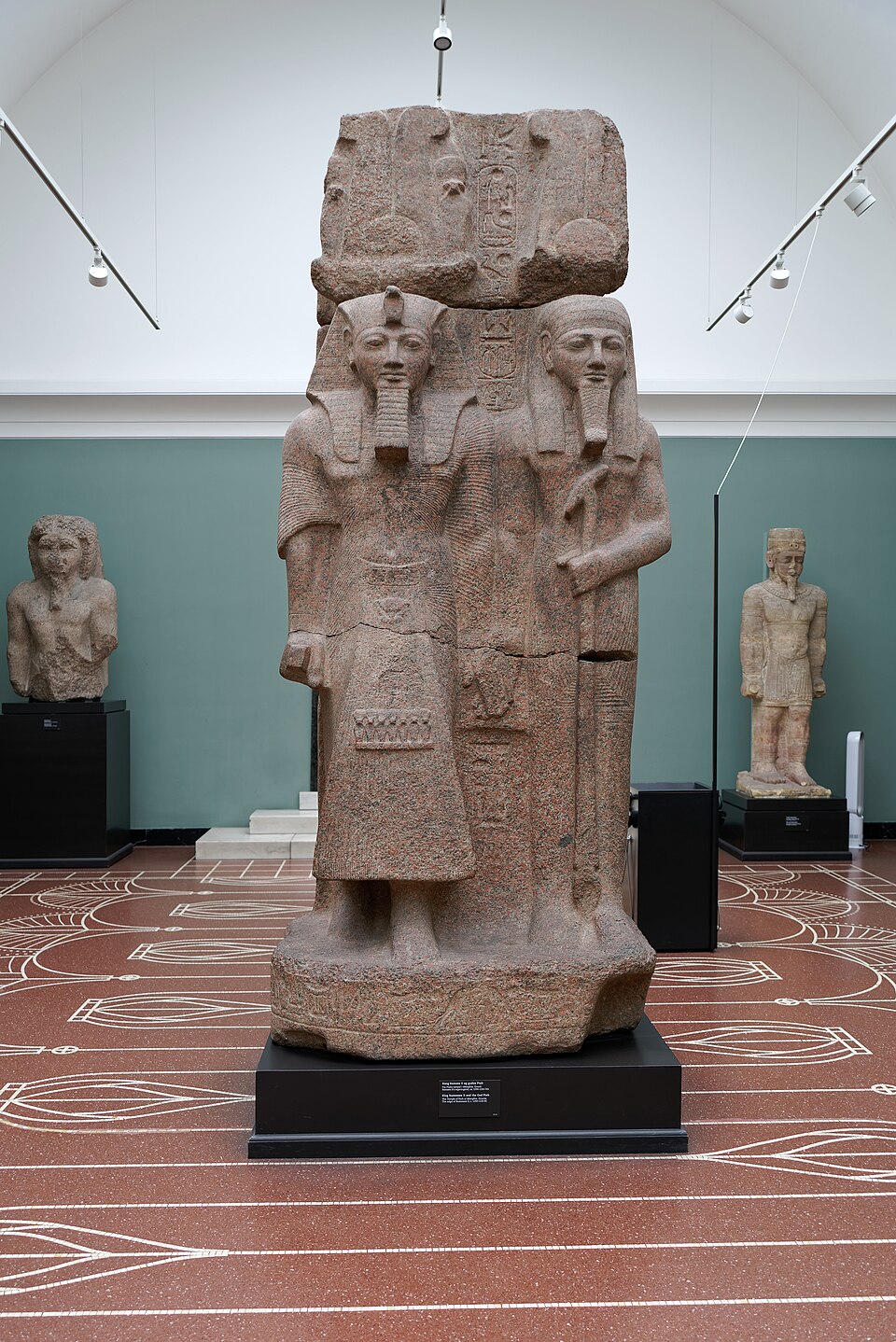
Eternity, Hattushili, nothing less. At Abu Simbel, I had four colossi of twenty cubits carved into the Nubian cliff, where the sun strikes them in the morning. I had it inscribed that my statues stand there like mountains, forever. The Ramesseum at Thebes, the great hall of Karnak that my father began and I finished, the temple of Luxor with its obelisks — everywhere my cartouche. A man dies, his name does not, if it is carved deeply enough. You ask me why: because the gods gave me this land, and I must give it back to them in monuments worthy of them. Stone does not lie and does not age. It will tell future peoples that Ramesses reigned.
A man dies, his name does not, if it is carved deeply enough.

—It is whispered that you erase the names of former pharaohs to inscribe your own. Does that not seem to you like stealing the glory of the dead?
Much is whispered, my brother, and you are not the last to hear it. Yes, I have had my cartouche placed on monuments that others erected. See it as you will: I see in it the continuity of the throne. The reigning pharaoh embodies all those who preceded him; by engraving my name, I steal nothing, I gather Egypt under a single hand. Do you think a Hittite king does not have his rivals' stelae hammered out? The memory of peoples is short, and stone is scarce. He who does not mark his time is forgotten by the first flood. I have chosen not to be forgotten — and if I am reproached for it in a thousand years, well, they will still speak my name.
He who does not mark his time is forgotten by the first flood.
—I saw you leave your apartments at dawn before the birds sang. How does a pharaoh's day begin, my brother?
Before daylight, Hattushili, when the sky is still gray over the delta. I go to the temple where the priests awaken the god's statue — for the pharaoh is also high priest, intercessor between men and heaven. It is my duty to maintain Maat, the order of the world, without which the Nile would no longer rise and chaos would return. Then, my two viziers bring me reports: one for Upper Egypt, the other for Lower. I settle disputes, order construction, listen to accounts of the granaries. To be per-aâ, the 'great house,' is not only to wear the double crown: it is to carry the entire country on one's shoulders, from sunrise to sunset. You know that weight, too.
Maintaining Maat: without which the Nile would no longer rise and chaos would return.
—And in the evening, when the viziers fall silent, where does the heart of a god-king go? What do you do with your nights, Ramesses?
In the evening, I retire to the royal harem, surrounded by my wives and children — and they are many, more than I can count. Scribes read me reports from all over the world: your letters, my brother, but also those of the Assyrians and the people of Mitanni. I dictate my replies late, by lamplight, for a great king does not sleep while the world speaks to him. I love this moment when the heat subsides, when wine and figs are brought to me, when I hear my sons laughing in the courtyard. It is there, far from colossi and crowds, that I am most simply a man. You see: even a living god likes to hear his own laugh before closing his eyes.
A great king does not sleep while the world speaks to him.
—The years pass over both of us, my brother. They say you have already seen several of your eldest sons die. How does one bear such mourning on a throne?
It is the hidden burden of longevity, Hattushili. The gods grant me so many years that I see those who were to succeed me depart. I have designated heirs, then mourned them. A father who buries his son walks against the order of things — and yet I must remain standing, for Egypt does not weep with the king, it waits for him to govern. My limbs grow heavy, my teeth pain me, I feel it with each flood. But as long as my breath lasts, I govern. Merenptah is growing, and one day he will take the double crown. To reign long, my brother, is to learn that glory has a price paid in silence, at night, alone.
Egypt does not weep with the king: it waits for him to govern.
—If your priests are right, your body will rest embalmed for eternity. What do you hope will be said of Ramesses when you have joined the gods?
Let them say that I held firm, my brother. That under my reign the Nile flowed, the granaries were full, and the borders guarded. That I built for the gods dwellings no wind will erase, and that I turned a fierce enemy into a brother by alliance — you, Hattushili, whose name will neighbor mine on silver. My body, the embalmers will preserve it against time, as one guards a statue. But what I hope is not that they look at my remains: it is that they speak my name aloud, again and again, for as long as a name is spoken, the man is not entirely dead. I have engraved that name throughout Egypt so that no mouth can forget it.
As long as a name is spoken, the man is not entirely dead.
Read further
This imaginary interview was generated by artificial intelligence from sources documented in Ramesses II's profile. It dramatises what the figure might have said based on what we know about them, but does not constitute attested historical testimony. For primary sources and factual documentation, refer to the full profile.