Kids interview Ramesses II
by Charactorium · Ramesses II (1302 av. J.-C. — 1212 av. J.-C.) · Politics · 5 min read
Two twelve-year-old students, on a school trip, walked through a stone door covered in hieroglyphs. Before them stands an old king with a calm smile, dressed in white linen. He invites them to sit near him and tells them he has all the time in the world: he reigned so long that one more hour doesn't scare him.
—What was it like to find yourself all alone in the middle of the enemy at Qadesh?
You know, my child, my heart was beating very fast. My army had scattered near the Orontes, that river in Syria. And there I was, on my chariot pulled by two horses. Imagine a cloud of dust, shouts everywhere, and around you enemies as numerous as grains of sand. I took my khepesh, my curved-blade sword. I called upon the god Amun with all my might. When you are very afraid, sometimes you have no choice: you must advance or die. So I advanced.
When you are very afraid, sometimes you must advance or die.
—Did you really fight alone against thousands of chariots? It sounds too good to be true.
Ah, you are clever to ask that! I had this episode engraved on many of my temples. The text called the Poem of Pentaur says this: 'His Majesty galloped forward and entered the mass of the Hittite enemies, he was alone, no one else was with him.' Was it exactly like that? Let's say I told it my way. A king must show that he is protected by the gods. It's like a storyteller who embellishes his tale a bit by the fire. But the danger, that was real.
A king tells his battle like a storyteller embellishes his tale.
—Why make peace with the Hittites after fighting them so hard?
Because war, my boy, tires everyone out. For years we fought without anyone truly winning. So around 1259 BC, with the Hittite king Hattushili III, we did something no one had done before: a real peace treaty. It was engraved in Akkadian, the language of diplomats, on silver tablets. It was written that we would help each other if one of us was attacked. Imagine two former enemies shaking hands forever. It's harder than fighting, and much more useful.
Making peace is harder than war, and much more useful.
—Is it true you married the daughter of your former enemy?
It's true! A few years after the treaty, around 1246 BC, I married a Hittite princess, the daughter of my former rival. In my time, a marriage between two royal families was like a seal on a promise. It meant: our two peoples are no longer enemies, they are one family. The princess made a long journey to Egypt, through mountains and deserts. When she arrived, we had a great feast. A marriage that ends a war is the finest gift a king can give his people.
A marriage can seal peace better than an army.
—Why carve giant temples directly into the cliff at Abu Simbel?
Because I wanted something that would never fall, my child. A house built with bricks collapses. But a mountain hollowed out from within lasts as long as the rock. In Nubia, that region south of Egypt, I had four colossi carved in my image, as tall as ten men stacked on top of each other. I had it written: 'I have built for you a dwelling carved in the mountain of Nubia... My statues stand there like mountains, for eternity.' Imagine entering a cliff and seeing your own giant face staring at you in the dark.
A house collapses, but a hollowed mountain lasts forever.

—How did you feel seeing yourself turned into a god on the walls?
That's a tricky question, and you're right to ask it. For my people, the pharaoh was not a man like others. I was seen as a living god on earth, tasked with keeping Ma'at, that is, the order of the world, justice. In the great temple of Abu Simbel, my statue was placed next to the great gods Amun, Ra, and Ptah. Seeing yourself worshipped makes you dizzy, I won't lie. But deep down, I knew I had toothaches and was growing old. A stone god often hides a tired man.
A stone god often hides a tired man.
—Is it true you wrote your name on monuments built by other kings?
Oh yes! I won't lie to you, I did it. My name was enclosed in a cartouche, an elongated oval that protected the pharaoh's name. I had it engraved everywhere, on thousands of stones. And sometimes, yes, on monuments started by my ancestors. Why? Because in my time, having your name written meant staying alive after death. As long as your name is spoken, you never truly disappear. It was perhaps a bit prideful, I admit. But look: you still know my name today. So, did it work, do you think?
As long as your name is spoken, you never truly disappear.
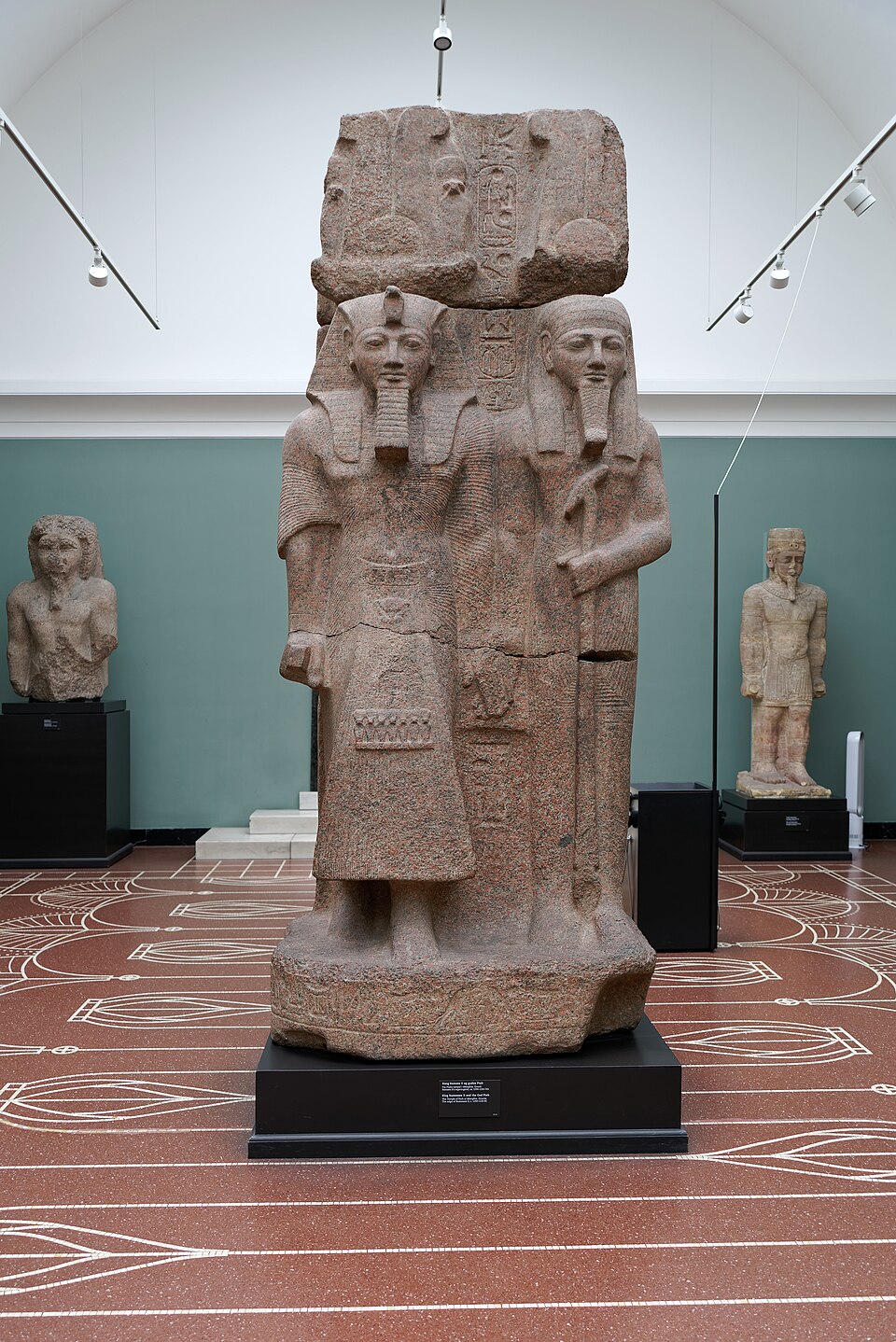
—Why put statues in your likeness all over Egypt?
Because my kingdom was immense, my boy. It stretched from the Nile delta to the lands of Nubia. Most of my subjects would never see me in person in their lives. So my colossi spoke for me. Imagine a farmer who never left his village: he looked up, saw my giant statue, and knew who his king was. At Karnak, I even completed a vast hall with one hundred and thirty-four columns, started by my father Seti I. A statue is like a stone messenger that never sleeps and never lies about who is in charge.
My statues were stone messengers that never sleep.
—What did you eat in the morning, when you were the most powerful pharaoh of Egypt?
Ah, the real question of a hungry belly! I got up before the sun, because the priests woke the statues of the gods at dawn. Then they brought me fresh bread, the best in the kingdom, and sometimes roasted meat: beef, duck, goose. There were figs, sweet dates, grapes. And to drink, thick beer, almost a meal in itself. Imagine a table where everything the Nile offers is set before you. But you know, even a king eats bread in the morning. The belly doesn't know you are pharaoh.
The belly doesn't know you are pharaoh.
—What is it like to live very old and see your own children die?
That is the greatest sorrow of my long life, my child. I reigned for a very, very long time. The royal list of the Turin Papyrus says: 'Ramesses II, son of Seti I, reigned sixty-seven years.' I had over a hundred children. But living old also means burying those you love. Several of my eldest sons died before me. In the end, my back hurt, my teeth too. It was finally Merneptah, an already elderly son, who succeeded me. Reigning long is a gift from the gods. But outliving your children is a burden no crown can lighten.
Reigning long is a gift; outliving your children is a burden.
Read further
This imaginary interview was generated by artificial intelligence from sources documented in Ramesses II's profile. It dramatises what the figure might have said based on what we know about them, but does not constitute attested historical testimony. For primary sources and factual documentation, refer to the full profile.