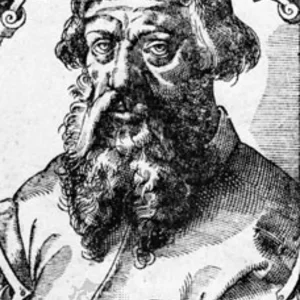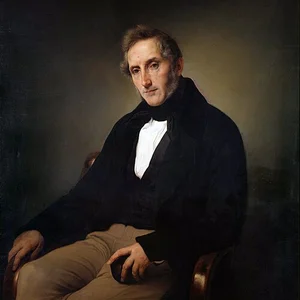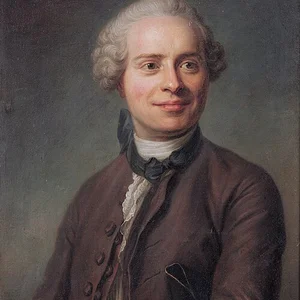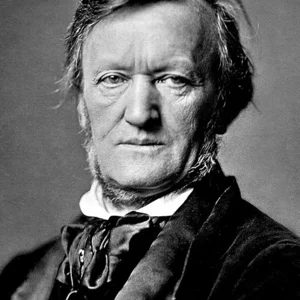

Italian diplomat, writer, and courtier (1478–1529), Castiglione is the author of The Book of the Courtier, a treatise defining the ideal of the Renaissance court gentleman. Close to the great princes and artists of his time, he embodies the humanism of the court of Urbino.
Baldassare Castiglione(1478 — 1529)
Baldassarre Castiglione
duché de Milan
9 min read
Frequently asked questions
Famous Quotes
« The true rule is to depart from the rules.»
« The courtier must in all things avoid affectation and practice a certain sprezzatura.»
Key Facts
- 1478: born in Casatico, near Mantua
- 1508–1516: writing of The Book of the Courtier at the court of Urbino
- 1528: publication of the Libro del Cortegiano, a major work of Renaissance literature
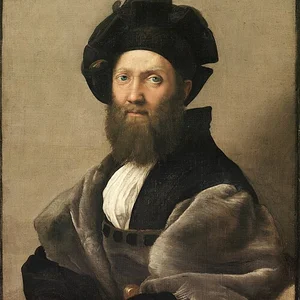
- Friend of Raphael, who painted his famous portrait now housed in the Louvre
- 1529: death in Toledo, while serving as apostolic nuncio in Spain
Works & Achievements
A masterpiece of Renaissance literature, this dialogue-form work defines the ideal of the perfect courtier: noble, cultured, athletic, musical, and possessed of *sprezzatura*. Translated into every European language by the sixteenth century, it profoundly shaped aristocratic ideals across Europe for two hundred years.
A pastoral play composed with Cesare Gonzaga and performed at the court of Urbino during carnival. It embodies the humanist court's ideals of culture and refinement, blending poetry, music, and elaborate staging.
Castiglione composed poems in classical Latin and literary Tuscan, genres highly prized among humanist courtiers. Less celebrated than the *Cortegiano*, these works demonstrate his command of both literary languages of his era.
Castiglione's letters — especially those exchanged from Spain with Rome and with his family — are a valuable historical source on European diplomacy, the Italian Wars, and daily life at princely courts.
Anecdotes
Raphael, one of the greatest painters of the Renaissance, painted around 1514–1515 a famous portrait of Castiglione, now housed in the Louvre. The painting shows him dressed with calculated restraint, in shades of grey and black of perfect elegance. Much later, in 1639, Rembrandt made a drawing after this work at an Amsterdam auction — proof that Castiglione's image continued to fascinate artists for centuries to come.
In 1506, Duke Guidobaldo da Montefeltro of Urbino entrusted Castiglione with an exceptional mission of honor: to travel to England and receive, on his behalf, the Order of the Garter from the hands of King Henry VII. This decoration, the most prestigious in England, testified to the renown of the court of Urbino across all of Europe and to the absolute trust the duke placed in his courtier.
Castiglione invented the concept of *sprezzatura*, which he defined in his *Book of the Courtier* as the art of concealing all effort — of making what requires long and hard work appear natural and effortless. This idea exerted a considerable influence on European ideals of politeness and elegance far beyond the Renaissance, and continues to inspire codes of etiquette to this day.
Castiglione spent nearly twenty years writing and revising his *Book of the Courtier*. Begun around 1508 from imaginary conversations at the court of Urbino, the work was not published in Venice until 1528, just one year before his death. A perfectionist, he long hesitated before entrusting his text to the printer.
When the troops of Charles V sacked Rome in 1527, Castiglione was in Spain serving as the papal nuncio of Pope Clement VII. The pope, seeking someone to blame, reproached him in a scathing letter for having failed to prevent the disaster. This unjust accusation deeply wounded Castiglione's sense of honor; Emperor Charles V came to his defense, but Castiglione died in Toledo two years later, broken by the humiliation.
Primary Sources
"Voglio adunque che 'l cortegiano, oltra la nobiltà del sangue, sia di prospera fortuna ancora dotato di natura, non solamente di ingegno e di persona bella e ben disposta, ma abbia una certa grazia..." (I want the courtier, beyond noble birth, to be favored by nature not only with a fine mind and a handsome, well-proportioned figure, but also with a certain grace...)
"To paint a beautiful woman, I would need to see several beautiful women [...] but lacking good judges and beautiful women, I make use of a certain idea that comes to my mind." This celebrated letter bears witness to the intellectual friendship between the two men and their exchanges on the ideal of beauty.
Castiglione writes to his mother describing his life at the court of Charles V, his duties as papal nuncio, and his longing for Italy: he speaks of the difficulties of his diplomatic mission and his attachment to his family back in Lombardy.
A pastoral play composed by Castiglione together with Cesare Gonzaga, performed at the court of Urbino during the carnival of 1506 in honor of Duke Guidobaldo. Blending poetry and music, it embodies the ideal of refined courtly life celebrated by Renaissance humanism.
Key Places
Castiglione's birthplace, near Mantua, where his family owned a seigneurial estate. He returned there throughout his life and is buried in the parish church.
The court of the Montefeltro dukes at Urbino provided the setting for the conversations that inspired *The Book of the Courtier*. Castiglione lived there from 1504 to 1516 and regarded this court as the model of refined Renaissance civilization.
Castiglione spent extended periods in Rome as ambassador to the Holy See. There he moved among the great artists of his day, including Raphael, and witnessed the splendor of the pontifical courts of Julius II and Leo X.
The city where Castiglione resided as papal nuncio to Charles V from 1524 onward, and where he died in 1529. Upon learning of his death, the emperor paid him a solemn tribute.
Castiglione received his humanist education here during the 1490s, at the brilliant court of Ludovico il Moro, where he mingled with artists such as Leonardo da Vinci and renowned humanist scholars.
Liens externes & ressources
Références
Œuvres
Il Libro del Cortegiano (Le Livre du Courtisan)
1528
Tirsi (pastorale dramatique)
1506
Poèmes en latin et en italien
début XVIe siècle
Correspondance diplomatique
1499-1529