Imaginary interview with Sun Wukong
by Charactorium · Sun Wukong · Mythology · 6 min read
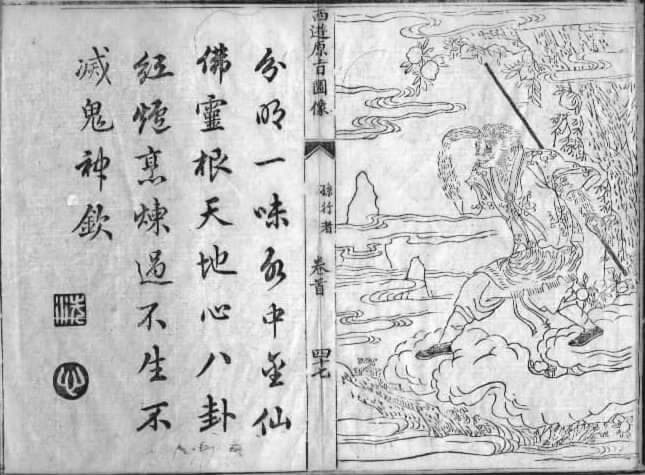
On the Mountain of Flowers and Fruit, where waterfalls fall like curtains of jade, the Monkey King sits on a rock warm from the sun, twirling between his fingers a staff no larger than a sewing needle. He has agreed to talk, on condition that no one asks him to behave. Here are his words.
—They say you have neither father nor mother. Where do you really come from?
I was born from a stone. Not a poet's image: a real cosmic stone, placed atop the Mountain of Flowers and Fruit, which Heaven and Earth had nourished for ages until it burst and spat me into the world. No womb, no milk, no debt to anyone. When I opened my eyes, two rays shot from my pupils to the Heavenly Palace, and up there they trembled without yet knowing my name. The other monkeys made me king because I dared to leap through the waterfall first, into the Water Curtain Cave. Understand well: I descend from nothing, so I fear nothing. He who is born from a rock does not bow easily.
He who is born from a rock does not bow easily.
—How did you come to defy the Heavenly Emperor himself?
They gave me a lowly post up there, stable boy for the heavenly horses, a title to amuse children. When I realized they were mocking me, I planted my banner on the Mountain of Flowers and Fruit and proclaimed myself Great Sage Equal to Heaven. Equal, you hear? Not servant, not vassal. I turned their banquets upside down, tasted the peaches of immortality from the Queen Mother's garden, swallowed Old Laozi's gold pills like nibbling beans. The whole heavenly army descended, a hundred thousand spears, and I sent them back home disheveled. What they call up there The Rebellion Against Heaven, I call the day I refused to let them decide my size for me.
I proclaimed myself Great Sage Equal to Heaven. Equal, you hear?
—Your transformations are legendary. Where did you learn this art?
I crossed two oceans on a makeshift raft to find a master. It was the Patriarch Subodhi who took me in, in his secluded monastery, and gave me my name, Sun Wukong, 'Awakened to Emptiness.' He taught me the seventy-two transformations. Understand what that means: I can become a hawk, a carp, a mosquito, an entire temple with my tail sticking up as a flagpole behind. I can clone myself by pulling a handful of my own hairs and blowing on them — each hair a little me, howling and leaping. Subodhi also taught me the cloud somersault: one flip and I cover thirty-six thousand leagues. But he drove me away, forbidding me to ever speak his name. Such a master is not to be boasted of. I, on the other hand, boast very well on my own.
—Tell us about that staff you never put down.
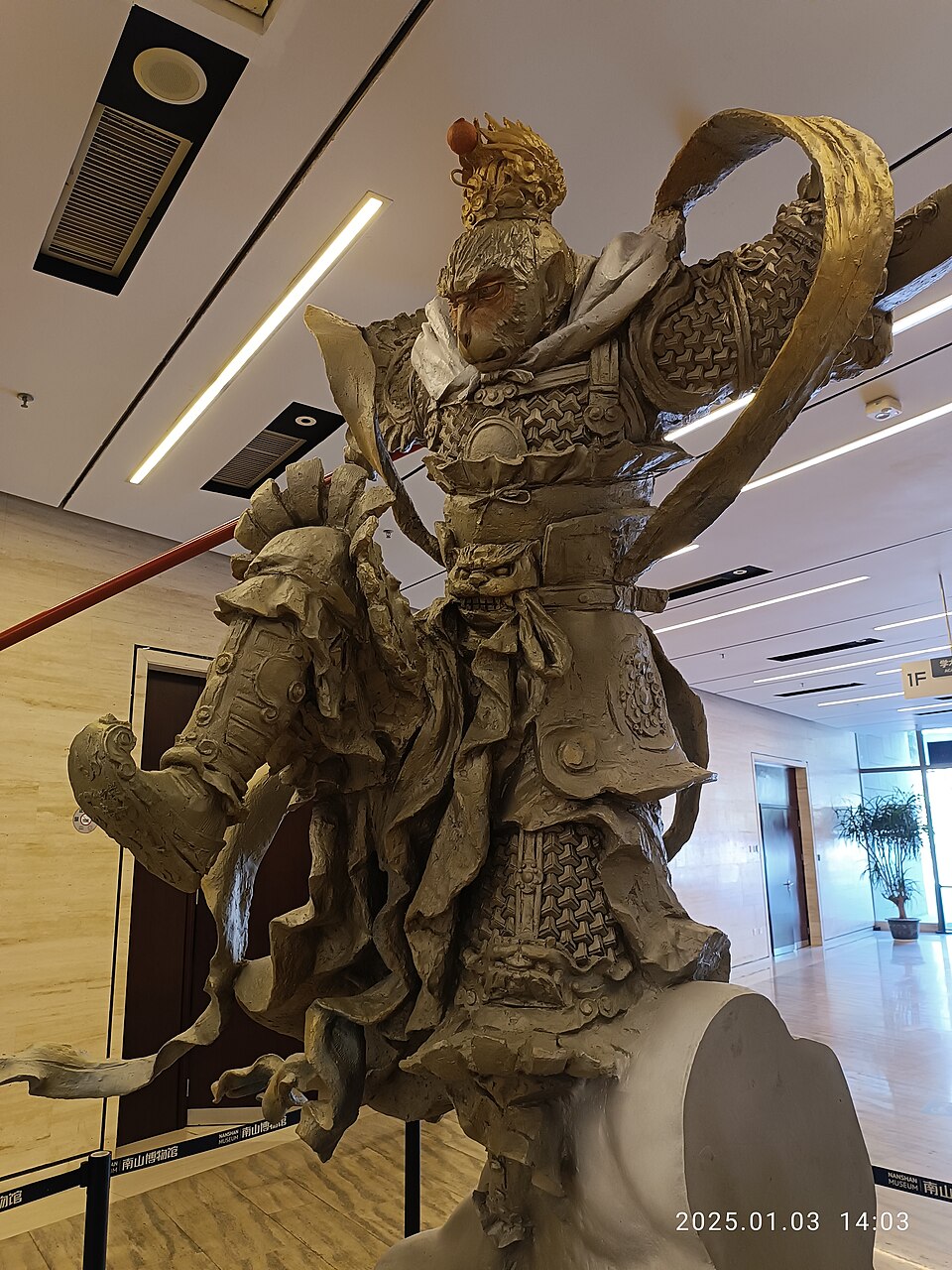
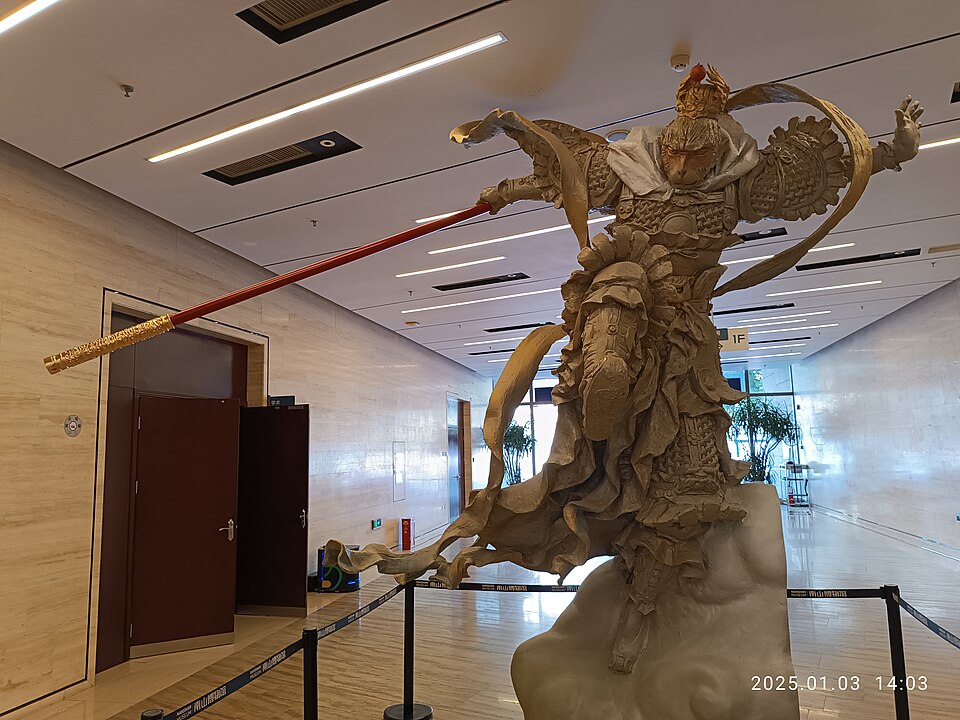
It is called the Ruyi Jingu Bang, the golden-banded staff-needle. I took it from the Dragon King of the Eastern Sea, in his palace beneath the waves, where it served as a pillar to measure the depth of the waters. Thirteen thousand five hundred pounds, yet it obeyed me as soon as I touched it: it began to grow, to shrink, according to my will alone. When I want it as thick as a pillar of Heaven, it cleaves the clouds; when I want it as thin as a needle, I tuck it behind my ear and go off whistling. The Dragon King paled, poor fellow. This weapon resembles me: it knows only one measure, mine. Give me a staff that changes size at my whim, and I'll overthrow any established order.
This weapon resembles me: it knows only one measure, mine.
—Your rebellion ended badly. What happened?
Heaven couldn't subdue me, so they called the Buddha. He didn't fight. He held out his palm and said: if you can jump out of my hand in one of your cloud leaps, you will have won Heaven. I leaped, thirty-six thousand leagues, until I saw five pink pillars that I took for the edge of the world — I even left my mark at the foot of one. And I had not left his palm. The pillars were his fingers. With a flick, he turned his hand into a Five Elements Mountain and sealed me beneath it. Five hundred years, crushed, chewing iron pellets and drinking molten copper for sustenance. Five hundred years learning that there is a hand wider than my pride.
Five hundred years learning that there is a hand wider than my pride.
—How did your path cross that of the monk Xuanzang?
After my five hundred years under the Five Elements Mountain, I heard footsteps. A bald monk, fragile, almost trembling: Xuanzang, heading West, to India, to bring back the sacred scriptures. The Buddha had promised that whoever freed me would become my master. The monk peeled off the talisman that pinned me to the rock, and the mountain opened like a shell. I came out roaring, free, and I bowed — I, the Great Sage, before this weak little monk. Understand the strangeness: it is the weakest who returned me to the world. From then on I would walk ahead of him on the Silk Road, sweeping demons from his path. My first disciple, my first chain, and the beginning of everything.
—They say you wear a headband that causes you pain. Why do you accept it?
I didn't accept it; they slipped it onto my head by trickery, disguised as a pretty cap. It's the golden headband, the Jingu. As soon as Xuanzang recites the tightening spell under his breath, the ring contracts on my skull and the pain throws me to the ground, me who defied the armies of Heaven. The first time, I tried to break it with my staff — impossible; it had taken root in my flesh. Then I understood that force could do nothing against it. This cursed ring teaches me what a thousand battles had not taught me: that you don't tame a wild monkey by fear, but by a pain that brings him back, again and again, to the step of duty. I hate it. And yet, without it, I would have long since gone back to sack Heaven.
You don't tame a wild monkey by fear, but by a pain that brings him back to duty.
—You were the embodiment of chaos. What has discipline changed in you?
At first, I cut down everything in my path: bandits, demons, spirits, I saw evil with my piercing eyes and struck. Xuanzang drove me away for that, because he refused to let me kill, even bandits. It took the golden headband spell tightening on my skull for me to learn to hold back. Discipline is not about becoming gentle — a monkey born from a stone never becomes gentle. It's about learning to put my savagery at the service of something other than myself. On the Silk Road, protecting this monk weaker than a reed, I discovered a strength I didn't know: that of not striking when I could. The Great Sage Equal to Heaven ended up kneeling. Not from defeat. By choice.
—The journey to the West was full of trials. How did you get through it?
Eighty-one trials, not one less — Heaven counts justly. Rivers where the water itself was a monster, mountains of flame that no cloud could cross, demons wearing the faces of old women to trick my master. Each time my piercing eyes tore through the illusion, each time Xuanzang doubted me, and each time I came back. I pulled out my hairs to make an army, I turned into a fly to enter the bellies of demons, I jumped on my cloud to seek help from Guanyin. The hardest part was not fighting — fighting is my joy. The hardest part was enduring being sent away, being suspected, and protecting nonetheless the one who distrusted me. That is the trial no staff could solve.
—At the end of it all, you became a Buddha. What does that mean for the rebel you were?
When we brought the sacred scriptures to the Buddha Kingdom, in India, they conferred upon me a title: Victorious Fighting Buddha. Think of the irony: the monkey who set Heaven ablaze becomes one of the Awakened, canonized, sanctified. And do you know what I asked first? That they finally remove the golden headband. They told me to touch it: it had disappeared on its own. For he who has found enlightenment no longer needs his skull squeezed — discipline had become my own. I am still born from a stone, I still leap my thirty-six thousand leagues. But the chaos that consumed me has turned to clarity. The Wukong in my name — Awakening to Emptiness — was not an empty promise. It was, from the beginning, the end of the road.
The monkey who set Heaven ablaze becomes one of the Awakened.
Read further
This imaginary interview was generated by artificial intelligence from sources documented in Sun Wukong's profile. It dramatises what the figure might have said based on what we know about them, but does not constitute attested historical testimony. For primary sources and factual documentation, refer to the full profile.