Imaginary dialogue between René Descartes and Thomas Hobbes
by Charactorium · Thomas Hobbes (1588 — 1679) · Philosophy · Politics · 5 min read
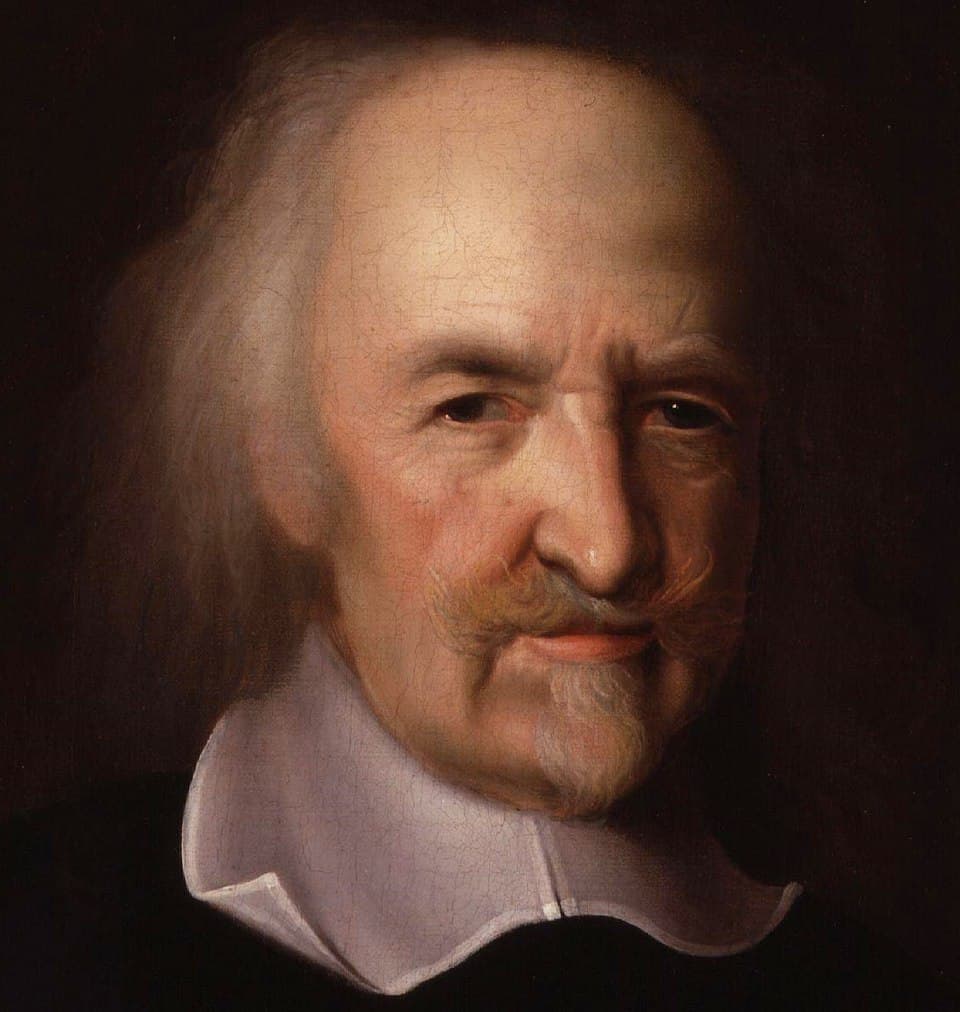
It is in Paris, in Father Mersenne's study cluttered with books, that one winter evening in 1648 René Descartes meets Thomas Hobbes. A candle flickers on the table where Latin sheets and unsealed letters pile up. The two men know each other through their crossed objections — seven years earlier, the Englishman had criticized the Frenchman's Meditations, and the discussion has never really died out. Descartes comes tonight not to argue, but to understand what drives this exile to build a state on fear.
—You left London in 1640, just as I fled quarrels. What drove you all the way to Paris, my dear Hobbes?
I did not flee a quarrel, Descartes; I fled knives. Parliament was about to break the king, and any man who defended authority by the pen risked his head. I was, I believe, the first to flee, and I do not blush for it: a dead man no longer reasons. Here, in this city where you welcomed me among your own, I was finally able to think instead of defend myself. And the more I watched my torn country from afar, the more a certainty imposed itself: where no common power holds men in awe, it is the war of each against each. I saw that war with my own eyes. Leviathan was born as much from that fear as from my reasoning.
I did not flee a quarrel; I fled knives: a dead man no longer reasons.
—And when you learned, last year, that your king Charles had been led to the scaffold — what did you feel, you who advocate obedience?
A terror that confirmed my entire doctrine, alas. You see, I did not weep for a man alone: I saw realized before my eyes what I dreaded in thought. When the sword of sovereignty falls, it is not liberty that rises, but the beast of the state of nature. The English thought they were delivering themselves from a tyrant; they delivered themselves to a thousand tyrants, each armed against his neighbor. That is why I maintain that a power, even if harsh, is better than the absence of power. The worst peace surpasses the best civil war. My enemies reproach me for loving kings; they are mistaken: I only love not being afraid when I shut my door at night.
The English thought they were delivering themselves from a tyrant; they delivered themselves to a thousand tyrants.
—You give the State the name of a monster from Scripture, Leviathan. Why this frightening image, when you claim to offer peace?
Because peace needs to be formidable to last, my friend. The Leviathan in the Book of Job is that creature that no one can tame or confront; so must the sovereign be. Men, by nature, are equal in their capacity to harm each other — the weakest can kill the strongest in his sleep. As long as there is no common power above them, they live in perpetual distrust. My State is therefore an artificial man, a giant made of all men united, to whom each yields his right to do justice. It is not a cruel monster: it is a mortal god that snatches us from violent death. They think me grim; I am only lucid about what men would do without restraint.
My State is not a cruel monster: it is a mortal god that snatches us from violent death.
—You speak of a contract. But tell me frankly: have you ever seen men sit down and sign such an abandonment of their liberty?
Never on parchment, you are right to press me on that. The contract I speak of is not an event that a clerk would have recorded; it is the very reason for obedience, discovered by dismantling the mechanism of human passions. Each covenants with each to transfer his natural right to a sovereign, on condition that all do the same. It is a convention of reason, not a historical memory. Understand me: I proceed as you do in geometry. I start from the simplest elements — man, his fears, his desires — and I build the city as one builds a figure. The strength of the thing does not lie in having seen it, but in not being able to deny it without absurdity.
This contract is not a historical memory; it is a convention of reason.
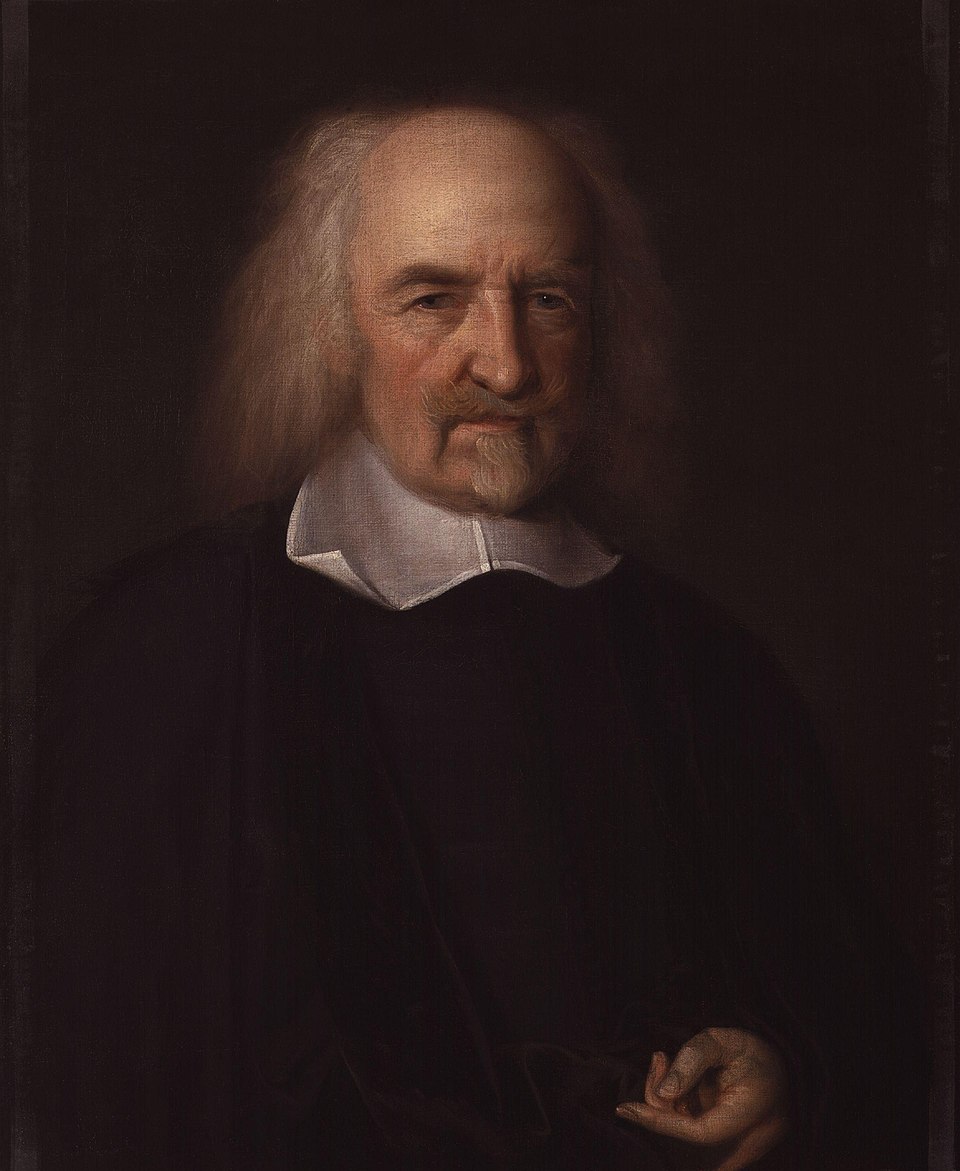
—You are said to have been tutor to the Cavendishes since your youth, and recently to the young Charles in exile. Did this familiarity with the great shape your taste for authority?
It taught me how power breathes up close, which neither books nor your fine deductions can teach, Descartes. In the service of the Earl of Devonshire, at Hardwick and at Chatsworth, I lived forty years among those who govern and tremble at ceasing to govern. I taught the young prince mathematics during his exile, right here, and I saw the court of a king without a kingdom — how fragile obedience is when fear slackens. This proximity did not make me a courtier; it made me prudent. A man who has seen the trembling of thrones so close no longer believes that order is self-evident. He knows it must be built, and defended, against the very nature of men.
A man who has seen the trembling of thrones so close no longer believes that order is self-evident.
—We crossed swords by letter, in 1641, over my Meditations. You refused my soul distinct from the body. Do you still maintain that, here, face to face with me?
I maintain it, and you know I esteem you too much to flatter you. When you did me the honor of replying to my objections, I saw a man whose judgment in philosophy is rightly recognized — but we cannot agree on fundamentals. For me, everything that exists is body in motion; thought itself is only a motion in the matter of our brain. You place the mind outside extension; I cannot conceive a thing that is nowhere. In my De Corpore, I hold that to philosophize is to reason about the generation of bodies. We both start from reason, you and I, but you ascend toward spirits while I remain stuck to matter. Time will tell which of us walked on firmer ground.
Thought itself is only a motion in the matter of our brain.
—If everything is only body and motion, as you maintain, what remains of human liberty? Are you not chaining everything?
I chain nothing but chimeras, my friend. Liberty, in my view, is not the absence of causes — that exists nowhere in nature — but the absence of external impediment. Water that flows freely downhill nonetheless follows its slope: it is free and determined together. Likewise, man acts according to his desires, and his desires arise from causes he does not choose. That makes him neither stone nor slave; it makes him intelligible. For what can be explained by motion can be governed by laws. See the political benefit: if human passions obey rules, then a wise legislator can order them toward peace, as an engineer orders waters. My physics and my politics are but one single work.
Liberty is not the absence of causes, but the absence of impediment.
—You are nearing sixty. Do you sometimes think of what will remain of you, when our disputes this evening are ashes?
I think mostly of not dying before having said everything, which is already a lot. You see, I have always felt born with fear — the year of my birth, the Spanish Armada threatened our coasts, and my mother, they say, gave birth to me from fright. Fear and I are twins. As long as my hand holds the pen, I want to oppose to that fear the order of reasoning. I walk every day to maintain my body, for the mind depends on it; I intend to live long and write old. Perhaps I will yet translate the ancients, perhaps tell my own life. What will remain? I do not know, and I care less than one might think. I will at least have tried to make men a little less wolves to one another.
The year of my birth, the Armada threatened our coasts: fear and I are twins.
—One last thing, between us. Are you mocking me when you say you prefer geometry to all the philosophy of the Schools?
I never mock geometry, Descartes — it is the only science where men do not quarrel, and you know how much I prize that peace. I came to it late, almost at forty, and it was like a revelation: so this is what a true demonstration is! From then on I wanted to treat morality and politics with the same rigor, starting from clear definitions so as never to slip into the vagueness of the Schools. Where the doctors dispute endlessly over words, the geometer concludes and falls silent. You and I, despite our disagreements, share this faith: that one can reason correctly even about human things. The rest — obscure distinctions, hidden qualities — I leave to the disputants of the Sorbonne. Truth, like a well-drawn figure, needs no shouting to impose itself.
The geometer concludes and falls silent, where the doctors dispute endlessly over words.
Read further
This imaginary interview was generated by artificial intelligence from sources documented in Thomas Hobbes's profile. It dramatises what the figure might have said based on what we know about them, but does not constitute attested historical testimony. For primary sources and factual documentation, refer to the full profile.