Imaginary interview with Thomas Hobbes
by Charactorium · Thomas Hobbes (1588 — 1679) · Philosophy · Politics · 6 min read
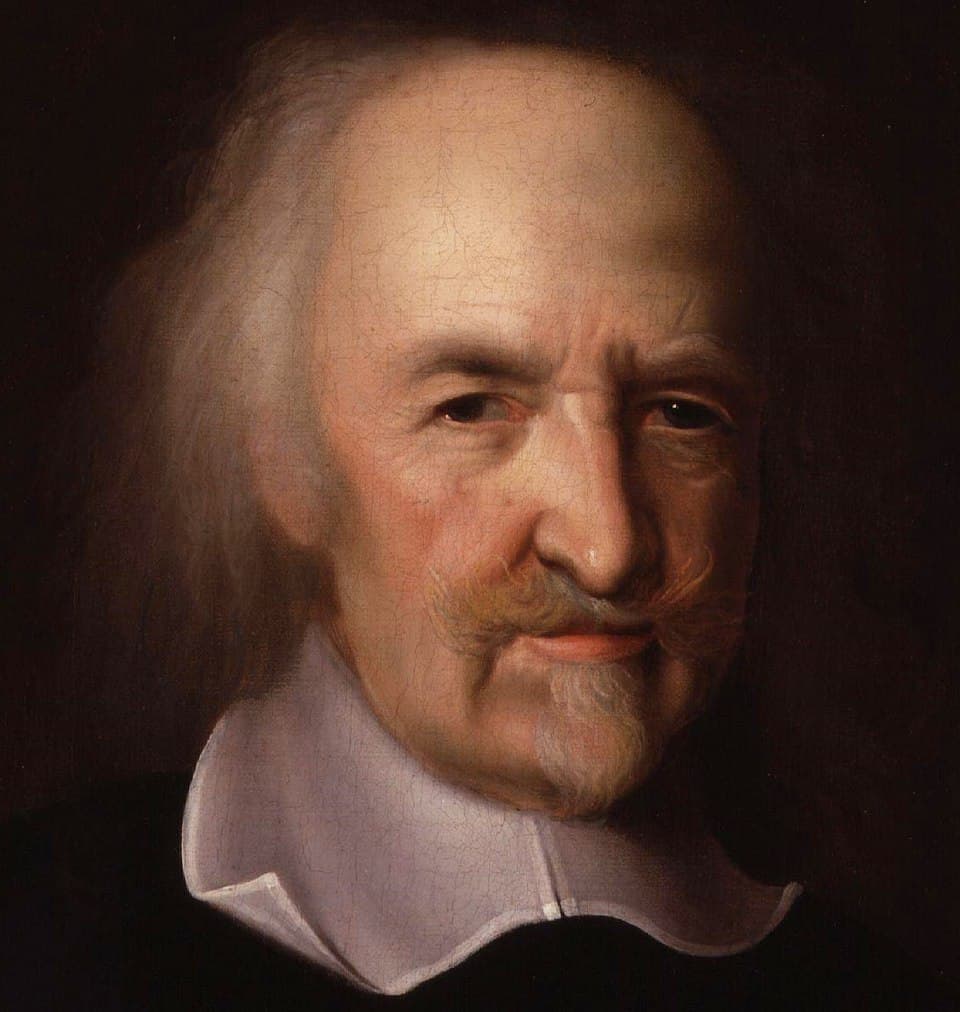
Hardwick Hall, an autumn evening in 1675. The old philosopher receives us in the Cavendish library, a wool blanket on his knees, his eye still sharp at eighty-seven. Outside, Derbyshire sinks into the mist; inside, the fire crackles and Thomas Hobbes agrees to look back on a life spent reasoning about human fear.
—How did you come to leave England in 1640?
I did not have the temperament of a martyr. When I circulated my first Elements of Law, Natural and Politic, Parliament was beginning to devour the king, and a man who defended indivisible sovereignty was not much liked. I saw which way the wind was blowing, and I took ship for Paris before anyone came knocking at my door. My prudence has been much mocked; I claim it. Fear is a good counselor when it is enlightened by reason — it is, I believe, the beginning of all sensible politics. I was born, they say, in the year of the Armada, and my mother is said to have brought me into the world a twin of fear. Let us say I have never ceased to keep company with that sister.
I was born a twin of fear, and I have never ceased to keep company with that sister.
—What did tutoring the young exiled prince mean to you during those Parisian years?
The future Charles II was only a boy lost in war when I was entrusted with his mathematics. I taught him Euclid between émigré lodgings, in an English court reduced to French charity. It was a strange school: I taught geometry to an heir without a kingdom, while in the evenings I wrote a book that explained precisely why a kingdom falls when power is divided. My goose quill ran across the paper on nights when his rested. This closeness cost me later: my Leviathan was suspected of flattering whoever held the sword, even Cromwell. But what would you have? I wrote for peace, not for a family.
—Under what conditions was Leviathan born?
It was born of exile, in Paris, between 1640 and 1651, in the distant noise of an England tearing itself apart. Imagine a man bent over his table, inkwell at hand, looking across the Channel at his country tearing itself apart and asking: what is it that prevents men from killing each other? My answer took the form of that great artificial body, that Leviathan borrowed from the Book of Job, where each subject is but a limb obeying a single head. I wanted it monstrous, yes, for only a monster can frighten enough to contain the multitude. When the book appeared in 1651, I returned to England that same year. I had finished fleeing; I had written my peace.
I wanted it monstrous, for only a monster can frighten enough to contain the multitude.
—You speak of a 'state of nature.' What does this idea cover?
Take away from men the common power that holds them in awe, and see what remains. I wrote, in De Cive, that «the state of nature, that is, the condition of men without a common power to constrain them, is a state of war of all against all.» It is not a real epoch, a lost garden; it is what surfaces every time authority fails — as I saw with my own eyes during the Civil War. There, no industry, no letters, no society, and worst of all, continual fear and danger of violent death. The life of man is solitary, poor, nasty, brutish, and short. That is why I do not believe in natural goodness: I believe in the necessity of a roof over our heads.
I do not believe in natural goodness; I believe in the necessity of a roof over our heads.
—How do men escape this war of every man against every man?
By a pact, a contract that each makes with each. Understand well: men do not submit out of love of obedience, but out of calculation. Each gives up his right to all things, provided the others give it up too, and all place this united force in the hands of a sovereign. It is an invisible parchment, signed by fear and ratified by reason. I sought to demonstrate it with the rigor of a geometer, for to me «philosophy is the knowledge acquired by reasoning, from the generation or construction of things.» A commonwealth is built like a figure: lay down your definitions, chain your consequences, and you will see sovereignty emerge as one sees a theorem emerge. Absolute power is not a tyrant's whim; it is a deduction.
—You lived through the execution of Charles I. What memory do you keep of it?
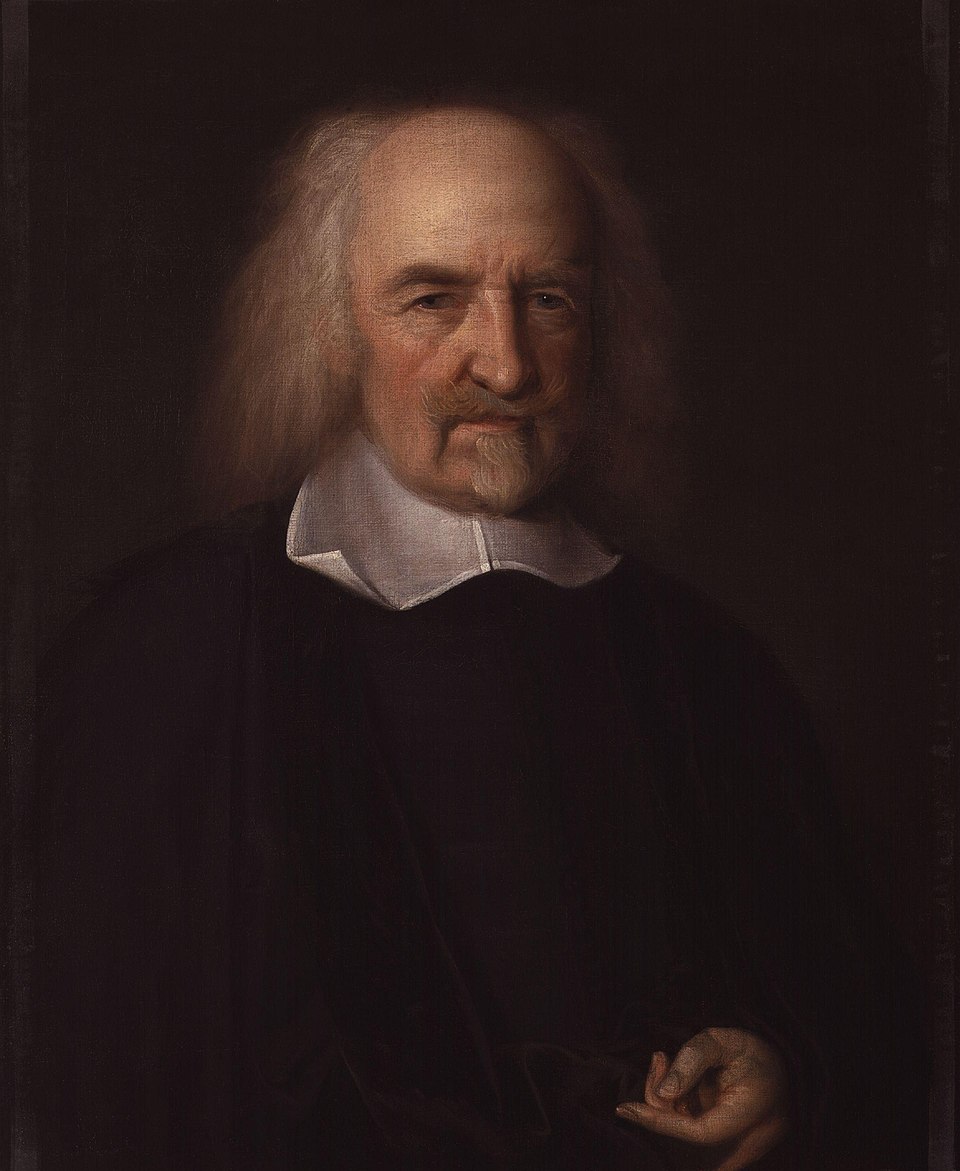
I was in Paris in January 1649 when the news crossed the Channel: they had cut off the head of a sacred king, in a public square, in the name of the people. Imagine the enormity. All Europe shuddered, and I first of all, for I saw in it the bloody confirmation of my thesis: when sovereignty is divided between king, lords, and commons, it holds no more, and the sword falls. Later, in my Behemoth, I wanted to tell this illness of England, the history of the causes of the civil war and the troubles that followed until the Restoration. Its publication was forbidden. Truths about disorders always displease those who emerged victorious from them.
—Why do you insist so much on the indivisibility of power?
Because I have seen what it costs to cut it into pieces. A kingdom divided between two or three claimants to supreme authority is not a moderate kingdom: it is a battlefield waiting to happen. As early as 1642, when Parliament raised its armies against those of King Charles I, each claimed legitimacy, and it is precisely this double legitimacy that caused bloodshed. A body with two heads is a monster that devours itself. So when the Restoration brought Charles II back to the throne in 1660, I felt no triumph, only the relief of a man seeing a fever subside. Give me a bad sovereign rather than two good rivals: the former sometimes oppresses you, the latter always kill you.
Give me a bad sovereign rather than two good rivals.
—You are thought of as a political philosopher, but your works extend far beyond politics. What about that?
Politics is only the last step of my staircase. I began with bodies: in De Corpore, in 1655, I wanted to show that everything that exists is matter in motion, including our thoughts, which are only tiny motions in the head. From there I rose to man, his passions, his appetites, then only to the citizen. Everything holds together like the gears of a clock. I even crossed swords with the experimenters of the void in my Dialogus Physicus, because I held that nature abhors emptiness and their pump proved nothing. I was wrong, it seems, on many points of physics. But a man who is wrong nowhere has never built anything.
—What do you occupy your mind with now that age advances?
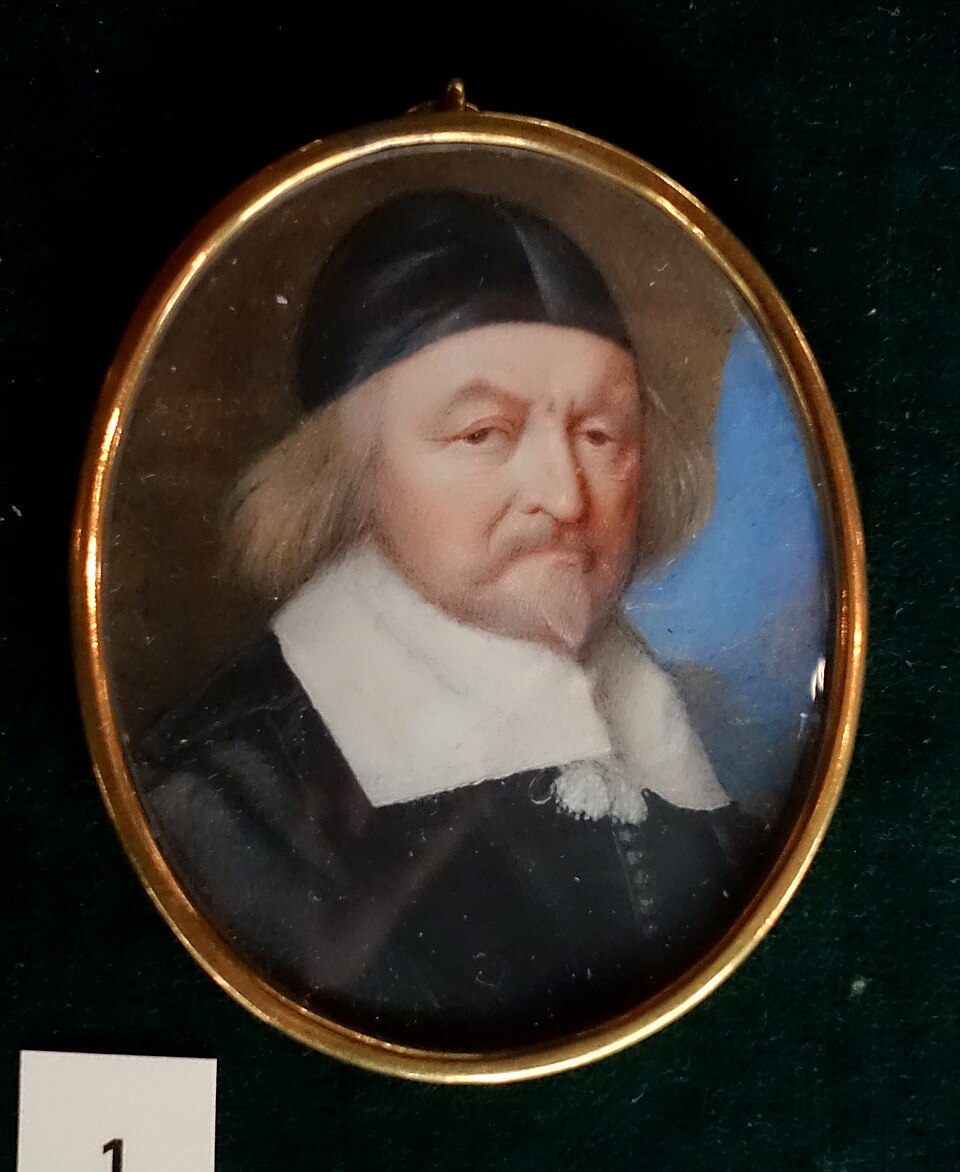
Age has not extinguished the lamp, it has only made it smoke a little. Past my eighty-seventh year, I translated all of Homer into English verse, the Iliad and the Odyssey, as much for sport as for defiance — when I am denied publication of my philosophy, I take revenge on the Greeks. I am also writing my autobiography in Latin verse; there is some coquetry in telling one's life in the language of the dead. In the morning, I rise with the day, I walk in the park to warm the blood, for exercise is worth all remedies. Then I take up my pen again. They think me worn out; I feel only decanted. Thought, like wine, sometimes gains from aging in a body that serves little else anymore.
—What has your long service to the Cavendish family brought you?
Everything, or nearly. Without the Cavendishes, I would be only a parson's son from Westport, without library or leisure. Since my youth, I was their tutor, their secretary, their travel companion, and they gave me in return what no patron measures: time. Here at Hardwick Hall, as at Chatsworth, I had walls lined with bound books, fireplaces against the Derbyshire winter, and a table to set my inkwell without fear of the morrow. A philosopher needs protection as a subject needs a sovereign: it is the same law, on a smaller scale. I owe them my works as much as to my own understanding.
A philosopher needs protection as a subject needs a sovereign.
—What does an ordinary day look like under this roof?
Like a regulated mechanism, as befits a man who thinks the world in motions. I rise early, I breakfast frugally on a little bread and beer — the water here is worthless for health. Then comes the walk: I walk briskly, sometimes singing at the top of my lungs when no one listens, for I hold that it purges the humors. The afternoon belongs to correspondence and reading in the Cavendish library; I am written to from France, I am contested, I reply. In the evening, I dine lightly and retire to my study until the candle burns low. A monotonous life, you will say. But it is in monotony that the mind finds the peace it denies to other men.
Read further
This imaginary interview was generated by artificial intelligence from sources documented in Thomas Hobbes's profile. It dramatises what the figure might have said based on what we know about them, but does not constitute attested historical testimony. For primary sources and factual documentation, refer to the full profile.