 flip
flipҚұрт (Kurt)
Құрт (Kurt)
Why this dish? Abai traveled extensively across the steppes between Semipalatinsk, the Chingiz-Tau mountains and Zhidebay. Kurt — small balls of very salty dried cheese — was the quintessential travel food of Kazakh nomads, transportable for months in a saddlebag. Abai indirectly mentions it in his evocations of nomadic life, the frugal existence he knew intimately.
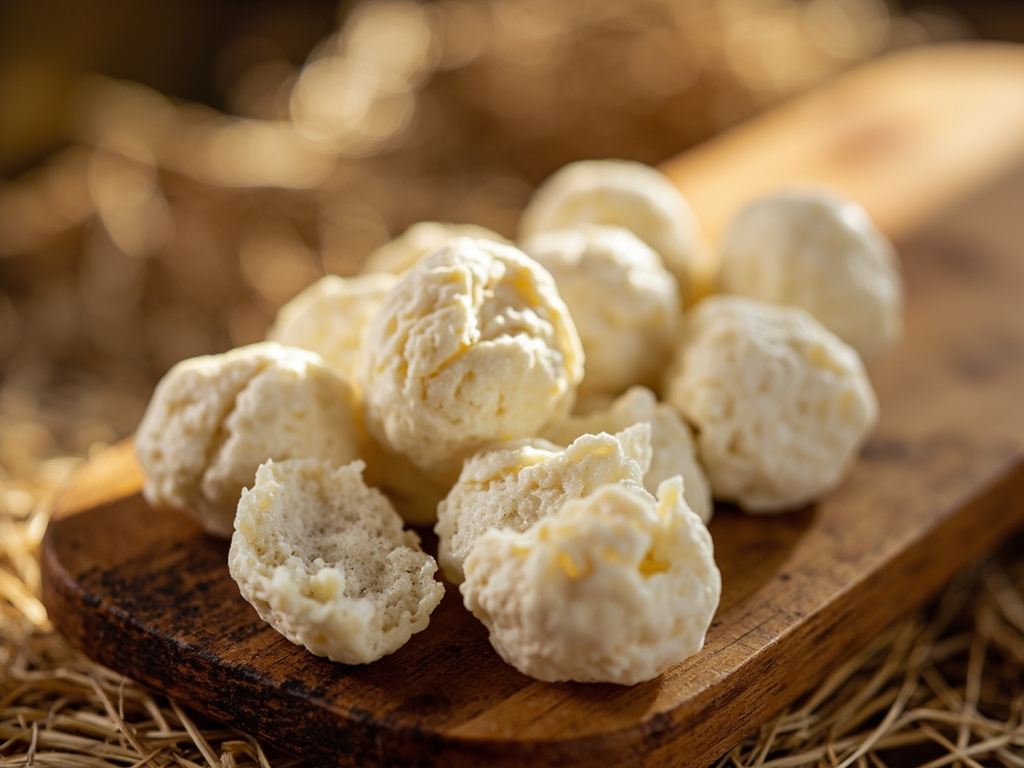
Small balls of fermented and sun-dried cheese, very salty and sour, hard as stone. Keep for months without refrigeration. Eaten as is, dissolved in tea or broth, or grated over a dish.
Kurt is our mothers' patience turned into white stone. They knead the curdled milk, salt it heavily, roll it between their palms and place it on mats in the steppe wind. In three days of sun, the cheese becomes as hard as a pebble from Chingiz-Tau. I always take some when I go to Semipalatinsk — a single piece dissolved in a bowl of hot water nourishes you better than a whole loaf of bread.
- •Curdled cow, sheep or mare's milk (suzbe — drained yogurt) — a large cauldron (Cheese base)
- •Steppe rock salt — to taste, abundant (Preservation)
Құрт (Kurt)
Small balls of fermented and sun-dried cheese, very salty and sour, hard as stone. Keep for months without refrigeration. Eaten as is, dissolved in tea or broth, or grated over a dish.
Why this dish? Abai traveled extensively across the steppes between Semipalatinsk, the Chingiz-Tau mountains and Zhidebay. Kurt — small balls of very salty dried cheese — was the quintessential travel food of Kazakh nomads, transportable for months in a saddlebag. Abai indirectly mentions it in his evocations of nomadic life, the frugal existence he knew intimately.
Kurt is our mothers' patience turned into white stone. They knead the curdled milk, salt it heavily, roll it between their palms and place it on mats in the steppe wind. In three days of sun, the cheese becomes as hard as a pebble from Chingiz-Tau. I always take some when I go to Semipalatinsk — a single piece dissolved in a bowl of hot water nourishes you better than a whole loaf of bread.
Ingredients (period version)
- Curdled cow, sheep or mare's milk (suzbe — drained yogurt) — a large cauldron (Cheese base)
- Steppe rock salt — to taste, abundant (Preservation)
Ingredients
- Full-fat plain yogurt (or drained cottage cheese) — 1 kg (Cheese base)
- Fine salt — 2 tbsp (Preservation and flavor)
Method
- Drain the yogurt in a cheesecloth (or fine towel) suspended over a bowl for 12 hours in the refrigerator, to obtain a thick labneh-like curd.
- Mix the drained curd with the salt. The paste should be firm and well blended.
- Form small balls 2 to 3 cm in diameter by rolling the paste between your palms. You can also form flat patties or short cylinders.
- Place the balls on a rack or baking sheet lined with parchment paper, spacing them well.
- Dry in a ventilated oven at 50-60°C for 6 to 8 hours, door ajar. Or, if the climate allows, in the sun on an airy balcony for 3 to 5 days, turning morning and evening.
- Kurt are ready when very hard, dry and white. They keep for several months in an airy container.
How it was made : Kurt is one of the oldest preserved foods of Turkic and Mongol peoples. Kazakh women prepared it in bulk at the end of summer, drying the balls on reed mats (shi) or on the yurt felt, in the open wind. It was carried in saddlebags (khorjun) for transhumance and long journeys. Dissolved in hot water, it made an instant nutritious broth. Steppe armies carried it as field rations — Marco Polo describes the principle among the Mongols.
The contemporary twist : Finely grate kurt over a salad of roasted root vegetables for a salty, lactic umami, like "steppe parmesan".
Sources : Потапов Л. П., Очерки народного быта тюрков (Essays on the Folk Life of the Turks), Moscow, 1969 · Polo, Marco, Le Devisement du Monde, ch. on Tatar customs, circa 1298
Abai Kunanbaev · Charactorium