 flip
flipSorghum Tô with Baobab Leaf Sauce and Soumbala
Sorghum Tô with Baobab Leaf Sauce and Soumbala
Why this dish? For a scholar of Sankoré bent all day over his reed pen and manuscripts, tô is the daily bread of the Sudan: a cereal paste from the Sahel that the household prepares morning and evening, simple, nourishing, shared. Al-Saadi grew up and grew old to the rhythm of this dish, from the grains of the delta whose abundance around Timbuktu his Tarikh describes.
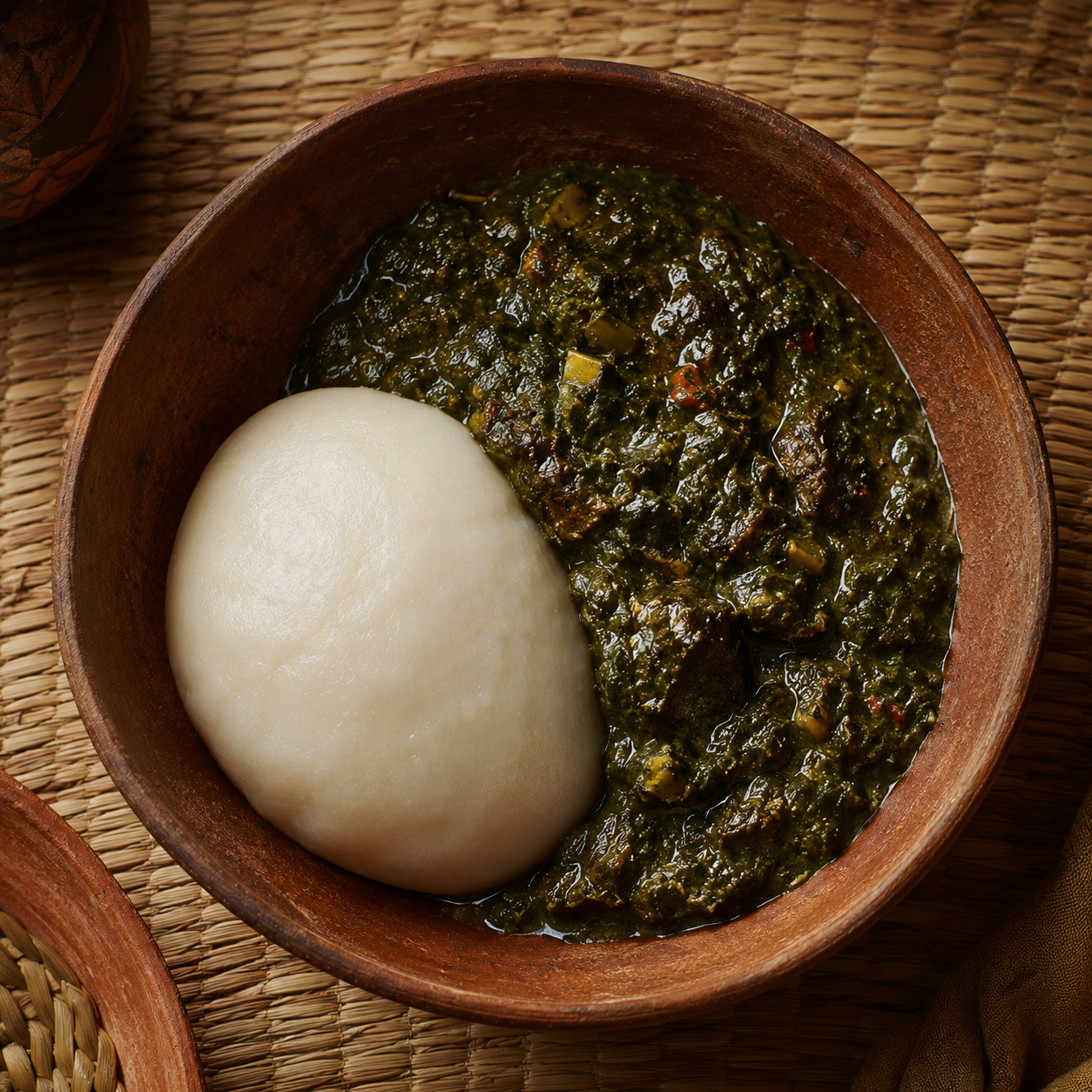
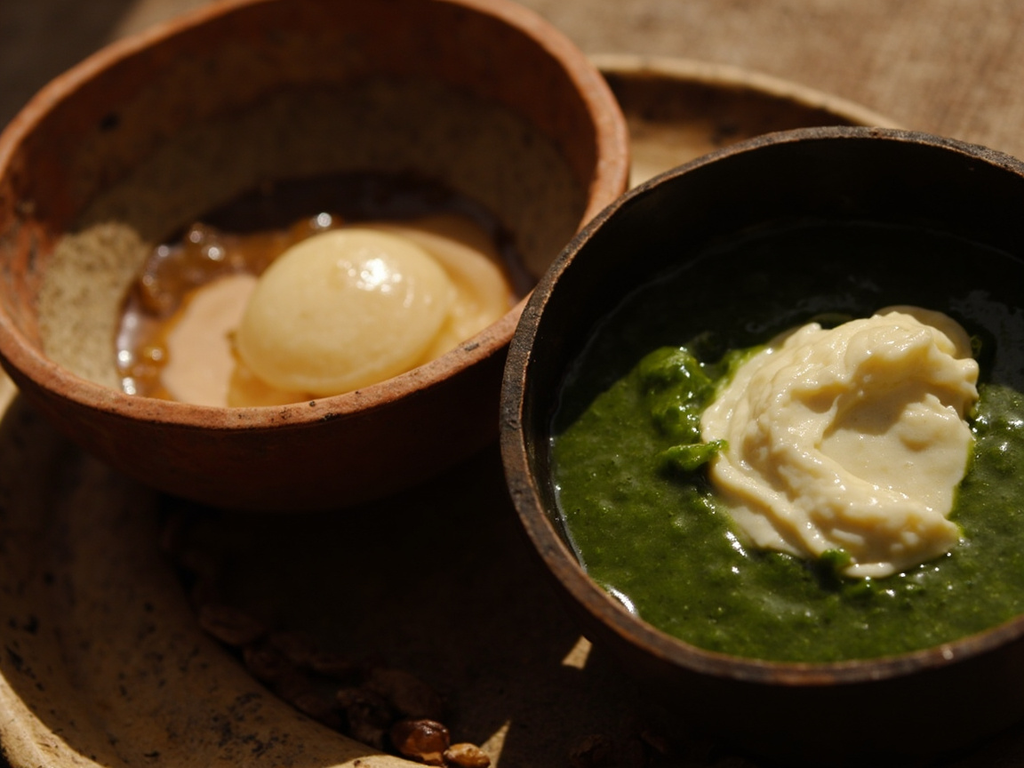
A smooth, firm sorghum paste, shaped into bites with the fingertips and dipped into a green sauce of baobab leaves (lalo) bound with soumbala. The néré ferment gives a deep umami roundness, the lalo a silky, slightly stringy texture much appreciated.
Approach, my guest, and praise be to God who gives us grain. See this sorghum paste: at my table in Timbuktu, we knead it until it leaves the pot without sticking, and we break off a morsel, hollowing it with the thumb to scoop up the sauce. The secret, my friend, is the néré: a single ball of this ferment in the pot, and the leaf sauce speaks louder than meat. Eat with the right hand, slowly — this is how we took strength before returning to the manuscripts.
- •Sorghum flour (or millet) — two good handfuls per guest (the base)
- •Dried pounded baobab leaves (lalo) — one handful (body of the sauce)
- •Soumbala (néré ferment) — one small ball (fermented umami)
- •Shea butter — one spoonful (fat)
- •Taghaza salt — to taste (seasoning)
Sorghum Tô with Baobab Leaf Sauce and Soumbala
A smooth, firm sorghum paste, shaped into bites with the fingertips and dipped into a green sauce of baobab leaves (lalo) bound with soumbala. The néré ferment gives a deep umami roundness, the lalo a silky, slightly stringy texture much appreciated.
Why this dish? For a scholar of Sankoré bent all day over his reed pen and manuscripts, tô is the daily bread of the Sudan: a cereal paste from the Sahel that the household prepares morning and evening, simple, nourishing, shared. Al-Saadi grew up and grew old to the rhythm of this dish, from the grains of the delta whose abundance around Timbuktu his Tarikh describes.
Approach, my guest, and praise be to God who gives us grain. See this sorghum paste: at my table in Timbuktu, we knead it until it leaves the pot without sticking, and we break off a morsel, hollowing it with the thumb to scoop up the sauce. The secret, my friend, is the néré: a single ball of this ferment in the pot, and the leaf sauce speaks louder than meat. Eat with the right hand, slowly — this is how we took strength before returning to the manuscripts.
Ingredients (period version)
- Sorghum flour (or millet) — two good handfuls per guest (the base)
- Dried pounded baobab leaves (lalo) — one handful (body of the sauce)
- Soumbala (néré ferment) — one small ball (fermented umami)
- Shea butter — one spoonful (fat)
- Taghaza salt — to taste (seasoning)
Ingredients
- Sorghum flour (or fine millet semolina) — 200 g (the base)
- Baobab leaf powder (lalo) — 3 tbsp (body and binder of the sauce)
- Soumbala (or failing that, dark miso, ¼ of the quantity) — 1 tbsp, crushed (fermented umami)
- Food-grade shea butter (or clarified butter) — 2 tbsp (fat)
- Onion — 1 small, thinly sliced (aromatic base)
- Water — about 1 L (cooking liquid)
- Salt — 1 tsp (seasoning)
Method
- Heat 600 ml salted water. Dissolve the soumbala in a little hot water and add it with the onion; let simmer 10 min.
- Sprinkle in the baobab powder while whisking to avoid lumps; add the shea butter and let thicken 10 min over low heat: the sauce turns green and coating.
- For the tô: bring 400 ml water to a boil, pour in the sorghum flour in a rain while stirring vigorously with a spatula.
- Work the paste over low heat for 8-10 min until it pulls away from the sides and becomes smooth and firm.
- Turn out the tô into a dish, press it into a dome. Serve with the sauce on the side: pinch off a piece of tô, dip it.
How it was made : Tô (thick couscous or cereal paste) has been attested as a staple of the western Sudan since the Middle Ages. Soumbala and pounded baobab leaves (lalo) are among the oldest Sahelian techniques: fermenting néré seeds and drying leaves allowed umami and greenness to be kept all year in the Sahara. They cooked with shea butter, the precious salt coming from the Taghaza mines by caravan.
The contemporary twist : Serve the tô shaped into quenelles with two wet spoons, the baobab sauce as a mirror underneath, chef's-plate style — without betraying the hand gesture.
Sources : Abd al-Rahman al-Saadi, Tarikh es-Soudan (17th c.), trans. O. Houdas · Jean-Pierre Chrétien & al., works on Sahelian food
Abd al-Rahman al-Saadi · Charactorium