 flip
flipBint al-sahn — Layered Honey Bread for Feast Days
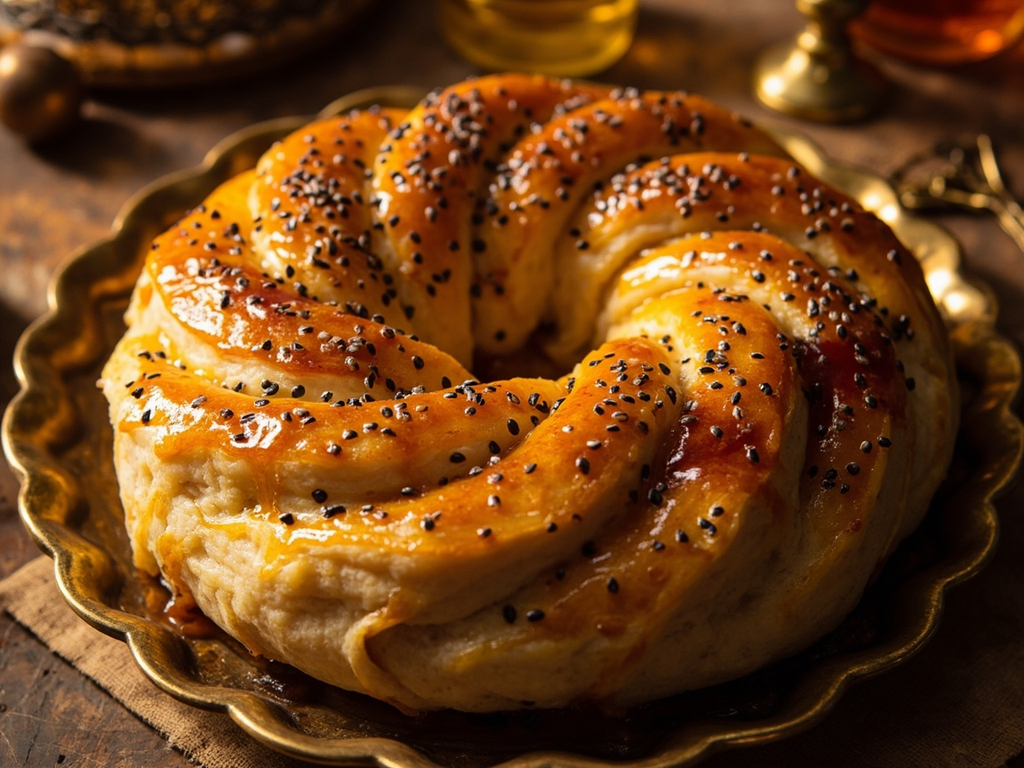
Bint al-sahn — Layered Honey Bread for Feast Days
Why this dish? At feasts and during ziyâra—pious visits to the sheikh's mausoleum—sobriety gives way to generosity. Then this bread of thin leaves, drenched in honey and sprinkled with nigella, is prepared: a dish of joy and sharing offered to visitors and the poor in the saint's name. Honey, a gift of God mentioned in the Quran, makes it a blessed food.
A cake of thin layers of clarified butter dough, golden from the oven, generously drenched in warm honey and sprinkled with black nigella seeds. Tender inside, golden on top, it is the sweetness of great Yemeni days.
Today is a feast day, O visitor, and the table must open wide: God loves that we share His blessings. See how I stretch the dough until it is thin as a veil, I fold it, I butter it with melted semn, layer upon layer. When it comes out of the oven, golden, I drown it under flowing honey and scatter the blessed black seed. Take a piece, and do not forget to bring some to the poor sitting at the door.
- •Wheat flour — a good measure (dough)
- •Eggs — a few (binder and softness)
- •Clarified butter (semn / ghee) — generously (layering)
- •Honey — in abundance (drenching)
- •Nigella seeds (habba sawda) — a pinch (fragrance, blessed garnish)
Bint al-sahn — Layered Honey Bread for Feast Days
A cake of thin layers of clarified butter dough, golden from the oven, generously drenched in warm honey and sprinkled with black nigella seeds. Tender inside, golden on top, it is the sweetness of great Yemeni days.
Why this dish? At feasts and during ziyâra—pious visits to the sheikh's mausoleum—sobriety gives way to generosity. Then this bread of thin leaves, drenched in honey and sprinkled with nigella, is prepared: a dish of joy and sharing offered to visitors and the poor in the saint's name. Honey, a gift of God mentioned in the Quran, makes it a blessed food.
Today is a feast day, O visitor, and the table must open wide: God loves that we share His blessings. See how I stretch the dough until it is thin as a veil, I fold it, I butter it with melted semn, layer upon layer. When it comes out of the oven, golden, I drown it under flowing honey and scatter the blessed black seed. Take a piece, and do not forget to bring some to the poor sitting at the door.
Ingredients (period version)
- Wheat flour — a good measure (dough)
- Eggs — a few (binder and softness)
- Clarified butter (semn / ghee) — generously (layering)
- Honey — in abundance (drenching)
- Nigella seeds (habba sawda) — a pinch (fragrance, blessed garnish)
Ingredients
- Wheat flour — 400 g (dough)
- Eggs — 2 (binder)
- Clarified butter (ghee) — 150 g, melted (layering)
- Warm water — 120 ml approx (dough)
- Salt — 1 pinch (balance)
- Honey — 150 g, warmed (drenching)
- Nigella seeds — 1 tsp (garnish)
Method
- Knead flour, eggs, salt, and warm water into a smooth, supple dough; let rest 30 minutes.
- Divide into balls, then roll each ball as thin as possible.
- Stack the leaves in a round ghee-buttered mold, brushing melted ghee between each layer.
- Bake in a hot oven (200°C) for 20 to 25 minutes until the top is golden brown.
- Upon removal, immediately drench with warm honey so it soaks into the layers.
- Sprinkle with nigella seeds and serve warm, cut into pieces.
How it was made : Pastries of buttered and honeyed layered dough are ancient throughout the Arab-Muslim world; bint al-sahn ('daughter of the dish') is Yemen's great festive dessert. It was baked in the communal bread oven and drenched with mountain honey, one of the most renowned in the peninsula.
The contemporary twist : A few drops of orange blossom water in the honey and a fan-shaped presentation: the 'teahouse' bint al-sahn.
Abdal Hayy ibn Mawlud · Charactorium