 flip
flipPancit bihon guisado (stir-fried rice noodles)
Pancit bihon guisado (stir-fried rice noodles)
Why this dish? No Filipino birthday or celebration goes without pancit: its long noodles symbolize long life. For Abra, it's the dish of handa, those big family and neighborhood feasts where you celebrate an album release, a success, a homecoming.
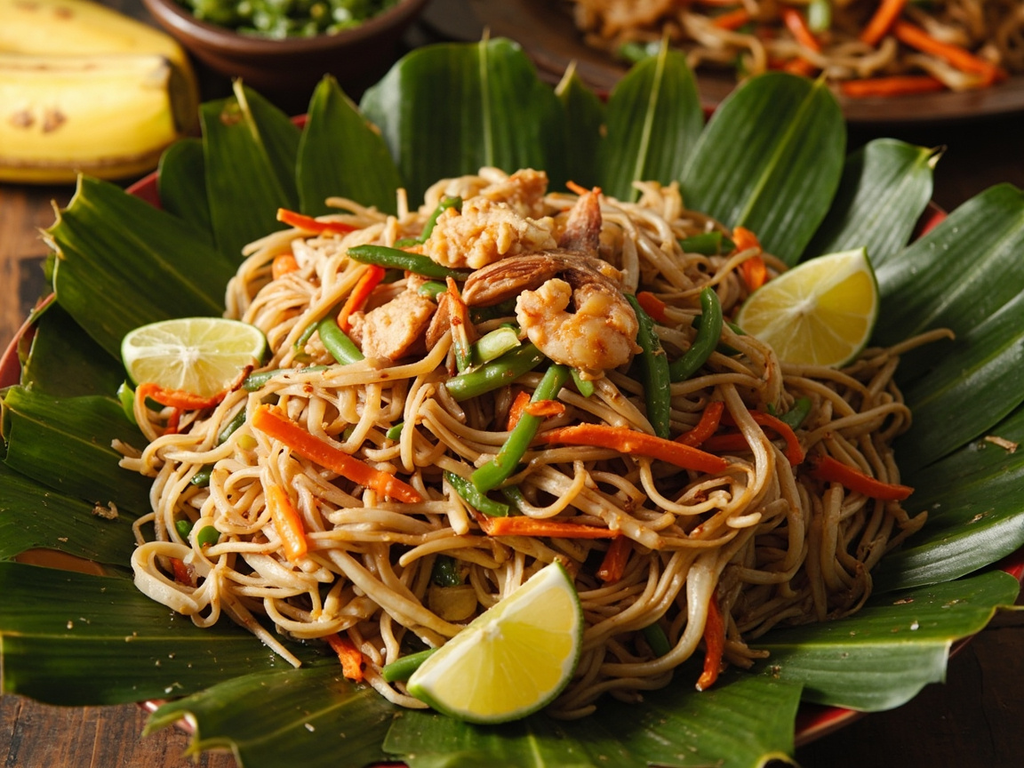
Thin rice noodles stir-fried in a wok with chicken, shrimp, and crunchy vegetables, seasoned with soy sauce and brightened with a squeeze of kalamansi. The quintessential party dish, served in large quantities at the center of the table.
When there's a party at home – a birthday, good news – there's always pancit. The long noodles, you must never cut them, it's for long life, my grandmother always repeated that. We'd sauté garlic, onion, chicken, shrimp, toss in the vegetables so they stay crunchy, and the noodles drink up all the broth. At the end, you squeeze kalamansi over it, that little acidity that wakes everything up. We put the big platter in the middle, and then it's party time, salu-salo, everyone serves themselves.
- •Thin rice noodles (bihon) — a large pack (base)
- •Chicken and shrimp — in strips (proteins)
- •Cabbage, carrot, beans, celery — julienned (crunchy vegetables)
- •Soy sauce (toyo) — a splash (seasoning)
- •Kalamansi — a few citrus fruits (final acidity)
- •Garlic and onion — generous (aromatic base)
Pancit bihon guisado (stir-fried rice noodles)
Thin rice noodles stir-fried in a wok with chicken, shrimp, and crunchy vegetables, seasoned with soy sauce and brightened with a squeeze of kalamansi. The quintessential party dish, served in large quantities at the center of the table.
Why this dish? No Filipino birthday or celebration goes without pancit: its long noodles symbolize long life. For Abra, it's the dish of handa, those big family and neighborhood feasts where you celebrate an album release, a success, a homecoming.
When there's a party at home – a birthday, good news – there's always pancit. The long noodles, you must never cut them, it's for long life, my grandmother always repeated that. We'd sauté garlic, onion, chicken, shrimp, toss in the vegetables so they stay crunchy, and the noodles drink up all the broth. At the end, you squeeze kalamansi over it, that little acidity that wakes everything up. We put the big platter in the middle, and then it's party time, salu-salo, everyone serves themselves.
Ingredients (period version)
- Thin rice noodles (bihon) — a large pack (base)
- Chicken and shrimp — in strips (proteins)
- Cabbage, carrot, beans, celery — julienned (crunchy vegetables)
- Soy sauce (toyo) — a splash (seasoning)
- Kalamansi — a few citrus fruits (final acidity)
- Garlic and onion — generous (aromatic base)
Ingredients
- Thin rice noodles (bihon/rice vermicelli) — 250 g, soaked (base)
- Chicken breast — 200 g, in strips (protein)
- Peeled shrimp — 150 g (protein)
- Shredded cabbage, carrot, green beans, celery — 3 generous handfuls total (vegetables)
- Soy sauce — 3 tbsp (seasoning)
- Chicken broth — 250 ml (noodle cooking liquid)
- Kalamansi (or lime) — 3-4, in wedges (acidity)
- Garlic and onion — 4 cloves + 1 (aromatic base)
Method
- Soak rice noodles in warm water for 10 min, drain.
- In a wok, sear chicken and shrimp, set aside. Sauté garlic and onion.
- Add julienned vegetables, stir-fry on high heat to keep them crunchy.
- Pour in broth and soy sauce, bring to a simmer, add noodles and let them absorb the liquid.
- Return chicken and shrimp, toss, arrange on a large platter and serve with kalamansi wedges to squeeze on top.
How it was made : Pancit (from Hokkien pian i sit, “something quickly cooked”) testifies to centuries-old Chinese influence in the Philippines. Each region has its version: pancit Malabon, pancit habhab from Lucban eaten on banana leaves, pancit Molo... Serving noodles at birthdays for longevity is a custom inherited from the Chinese.
The contemporary twist : Manila's food parks reinvent pancit as fusion bowls or “overload” versions topped with chicharon (crispy pork rind) for the social media generation.
Sources : Doreen G. Fernandez, Tikim: Essays on Philippine Food and Culture, 1994 · Amy Besa & Romy Dorotan, Memories of Philippine Kitchens, 2006
Abra · Charactorium