 flip
flipTcholent, the Overnight Stew
Tcholent, the Overnight Stew
Why this dish? Because lighting a fire is forbidden on Shabbat, Polish families from Heschel's youth would slide a sealed pot into the baker's oven on Friday before nightfall, where it cooked until midday Saturday. The dish is the very embodiment of the rest he so deeply contemplated: cooking happens without anyone touching it.
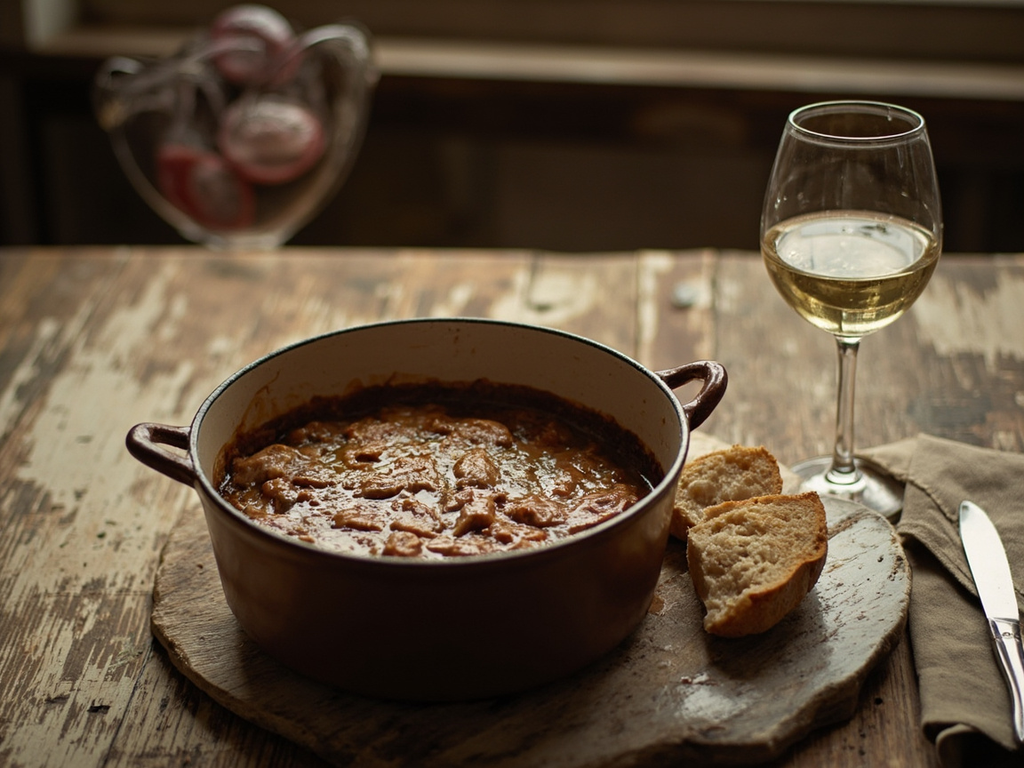
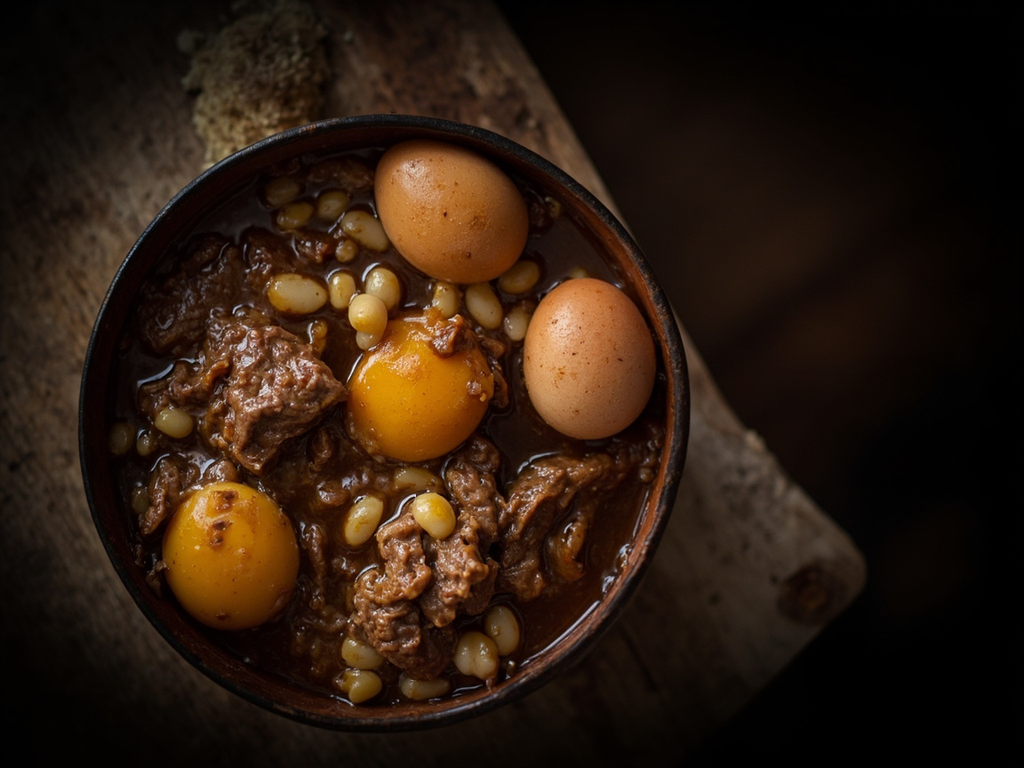
A brown, tender stew of beans, barley, and braising meat, cooked very slowly overnight. Eggs cooked in their shells brown in the heart of the pot.
On Friday, as the sun was setting, we would carry the pot to the baker's — our own, sealed with dough, among a hundred others that all looked alike. And on Saturday at noon, we would bring it back steaming: the meat falls apart by itself, the beans have drunk all the juices, and the eggs have turned brown as amber. Understand: this dish cooks while we pray, it works while we rest. There is no finer lesson of Shabbat in a pot.
- •Beef brisket — a nice piece (tender meat)
- •Marrow bones — one or two (richness of the broth)
- •Dried beans — a good handful per person (starch)
- •Pearl barley — a bowl (thickener and body)
- •Onions — several (aromatic base)
- •Goose fat (schmaltz) — a spoonful (roundness)
- •Potatoes — a few (soft starch)
- •Whole eggs — one per person (cooked in shell at the heart of the dish)
- •Paprika and garlic — to taste (color and aroma)
Tcholent, the Overnight Stew
A brown, tender stew of beans, barley, and braising meat, cooked very slowly overnight. Eggs cooked in their shells brown in the heart of the pot.
Why this dish? Because lighting a fire is forbidden on Shabbat, Polish families from Heschel's youth would slide a sealed pot into the baker's oven on Friday before nightfall, where it cooked until midday Saturday. The dish is the very embodiment of the rest he so deeply contemplated: cooking happens without anyone touching it.
On Friday, as the sun was setting, we would carry the pot to the baker's — our own, sealed with dough, among a hundred others that all looked alike. And on Saturday at noon, we would bring it back steaming: the meat falls apart by itself, the beans have drunk all the juices, and the eggs have turned brown as amber. Understand: this dish cooks while we pray, it works while we rest. There is no finer lesson of Shabbat in a pot.
Ingredients (period version)
- Beef brisket — a nice piece (tender meat)
- Marrow bones — one or two (richness of the broth)
- Dried beans — a good handful per person (starch)
- Pearl barley — a bowl (thickener and body)
- Onions — several (aromatic base)
- Goose fat (schmaltz) — a spoonful (roundness)
- Potatoes — a few (soft starch)
- Whole eggs — one per person (cooked in shell at the heart of the dish)
- Paprika and garlic — to taste (color and aroma)
Ingredients
- Beef brisket or chuck — 800 g (tender meat)
- Marrow bones — 2 (richness of the broth)
- Dried white beans — 250 g (soaked overnight) (starch)
- Pearl barley — 150 g (thickener and body)
- Onions — 3, sliced (aromatic base)
- Poultry fat or oil — 2 tbsp (roundness)
- Potatoes — 4, cut into large chunks (soft starch)
- Eggs — 4 to 6, whole and washed (brown in shell)
- Sweet paprika — 1 tbsp (color)
- Garlic — 3 cloves (aroma)
- Salt and pepper — to taste (seasoning)
Method
- Sauté the onions in the fat until nicely browned, add garlic and paprika.
- In a large pot, layer the meat, bones, drained beans, barley, and potatoes.
- Place the whole washed eggs on the surface, season with salt and pepper, cover generously with boiling water.
- Bring to a simmer, cover tightly, then place in the oven at a very low temperature, 100-110°C.
- Let cook for 10 to 12 hours without disturbing (a whole night, as in the old days).
- When serving, peel the brown eggs and distribute meat, beans, and juices.
How it was made : The word "tcholent" may come from the Old French "chald" (hot) or "chaud-lent" (slow-hot). Since one could neither light nor revive a fire on Saturday, the dish rested in the declining heat of the communal baker's oven: each family recognized its pot by a mark.
The contemporary twist : Lacking a baker's oven, an electric slow cooker turned on Friday evening faithfully reproduces the overnight cooking — and fills the house with aroma upon waking.
Sources : Claudia Roden, The Book of Jewish Food (1996) · John Cooper, Eat and Be Satisfied: A Social History of Jewish Food (1993)
Abraham Joshua Heschel · Charactorium