 flip
flipQadīd — Dried Meat of the Campaigns
Qadīd — Dried Meat of the Campaigns
Why this dish? A warrior caliph, Abū Yaʿqūb Yūsuf led his armies as far as Portugal, where he met his death at the siege of Santarém in 1184. On these long campaigns, they carried qadīd, dried and salted meat that kept for weeks.
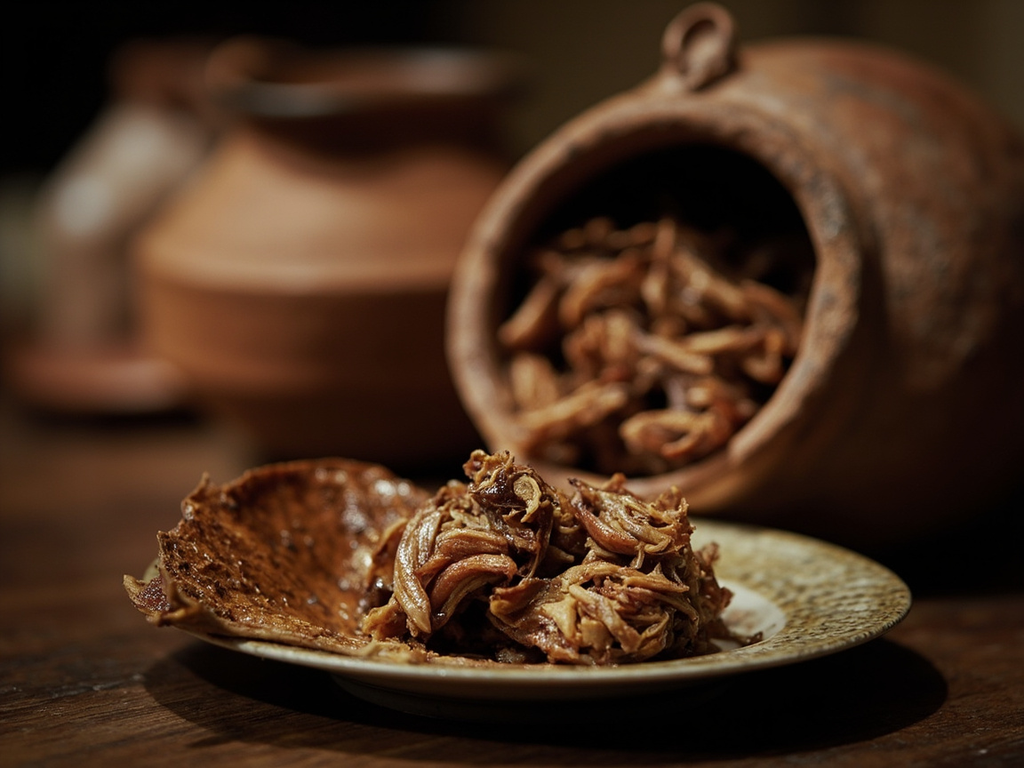
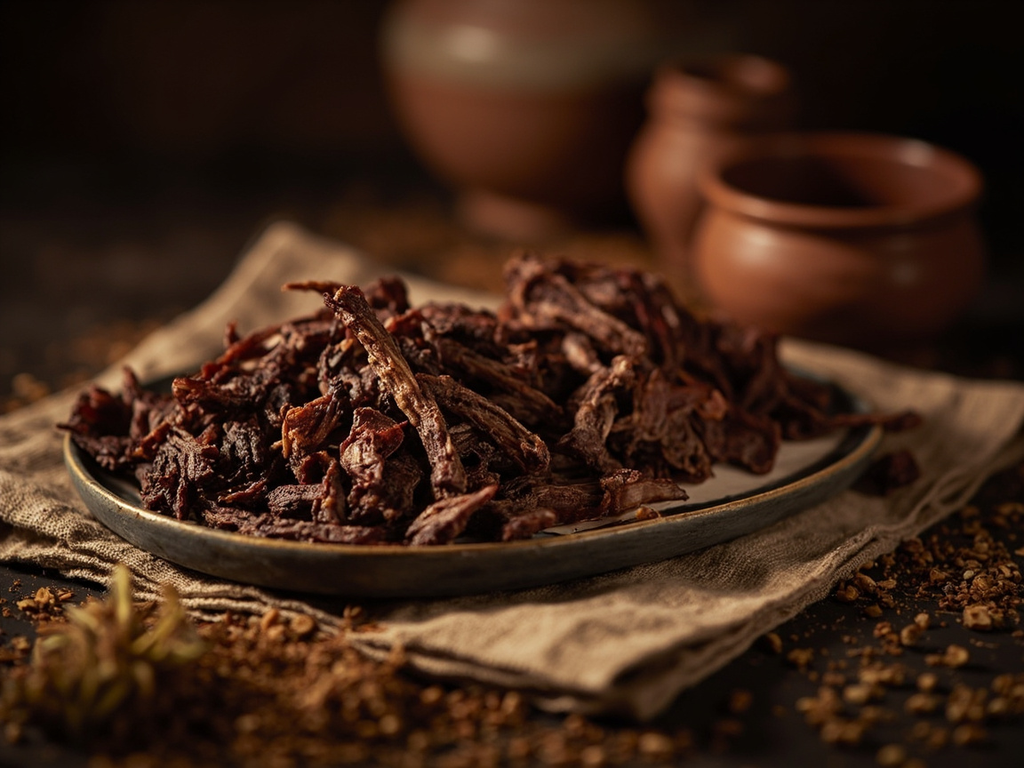
Strips of meat rubbed with salt and spices, dried in the sun and wind, sometimes confited in fat. The army's and traveler's provision, rehydrated in a broth or nibbled as is.
The caliph does not always stay under the water jets of his gardens: sometimes holy war must be waged far away, even to the lands of the Roum. There, neither oven nor market — so we provide ourselves with qadīd. We cut the meat into long strips, rub it with salt, coriander, and cumin, and give it to the sun and wind until it hardens like leather. Throw it into boiling water and it becomes man's food again; chew it dry, and it sustains a horseman for a whole day. By it, reader, my armies held the long marches.
- •Lean beef or lamb — in strips (base to preserve)
- •Salt — generous (preserving agent)
- •Coriander and cumin — to taste (spices, natural antiseptics)
- •Garlic — crushed (perfume and preservation)
- •Melted fat (samn) — as needed (confit/sealing optional)
Qadīd — Dried Meat of the Campaigns
Strips of meat rubbed with salt and spices, dried in the sun and wind, sometimes confited in fat. The army's and traveler's provision, rehydrated in a broth or nibbled as is.
Why this dish? A warrior caliph, Abū Yaʿqūb Yūsuf led his armies as far as Portugal, where he met his death at the siege of Santarém in 1184. On these long campaigns, they carried qadīd, dried and salted meat that kept for weeks.
The caliph does not always stay under the water jets of his gardens: sometimes holy war must be waged far away, even to the lands of the Roum. There, neither oven nor market — so we provide ourselves with qadīd. We cut the meat into long strips, rub it with salt, coriander, and cumin, and give it to the sun and wind until it hardens like leather. Throw it into boiling water and it becomes man's food again; chew it dry, and it sustains a horseman for a whole day. By it, reader, my armies held the long marches.
Ingredients (period version)
- Lean beef or lamb — in strips (base to preserve)
- Salt — generous (preserving agent)
- Coriander and cumin — to taste (spices, natural antiseptics)
- Garlic — crushed (perfume and preservation)
- Melted fat (samn) — as needed (confit/sealing optional)
Ingredients
- Lean beef (top round, flank) — 600 g (base to dry)
- Coarse salt — 3 tablespoons (preservation)
- Ground coriander — 1 tablespoon (spice)
- Cumin — 1 tablespoon (spice)
- Dried garlic powder — 1 teaspoon (perfume)
- Sweet paprika (modern touch, optional) — 1 teaspoon (color)
Method
- Cut the meat into thin strips 1 cm thick along the grain.
- Mix salt and spices, rub each strip generously.
- Let rest in the fridge for 12 hours to draw out moisture, then pat dry.
- Dry: either hang in a dry, airy place for 3–5 days, or use a dehydrator or oven at 60–70 °C with the door ajar for 6–8 hours.
- Store in a cloth or jar; rehydrate in broth or consume as is.
How it was made : Qadīd (and its cousin khliî confited in fat) is one of the oldest preservation techniques of the Maghreb, essential for caravans and armies. Salt and spices replaced refrigeration.
The contemporary twist : Finely sliced, it makes an «Andalusi jerky» to snack on as an appetizer — a nod to the caliphal horseman's provisions.
Sources : Manuela Marín, studies on food in al-Andalus · Anonyme andalou, Kitāb al-ṭabīkh fī l-Maghrib wa-l-Andalus (XIIIe s.)
Abu Yaqub Yusuf · Charactorium